From the free course AP Calculus AB on Lykke
8.9 Volume with Disc Method: Revolving Around the \(x\)- or \(y\)-Axis
Key concepts: Applications of integration · Volumes of solids of revolution · Disc method · Revolving regions around the x-axis · Revolving regions around the y-axis · Using definite integrals to calculate volume · Applying an appropriate mathematical definition, theorem, or test · Topic 8.9: Volume with Disc Method: Revolving Around the x- or y-Axis · Learning objective CHA-5.C
How the disc method gives the volume of a region revolved around the x-axis or the y-axis by integrating pi times the radius squared.
8.9 Volume with Disc Method: Revolving Around the (x)- or (y)-Axis
A flat region becomes a three-dimensional solid when it spins around an axis, and its volume can be found by adding the areas of infinitely many thin circular slices. The disc method turns that idea into a definite integral.
Learning Objective CHA-5.C: Calculate volumes of solids of revolution using definite integrals.
Essential Knowledge CHA-5.C.1: Volumes of solids of revolution around the $x$- or $y$-axis may be found by using definite integrals with the disc method.
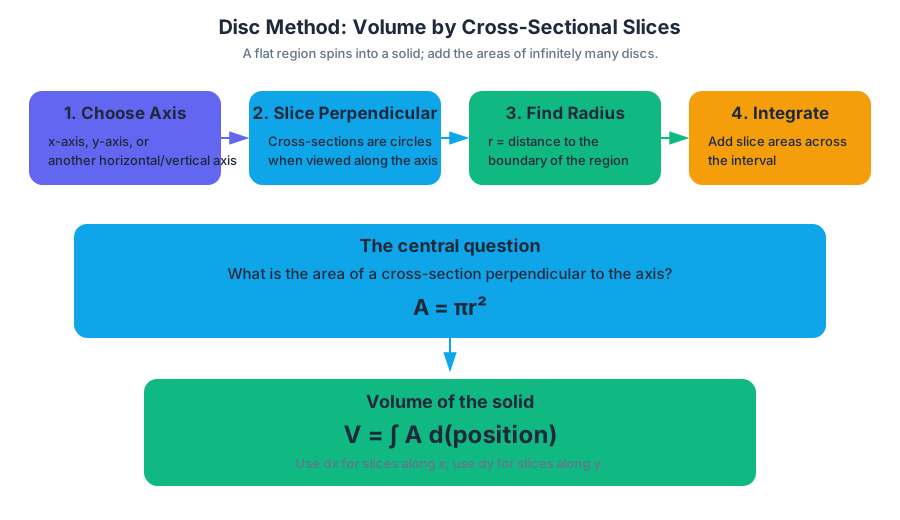
The central question is: What is the area of a cross section perpendicular to the axis of rotation? If the cross section is a filled circle, its area is
$$ A=\pi r^2, $$
where $r$ is the distance from the axis of rotation to the boundary of the region. Adding these cross-sectional areas across an interval gives
$$ V=\int A,d(\text{position}). $$
The disc method around the $x$-axis
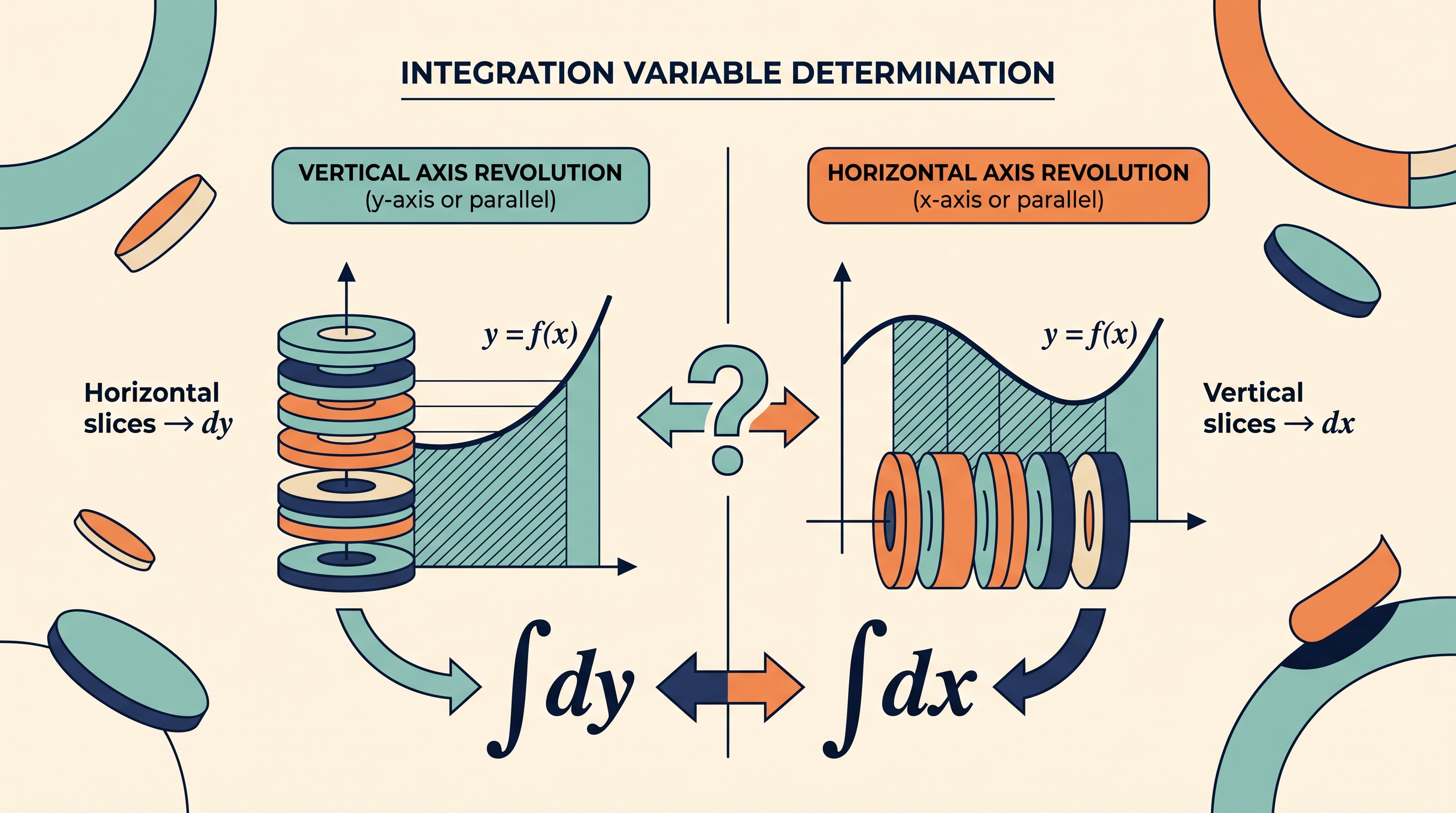
When a region under a nonnegative function $y=f(x)$ is revolved around the $x$-axis, a vertical slice becomes a circular disc. The radius is the vertical distance from the $x$-axis to the curve, so $r=f(x)$, and the thickness is $dx$:
$$ V=\int_a^b \pi [f(x)]^2,dx. $$
Worked example: rotating around the $x$-axis
Rotate the region bounded by $y=x^2$, the $x$-axis, $x=0$, and $x=2$ around the $x$-axis.
At a particular value of $x$, the slice has radius
$$ r=y=x^2. $$
Therefore its cross-sectional area is
$$ A(x)=\pi(x^2)^2=\pi x^4. $$
The volume is
$$ \begin{aligned} V&=\int_0^2 \pi x^4,dx\ &=\pi\left[\frac{x^5}{5}\right]_0^2\ &=\frac{32\pi}{5}. \end{aligned} $$
Thus the solid has volume
$$ \boxed{\frac{32\pi}{5}\text{ cubic units}}. $$
The square is essential: the function gives a length, namely the radius, while volume requires a cross-sectional area. Squaring $f(x)$ converts the radius into the area factor $\pi[f(x)]^2$.
The disc method around the $y$-axis
For rotation around the $y$-axis, horizontal slices are perpendicular to the axis. If the region is described by $x=g(y)$, then the radius is the horizontal distance from the $y$-axis:
$$ r=g(y). $$
The volume becomes
$$ V=\int_c^d \pi[g(y)]^2,dy. $$
The limits must now be $y$-values, because the slices have thickness $dy$.
Worked example: rotating around the $y$-axis
Consider the region bounded by $x=y^2$, the $y$-axis, $y=0$, and $y=2$, revolved around the $y$-axis. A horizontal slice extends from $x=0$ to $x=y^2$, so its radius is $y^2$.
$$ A(y)=\pi(y^2)^2=\pi y^4. $$
Therefore,
$$ \begin{aligned} V&=\int_0^2 \pi y^4,dy\ &=\pi\left[\frac{y^5}{5}\right]_0^2\ &=\boxed{\frac{32\pi}{5}}. \end{aligned} $$
Although the equations differ in appearance, both examples use the same structure:
$$ \boxed{\text{volume}=\int \text{area of a perpendicular cross section},d(\text{position})}. $$
Before you integrate
Misconception: Every volume integral should use $dx$.
Correction: The variable is determined by the direction of the slices. Rotation around a horizontal axis uses vertical slices and usually $dx$; rotation around a vertical axis uses horizontal slices and usually $dy$.
Before integrating, verify three choices:
- Are the slices perpendicular to the axis?
- Is the radius a distance to that axis?
- Do the limits describe the full range of the slicing variable?
The justification skill 3.D — Justification requires more than writing an integral: the radius, limits, and cross-sectional area must match the geometry.
Retrieval check: The region bounded by $x=\sqrt{y}$, the $y$-axis and the line $y=2$ is revolved around the $y$-axis. Which way do the slices run, and what is the volume? Horizontal slices are perpendicular to the $y$-axis, each with radius $\sqrt{y}$, so $V=\int_0^2\pi(\sqrt{y})^2,dy=\int_0^2\pi y,dy=2\pi$.