From the free course AP Calculus AB on Lykke
2.6 Derivative Rules: Constant, Sum, Difference, and Constant Multiple
Key concepts: Derivative rules for constant functions · Sum rule for derivatives · Difference rule for derivatives · Constant multiple rule for derivatives · Using appropriate mathematical rules and procedures to calculate derivatives · Differentiating familiar functions · Combining the power rule with sum and difference rules · Applying derivative rules with and without technology
The constant, sum, difference and constant multiple rules, why they follow from limit properties, and how they combine with the power rule to differentiate polynomials term by term.
2.6 Derivative Rules: Constant, Sum, Difference, and Constant Multiple
The power rule of Topic 2.5, $\frac{d}{dx}(x^r)=rx^{r-1}$, differentiates a single power of $x$. Most functions are built from several such pieces, scaled by coefficients, added, subtracted and shifted by constants. Four structural rules describe how a derivative passes through that algebra, so a polynomial can be differentiated one term at a time.
Learning Objective FUN-3.A: Calculate derivatives of familiar functions.
Essential Knowledge FUN-3.A.2: Sums, differences, and constant multiples of functions can be differentiated using derivative rules.
Essential Knowledge FUN-3.A.3: The power rule combined with sum, difference, and constant multiple properties can be used to find the derivatives for polynomial functions.
The four structural rules
A constant function has the same output for every input. Its graph is horizontal, so its instantaneous rate of change is zero:
$$ \frac{d}{dx}(C)=0, $$
where $C$ is any constant.
The sum rule differentiates each function separately:
$$ \frac{d}{dx}\bigl(f(x)+g(x)\bigr) =f'(x)+g'(x). $$
The difference rule works the same way:
$$ \frac{d}{dx}\bigl(f(x)-g(x)\bigr) =f'(x)-g'(x). $$
The constant multiple rule leaves a constant factor outside the derivative:
$$ \frac{d}{dx}\bigl(Cf(x)\bigr)=Cf'(x). $$
These rules are best viewed as a “preserve the structure” system:
| Function structure | Derivative action |
|---|---|
| Constant $C$ | Replace it with $0$ |
| Sum $f+g$ | Differentiate both terms and add |
| Difference $f-g$ | Differentiate both terms and subtract |
| Constant multiple $Cf$ | Keep $C$ and differentiate $f$ |
Worked example: a changing production rate
Suppose the number of components produced by a machine after $t$ hours is modeled by
$$ P(t)=4t^5-9t^3+12t-80. $$
The instantaneous production rate is $P'(t)$. Differentiate term by term:
$$ \begin{aligned} P'(t) &=\frac{d}{dt}(4t^5) -\frac{d}{dt}(9t^3) +\frac{d}{dt}(12t) -\frac{d}{dt}(80)\[4pt] &=4(5t^4)-9(3t^2)+12(1)-0\[4pt] &=20t^4-27t^2+12. \end{aligned} $$
Thus,
$$ \boxed{P'(t)=20t^4-27t^2+12}. $$
At $t=2$ hours,
$$ P'(2)=20(2^4)-27(2^2)+12 =320-108+12 =224. $$
So the model predicts an instantaneous production rate of $224$ components per hour at $t=2$.
Why term-by-term differentiation works
The derivative is built from a limit, and limits preserve sums, differences, and constant factors. That is why a polynomial does not require a new technique for every term: each term contributes its own rate of change, and those contributions combine according to the original algebraic signs and coefficients.
For instance, if
$$ f(x)=x^4-6x^2+3, $$
then
$$ f'(x)=4x^3-12x. $$
The constant $3$ contributes no change, the subtraction remains subtraction, and the coefficient $6$ remains attached to the derivative of $x^2$.
Misconception check
Misconception: “The derivative of $7x^4$ is $4x^3$.”
The exponent rule gives the derivative of $x^4$, not of the whole term. The coefficient must remain:
$$ \frac{d}{dx}(7x^4)=7(4x^3)=28x^3. $$
A second common error is differentiating a constant as though it were a variable expression:
$$ \frac{d}{dx}(11)=0, $$
not $1$ and not $11$.
A third is mishandling subtraction. The negative sign belongs to the term:
$$ \frac{d}{dx}\left(x^5-3x^2\right) =5x^4-6x, $$
not $5x^4+6x$.
Using procedures with and without technology
For a familiar polynomial, an analytical derivative is usually fastest and most informative. A graphing calculator or computer algebra system can verify the result, but technology should not replace the rule selection or the written derivative.
For
$$ h(x)=2x^3-5x+9, $$
the analytical calculation is
$$ h'(x)=6x^2-5. $$
A calculator can numerically estimate $h'(2)$, but the exact derivative immediately gives
$$ h'(2)=6(2^2)-5=19. $$
This is an instance of Suggested Skill 1.E: Apply appropriate mathematical rules or procedures, with and without technology.
Retrieval check
Differentiate
$$ q(x)=6x^4-2x^3+5x-14. $$
Apply the power rule, sum and difference rules, constant multiple rule, and constant-function rule:
$$ \boxed{q'(x)=24x^3-6x^2+5}. $$
If a coefficient or sign changes in your answer, identify the original term that caused it before continuing.
Source Materials
- Learn More (.pdf)
- AP Calculus AB and BC Course and Exam Description
- AP Calculus AB Course Overview
- AP Calculus Course at a Glance
- AP Calculus AB and BC Course at a Glance Poster
- Adopt AP Calculus AB
- AP Calculus AB
- AP Calculus AB
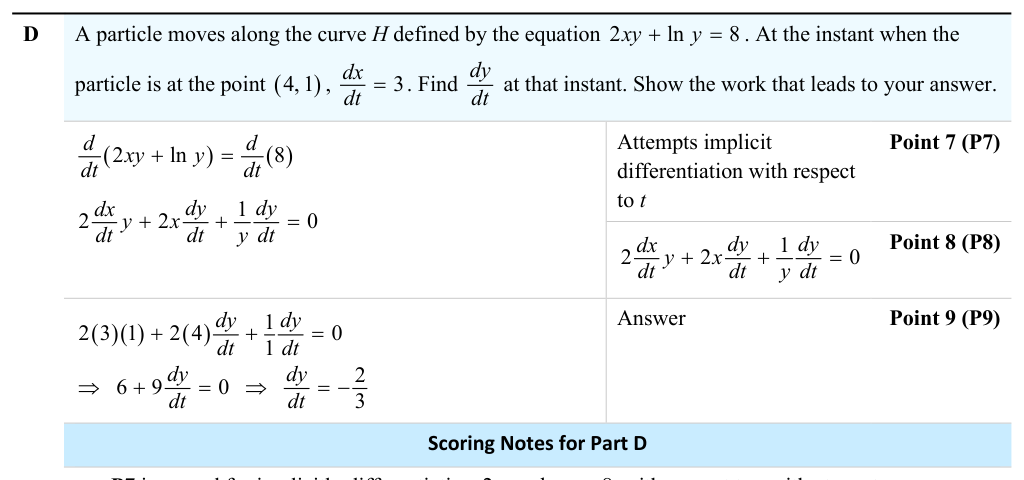
- • P7 is earned for implicitly differentiating 2xy + ln y 8 = with respect to t with at most one error.