From the free course AP Calculus AB on Lykke
5.3 Determining Intervals on Which a Function Is Increasing or Decreasing
Key concepts: Using the first derivative to determine where a function is increasing or decreasing · Using the sign of f′ on open intervals to analyze function behavior · Justifying conclusions about increasing/decreasing behavior and extrema · Interpreting the graph of f′ to determine the behavior of f · Applying derivative-based reasoning to a specific value, such as x = −3 · Using appropriate mathematical representations and explanations
How to use the sign of the first derivative, and a sign chart built from critical numbers, to find the intervals on which a function is increasing or decreasing.
5.3 Determining Intervals on Which a Function Is Increasing or Decreasing
A derivative can reveal whether a graph is climbing or falling without requiring us to see the graph itself. The essential question is simple: what does the sign of $f'(x)$ say about the behavior of $f(x)$?
The sign of the derivative controls direction
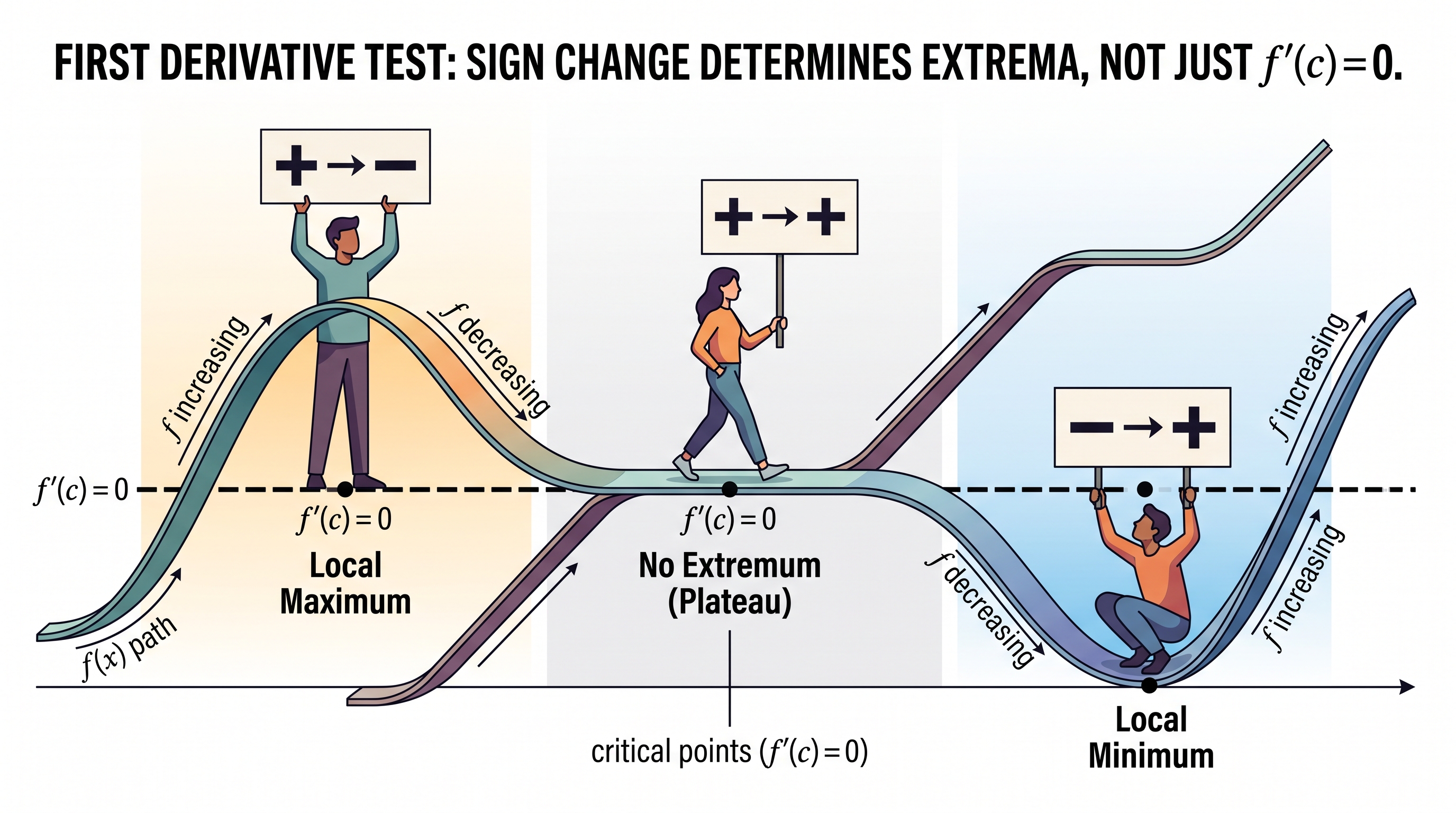
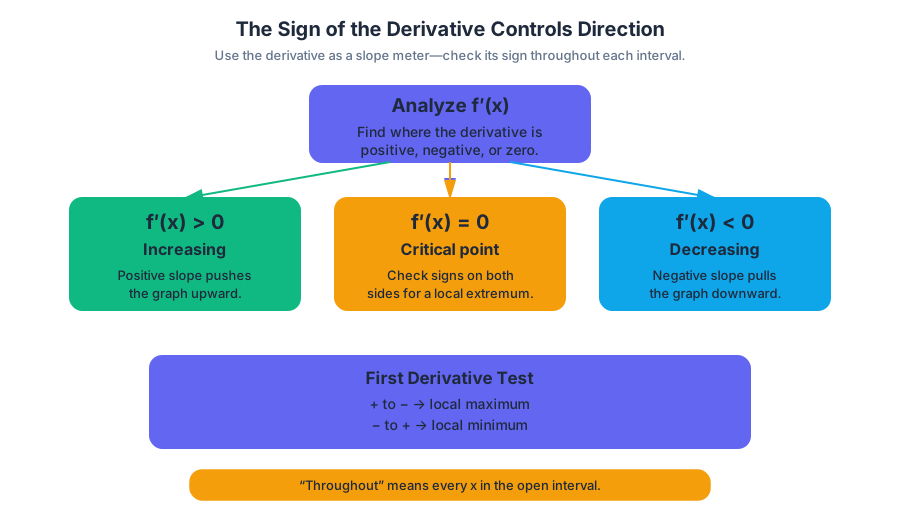
If $f'(x)>0$ throughout an open interval, then $f$ is increasing on that interval. If $f'(x)<0$ throughout an open interval, then $f$ is decreasing there. The derivative acts like a slope meter: positive slopes push the graph upward as $x$ increases, while negative slopes pull it downward.
Derivative sign rule
$$f'(x)>0 \Longrightarrow f \text{ is increasing}$$
$$f'(x)<0 \Longrightarrow f \text{ is decreasing}$$
The word throughout matters. To justify that $f$ is increasing on $(a,b)$, you must establish that $f'(x)>0$ for every $x$ in $(a,b)$, not merely calculate one positive derivative value.
From a derivative formula to intervals
Use the critical numbers identified earlier—where $f'(c)=0$ or does not exist—to divide the domain into intervals for a sign chart. Then determine the sign of $f'$ on each interval. One convenient test value is enough when the sign cannot change inside that interval, but the conclusion must refer to the entire interval.
Consider
$$f'(x)=5+3x.$$
Set the derivative equal to zero:
$$5+3x=0 \quad\Longrightarrow\quad x=-\frac{5}{3}.$$
This divides the real line into
$$\left(-\infty,-\frac{5}{3}\right) \quad\text{and}\quad \left(-\frac{5}{3},\infty\right).$$
Choose one test value from each interval:
| Interval | Test value | Sign of $f'(x)=5+3x$ | Behavior of $f$ |
|---|---|---|---|
| $\left(-\infty,-\frac{5}{3}\right)$ | $x=-3$ | $5+3(-3)=-4<0$ | Decreasing |
| $\left(-\frac{5}{3},\infty\right)$ | $x=0$ | $5+3(0)=5>0$ | Increasing |
Therefore, $f$ is decreasing on $\left(-\infty,-\frac{5}{3}\right)$ because $f'(x)<0$ there, and increasing on $\left(-\frac{5}{3},\infty\right)$ because $f'(x)>0$ there. Notice how evaluating at $x=-3$ is not the final conclusion; it supplies evidence for the sign on the whole interval containing $-3$.
Worked contextual example
Suppose $P(t)$ represents the population of a microorganism colony, and its derivative satisfies
$$P'(t)=(t-2)(t-5), \qquad 0\le t\le 7.$$
The critical numbers in the domain are $t=2$ and $t=5$. Test one value in each resulting interval:
| Time interval | Test value | Sign of $P'(t)$ | Population behavior |
|---|---|---|---|
| $(0,2)$ | $t=1$ | $(1-2)(1-5)>0$ | Increasing |
| $(2,5)$ | $t=3$ | $(3-2)(3-5)<0$ | Decreasing |
| $(5,7)$ | $t=6$ | $(6-2)(6-5)>0$ | Increasing |
Therefore, $P$ increases on $(0,2)$, decreases on $(2,5)$, and increases on $(5,7)$. At $t=2$, the sign changes from positive to negative, so the colony has a relative maximum. At $t=5$, the sign changes from negative to positive, so the colony has a relative minimum.
The interval conclusions are this topic's work. The sign changes at $t=2$ and $t=5$ are what Topic 5.4's First Derivative Test reads to classify those points as relative extrema.
These conclusions demonstrate FUN-4.A: Justify conclusions about the behavior of a function based on the behavior of its derivatives: the first derivative shows the intervals on which a function is increasing or decreasing. A complete justification gives the sign of $f'$ on the whole interval as the reason, not merely the answer.
Retrieval check: Suppose $f'(x)=(x-1)(x+4)$. Which critical numbers divide the real line, and on which intervals is $f$ increasing? Explain using the sign of $f'$. (Here $f'>0$ on $(-\infty,-4)$ and on $(1,\infty)$, so $f$ is increasing there; $f'<0$ on $(-4,1)$, so $f$ is decreasing there.)
Source Materials
- Learn More (.pdf)
- AP Calculus AB and BC Course and Exam Description
- AP Calculus AB Course Overview
- AP Calculus Course at a Glance
- AP Calculus AB and BC Course at a Glance Poster
- Adopt AP Calculus AB
- AP Calculus AB
- AP Calculus AB
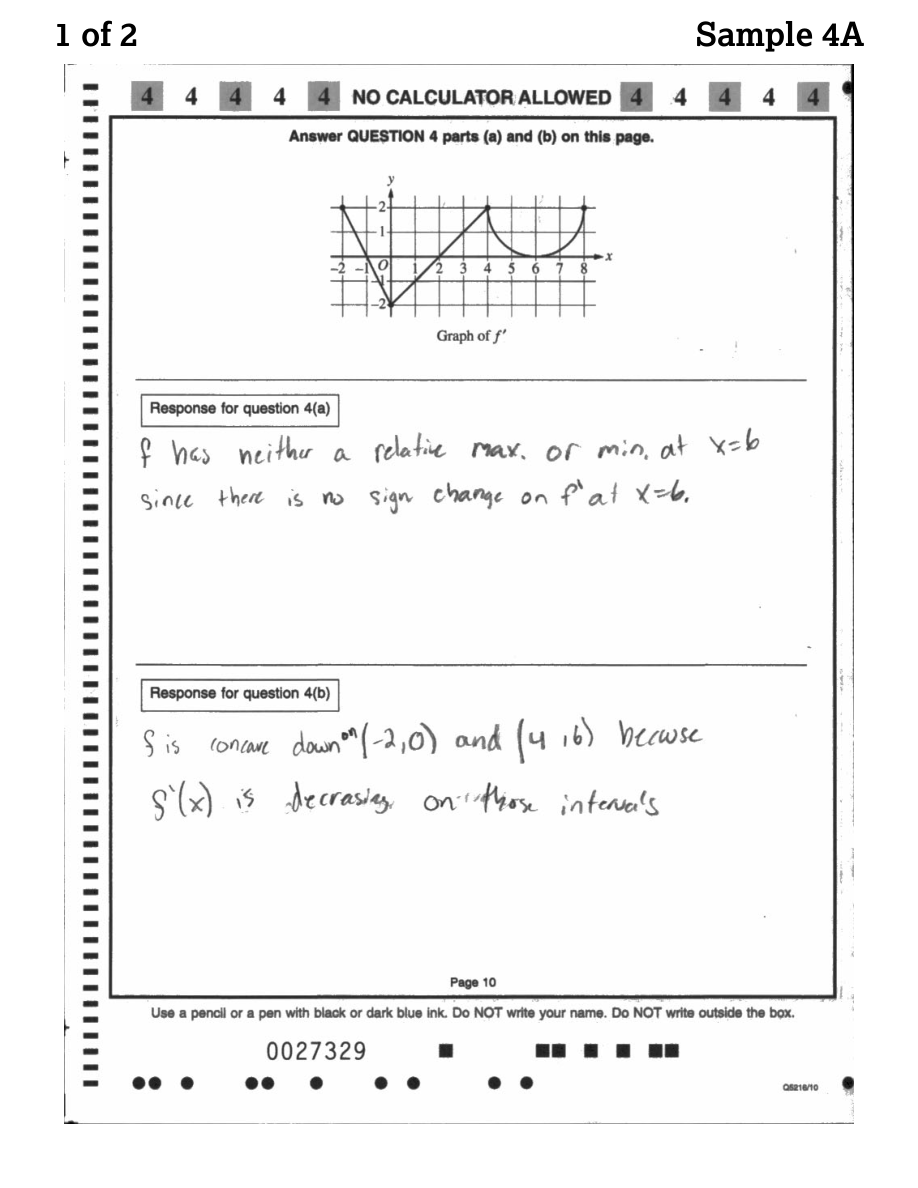
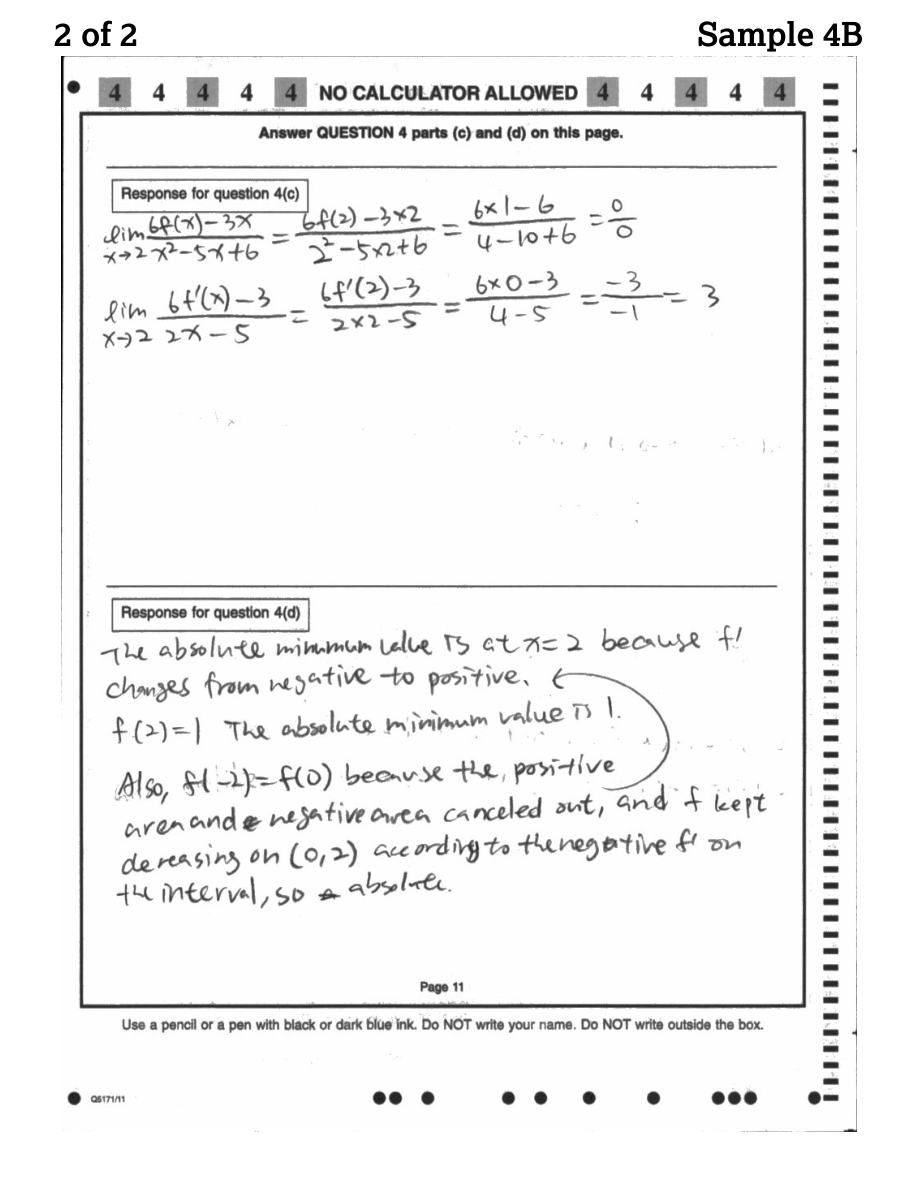
- Figure — Sample Responses Q4 (p. 5)
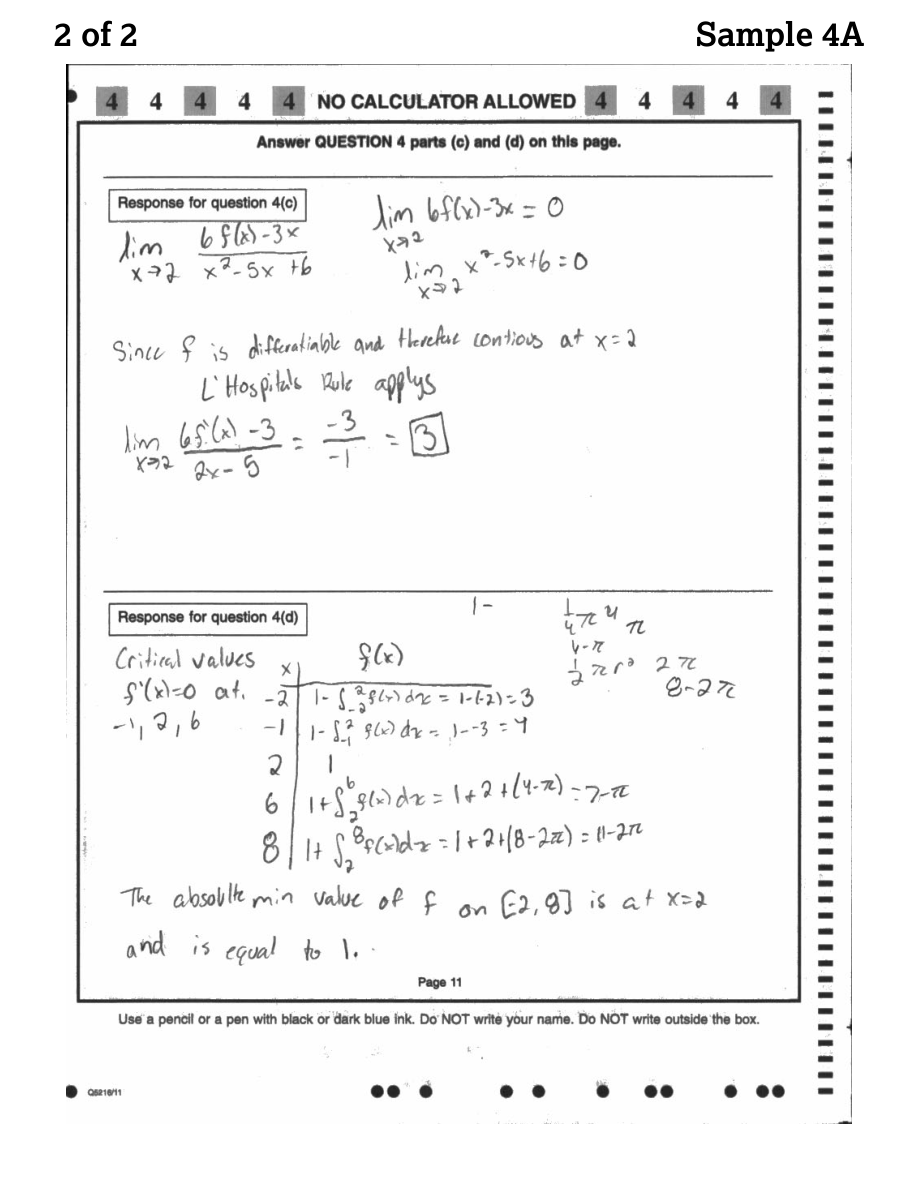
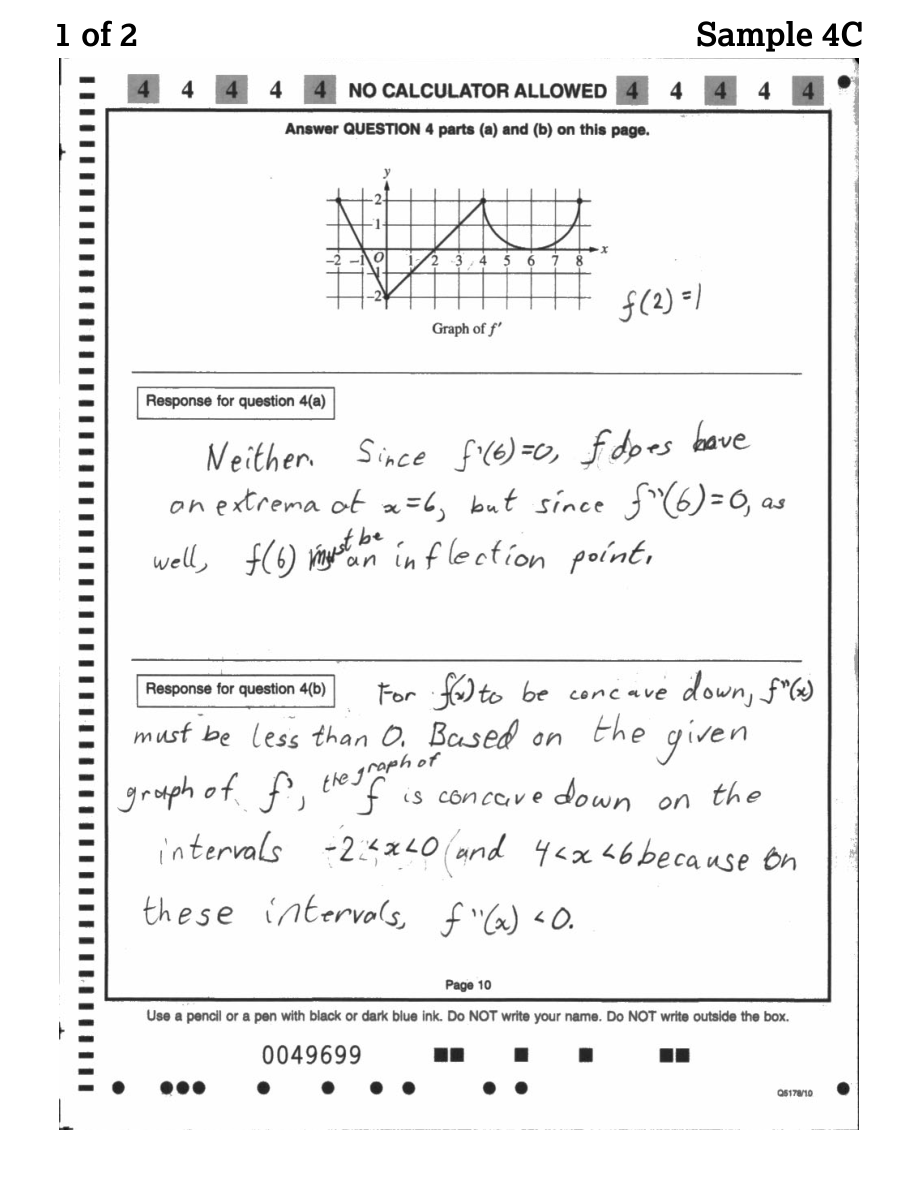
- Figure — Sample Responses Q4 (p. 6)
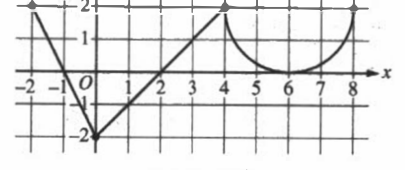
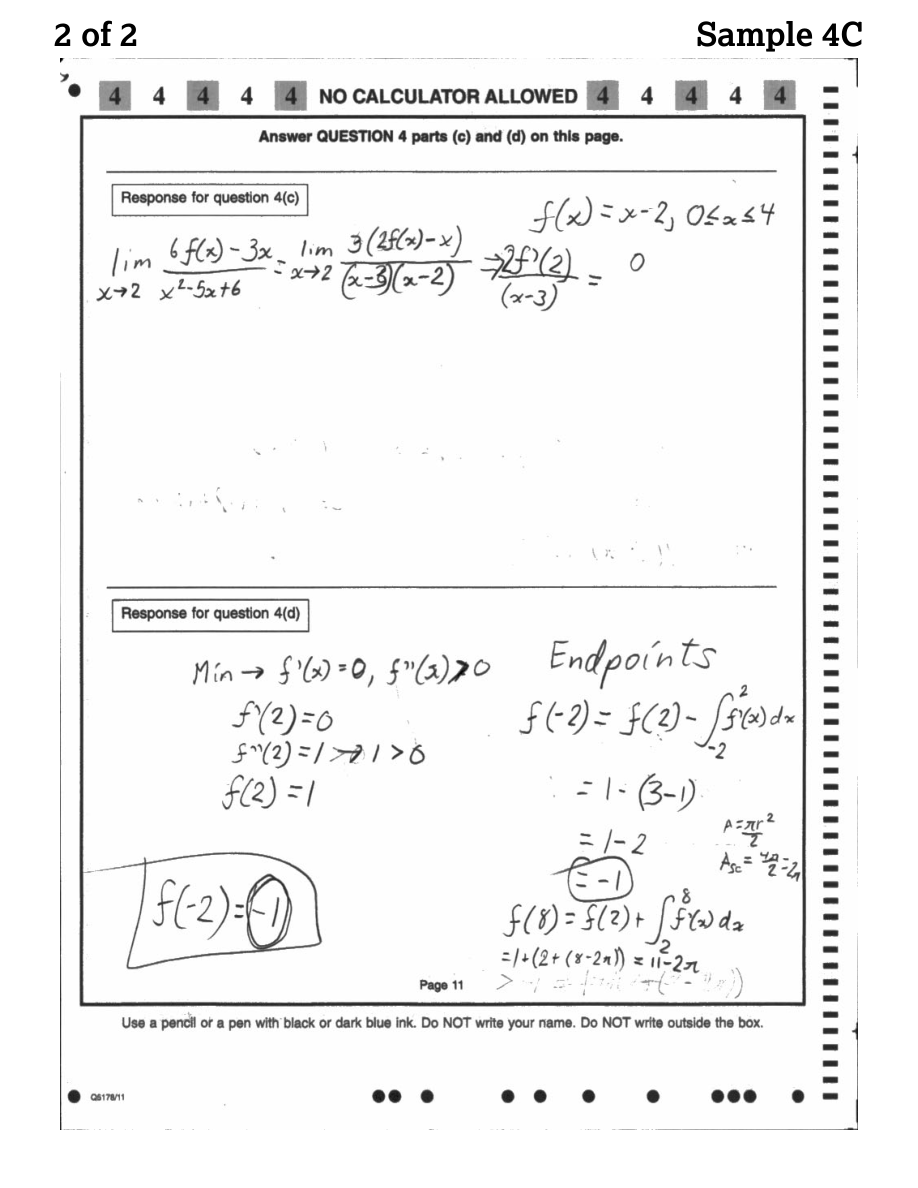
- Gra.ph of j'
- Figure — Sample Responses Q4 (p. 8)