From the free course AP Calculus AB on Lykke
8.3 Using Accumulation Functions and Definite Integrals in Applied Contexts
Key concepts: Accumulation functions · Definite integrals in applied contexts · Accumulation of change over an interval
How an accumulation function and a definite integral of a rate give the net change of a quantity in context, with correct units and sign.
8.3 Using Accumulation Functions and Definite Integrals in Applied Contexts
A quantity can accumulate even when its rate is changing every moment: water enters a tank at a time-dependent rate, pollutants spread across a region, or energy is used at a varying rate. A definite integral turns that changing rate into the total signed change over an interval.
Accumulation functions: turning a rate into a total
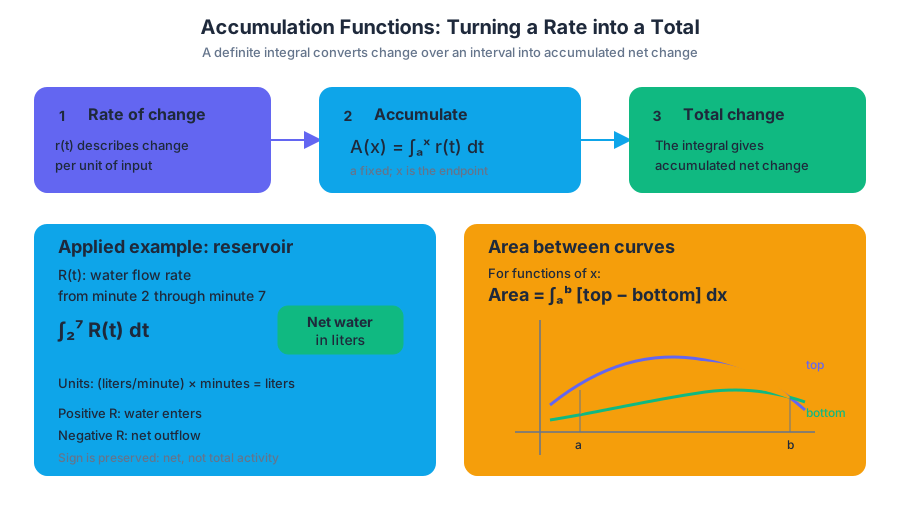
An accumulation function records how much of a quantity has built up from a starting point $a$ to a variable endpoint $x$:
$$ A(x)=\int_a^x r(t),dt, $$
where $r(t)$ is the rate of change of the quantity and $t$ is the input variable. The variable $x$ is the endpoint of accumulation, while $a$ remains fixed.
CHA-4: Definite integrals allow us to solve problems involving the accumulation of change over an interval.
The learning objectives are CHA-4.D: Interpret the meaning of a definite integral in accumulation problems and CHA-4.E: Determine net change using definite integrals in applied contexts. The essential knowledge is expressed through CHA-4.D.1 and CHA-4.E.1: an integral of a rate over an interval represents the accumulated, or net, change in the related quantity.
Suppose $R(t)$ measures water entering a reservoir in liters per minute. Then
$$ \int_2^7 R(t),dt $$
represents the net amount of water entering from minute $t=2$ through minute $t=7$, measured in liters. The units arise automatically:
$$ \left(\frac{\text{liters}}{\text{minute}}\right)(\text{minutes}) =\text{liters}. $$
If $R(t)$ is positive, the reservoir gains water; if $R(t)$ is negative, the model represents net outflow. The integral preserves this sign, so it measures net change, not necessarily total activity.
Worked context: accumulated change
A chemical concentration changes at the rate
$$ C'(t)=4-t $$
milligrams per hour for $0\le t\le 5$. The net change from $t=1$ to $t=5$ is
$$ \int_1^5 (4-t),dt
\left[4t-\frac{t^2}{2}\right]_1^5. $$
Evaluating,
$$ \left(20-\frac{25}{2}\right)
\left(4-\frac12\right)
7.5-3.5
$$
Therefore, the concentration increases by $4$ milligrams over the interval. Notice that the rate becomes negative after $t=4$; the final answer is still positive because the earlier increase is larger than the later decrease.
In applied problems the integral gives only the change, so a final amount also needs the starting amount: $Q(b)=Q(a)+\int_a^b r(t),dt$. If the reservoir holds $500$ liters at $t=2$, it holds $500+\int_2^7 R(t),dt$ liters at $t=7$. When a quantity has both an inflow rate and an outflow rate, integrate their difference. By the Fundamental Theorem of Calculus the accumulation function satisfies $A'(x)=r(x)$, so the sign of the rate tells you where the accumulated amount is increasing or decreasing.
Retrieval check: Oil leaks from a tank at $L(t)$ gallons per hour, and the tank holds $300$ gallons at $t=0$. Write, but do not evaluate, the amount in the tank at $t=6$, and state the units of $\int_0^6 L(t),dt$. The amount is $300-\int_0^6 L(t),dt$, and the integral is measured in gallons.