From the free course AP Calculus AB on Lykke
6.14 Selecting Techniques for Antidifferentiation
Key concepts: Selecting appropriate techniques for antidifferentiation · Classifying an expression to identify the applicable mathematical rule or procedure (Skill 1.C) · Using partial fractions for antidifferentiation (BC only) · Using the washer method to find volume when revolving a region · Revolving regions around axes other than the usual coordinate axes · Finding distance traveled through antidifferentiation · Applying rules and procedures for antidifferentiation in Personal Progress Checks 6–8
How to classify an integrand and pick the matching antidifferentiation technique, with applications to distance traveled and washer volumes.
6.14 Selecting Techniques for Antidifferentiation
By this point the unit has built a full toolkit: basic rules, substitution, long division, completing the square and, for BC, integration by parts and partial fractions. On an exam nobody tells you which one to use. This topic is about reading the structure of an integrand and choosing the technique that fits it.
Selecting an antidifferentiation technique
Topic 6.14 Selecting Techniques for Antidifferentiation belongs to FUN-6 and emphasizes Skill 1.C: Identify an appropriate mathematical rule or procedure based on the classification of a given expression. The central question is not “Which formula have I just practiced?” but “What structural feature does this integrand have?”
Use the following classification pipeline:
| Form of the integrand | First procedure to consider |
|---|---|
| Sum of powers, constants, or basic functions | Basic antiderivative rules |
| A composite expression multiplied by its inner derivative | Substitution |
| A product such as polynomial times exponential or logarithmic function | Integration by parts |
| A rational function with a denominator that factors into linear terms | Partial fractions, BC only |
| A rational function with numerator degree at least the denominator degree | Long division first |
| A quadratic denominator | Completing the square or a related standard form |
| A definite integral with a singularity or infinite endpoint | Improper-integral limit |
For example,
$$ \int 2x\cos(x^2),dx $$
is classified as a composite-function pattern: the inner function is $u=x^2$, and $du=2x,dx$. Thus,
$$ \int 2x\cos(x^2),dx
\sin(x^2)+C. $$
By contrast,
$$ \int x e^x,dx $$
is a product pattern, so integration by parts is appropriate. For a BC-only rational example,
$$ \int \frac{1}{x^2-1},dx, $$
factor the denominator as $(x-1)(x+1)$ and use partial fractions before integrating.
Named misconception — “Any technique will work if I manipulate long enough.” A method can create unnecessary algebra or fail completely when the expression is misclassified. In Skill 1.C, the classification itself is part of the mathematics: identify the form, select the rule, then execute it accurately. Practice should therefore mix techniques rather than group identical integrals together.
Antidifferentiation in applications
Antidifferentiation also converts a rate into a total change. If velocity is $v(t)$, then displacement on $[a,b]$ is
$$ \int_a^b v(t),dt, $$
while distance traveled is
$$ \int_a^b |v(t)|,dt. $$
The absolute value matters because negative velocity indicates motion in the negative direction, not negative distance. Split the interval wherever $v(t)=0$ before evaluating the distance integral.
Worked application. Suppose
$$ v(t)=t-2 $$
for $0\le t\le4$. The particle changes direction at $t=2$. Its distance traveled is
$$ \int_0^2 (2-t),dt+\int_2^4(t-2),dt
2+2=4 $$
units. The signed displacement,
$$ \int_0^4(t-2),dt=0, $$
is different: the particle returns to its starting position.
Washer method and rotation around other axes
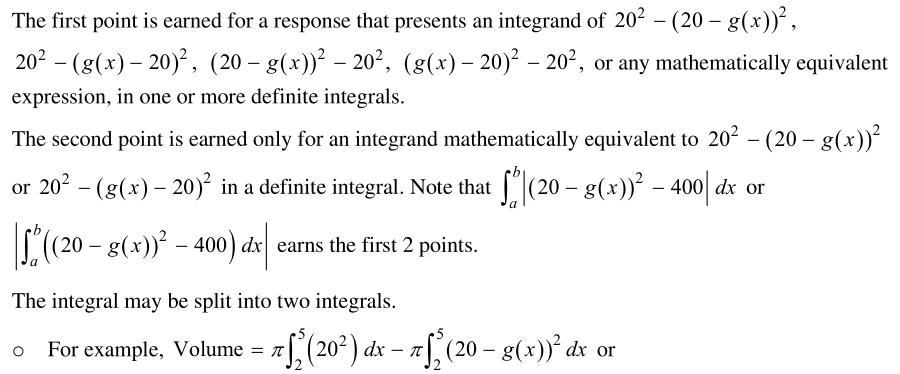
When a region is revolved, each thin slice becomes a cross-sectional disk or washer. For slices perpendicular to the axis of rotation,
$$ V=\pi\int_a^b\left(R(x)^2-r(x)^2\right),dx, $$
where $R$ is the outer radius and $r$ is the inner radius. A radius is always a distance to the axis, so revolving around $y=k$ requires expressions such as $|f(x)-k|$, not merely $f(x)$.
For example, revolving the region between $y=x$ and $y=x^2$ on $0\le x\le1$ around the horizontal line $y=2$ produces washers. The outer radius is $R(x)=2-x^2$, and the inner radius is $r(x)=2-x$, giving
$$ V=\pi\int_0^1\left[(2-x^2)^2-(2-x)^2\right],dx. $$
The same principle handles axes other than the coordinate axes: measure every radius from the stated axis, choose slices perpendicular to that axis, and split the integral if the outer and inner boundaries change.
Retrieval check. Classify each expression before integrating: $\int (3x^2+4),dx$, $\int 6x\sqrt{3x^2+1},dx$, and $\int \frac{x}{x^2+1},dx$. Which use basic rules, which use substitution, and why? For an improper integral, what must replace an infinite endpoint?