From the free course AP Calculus AB on Lykke
Course Framework, Skills and Reasoning Processes
Key concepts: AP course framework · Course content and skills · Instructional model · Course and exam description · Curriculum transparency · College-level course alignment · AP Course Audit · AP Classroom resources · Student assessment and reporting · Access and readiness for AP coursework
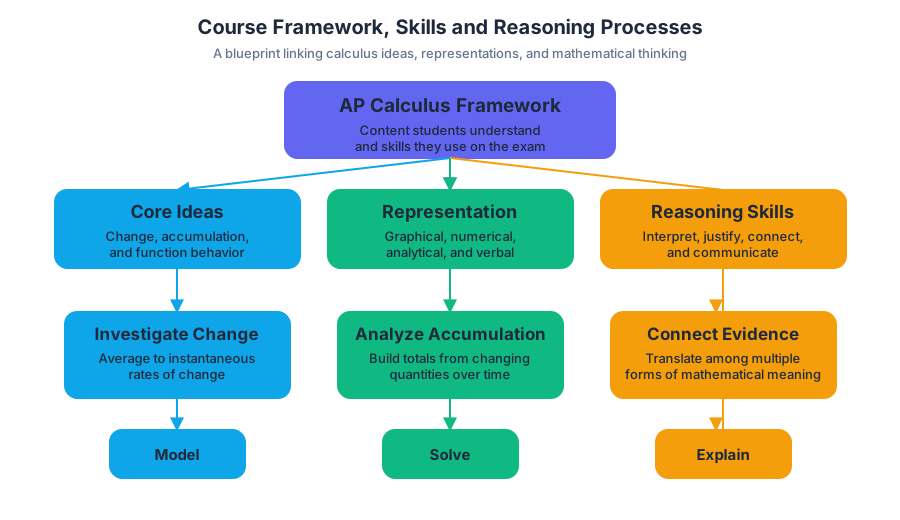
The AP Calculus course framework is the blueprint that identifies the calculus content students must understand and the skills they must be able to use on the AP Exam.
Course Framework, Skills and Reasoning Processes
The AP Calculus course framework is the blueprint that identifies the calculus content students must understand and the skills they must be able to use on the AP Exam.
AP Calculus AB treats calculus as more than a collection of derivative and integral rules. Students investigate how mathematics measures instantaneous change, describes accumulation over time, and analyzes functions through graphical, numerical, analytical, and verbal representations.
The framework as a course blueprint
The framework is the heart of the Course and Exam Description. It organizes required content and skills into units that resemble the sequence used in widely adopted college calculus textbooks. This structure gives teachers a coherent progression while leaving room to adjust examples, pacing, readings, and assignments for local needs.
A topic in the framework is best understood as a three-part chain:
| Framework element | Question it answers | Calculus example |
|---|---|---|
| Enduring Understanding | What lasting mathematical idea matters? | A function can describe changing quantities. |
| Learning Objective | What must a student be able to do? | Interpret the derivative in context. |
| Essential Knowledge | What facts and relationships make that action possible? | The derivative gives an instantaneous rate of change. |
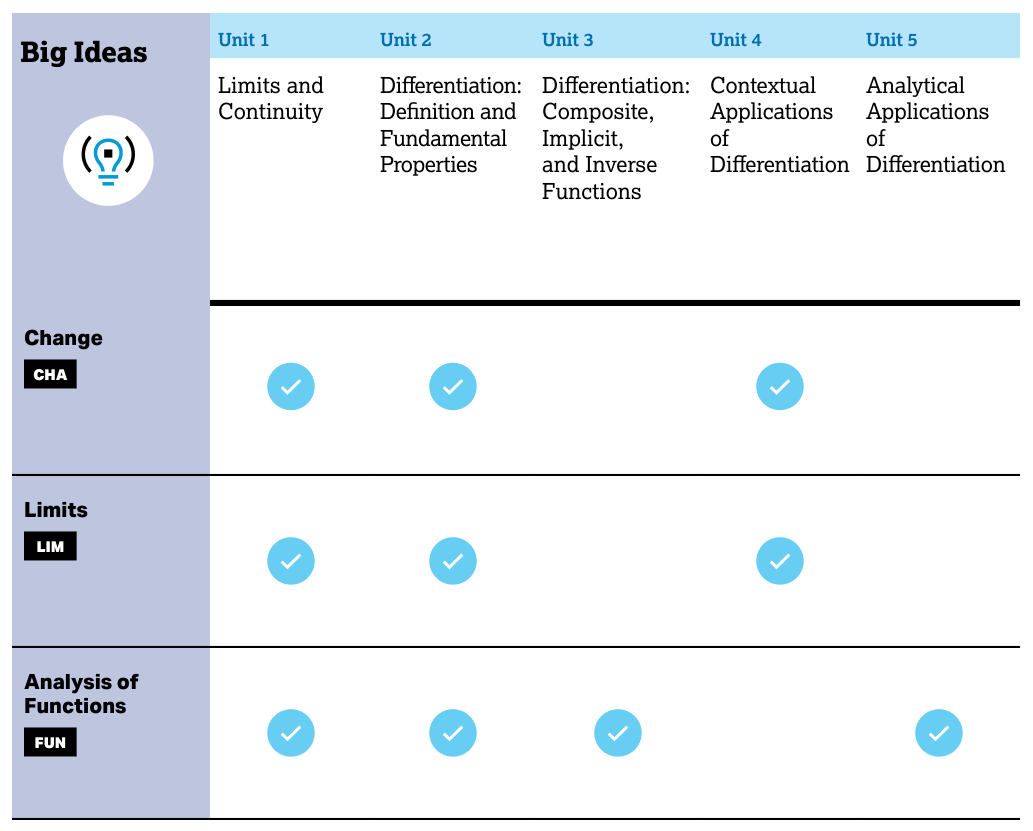
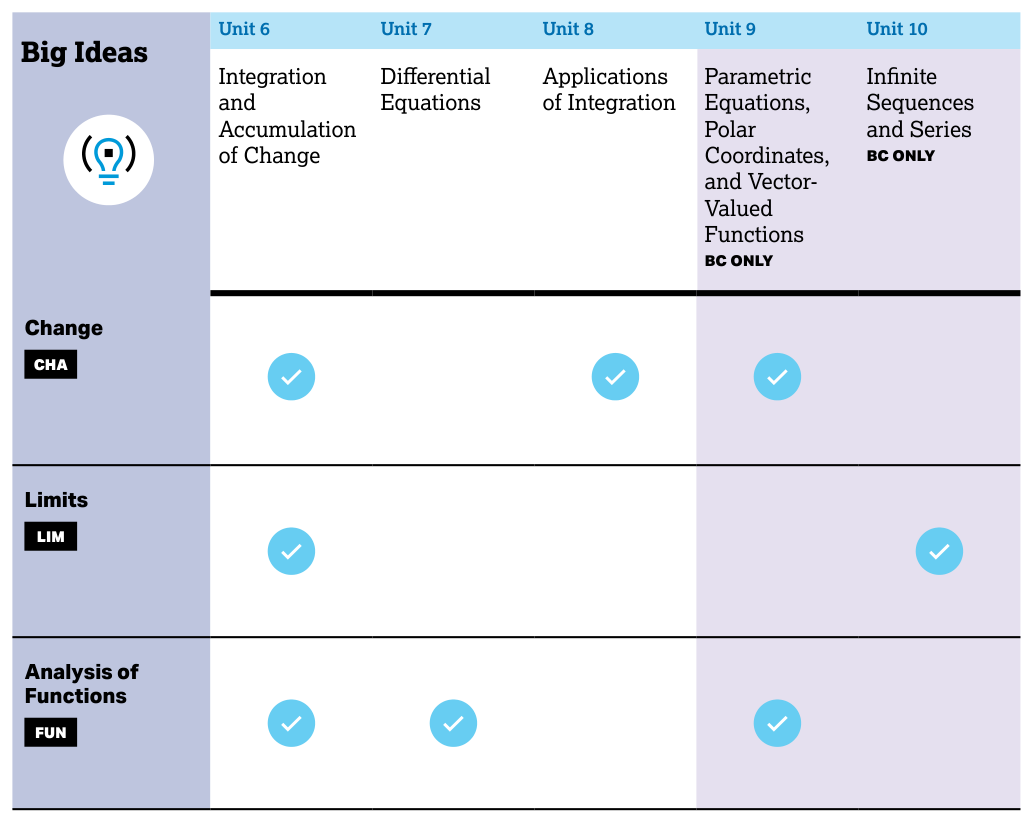
The units therefore should not be taught as isolated boxes. Limits support derivatives; derivatives support applications and differential equations; definite integrals connect rates to accumulated quantities; and representations allow students to move between a graph, table, equation, and explanation without losing the meaning of the mathematics.
The four Mathematical Practices
The AP Calculus framework develops four official reasoning processes, called Mathematical Practice 1—Implementing Mathematical Processes, Mathematical Practice 2—Connecting Representations, Mathematical Practice 3—Justification, and Mathematical Practice 4—Communication and Notation.
Mathematical Practice 1—Implementing Mathematical Processes means selecting and carrying out an appropriate mathematical procedure. A student may evaluate a limit algebraically, differentiate implicitly, construct a Riemann sum, or solve a differential equation. The important question is not merely whether the procedure was remembered, but whether it fits the structure of the problem.
Mathematical Practice 2—Connecting Representations means translating information among equations, graphs, tables, verbal descriptions, and numerical approximations. For example, if a velocity function satisfies $v(t)<0$ on an interval, its graph communicates that position is decreasing, while the integral $\int_a^b v(t),dt$ communicates the net change in position.
Mathematical Practice 3—Justification requires checking conditions and explaining why a conclusion follows. A statement such as “there is a zero” may require continuity and a sign change so that the Intermediate Value Theorem applies. A global-extrema conclusion may require checking endpoints as well as critical points.
Mathematical Practice 4—Communication and Notation requires precise mathematical language, notation, units, and conclusions. A response should distinguish a value from a rate, include units when the context supplies them, and state what a number means rather than leaving an unexplained calculation.
A skill-centered roadmap
All eight units use all four practices, but their emphasis shifts as the mathematics develops:
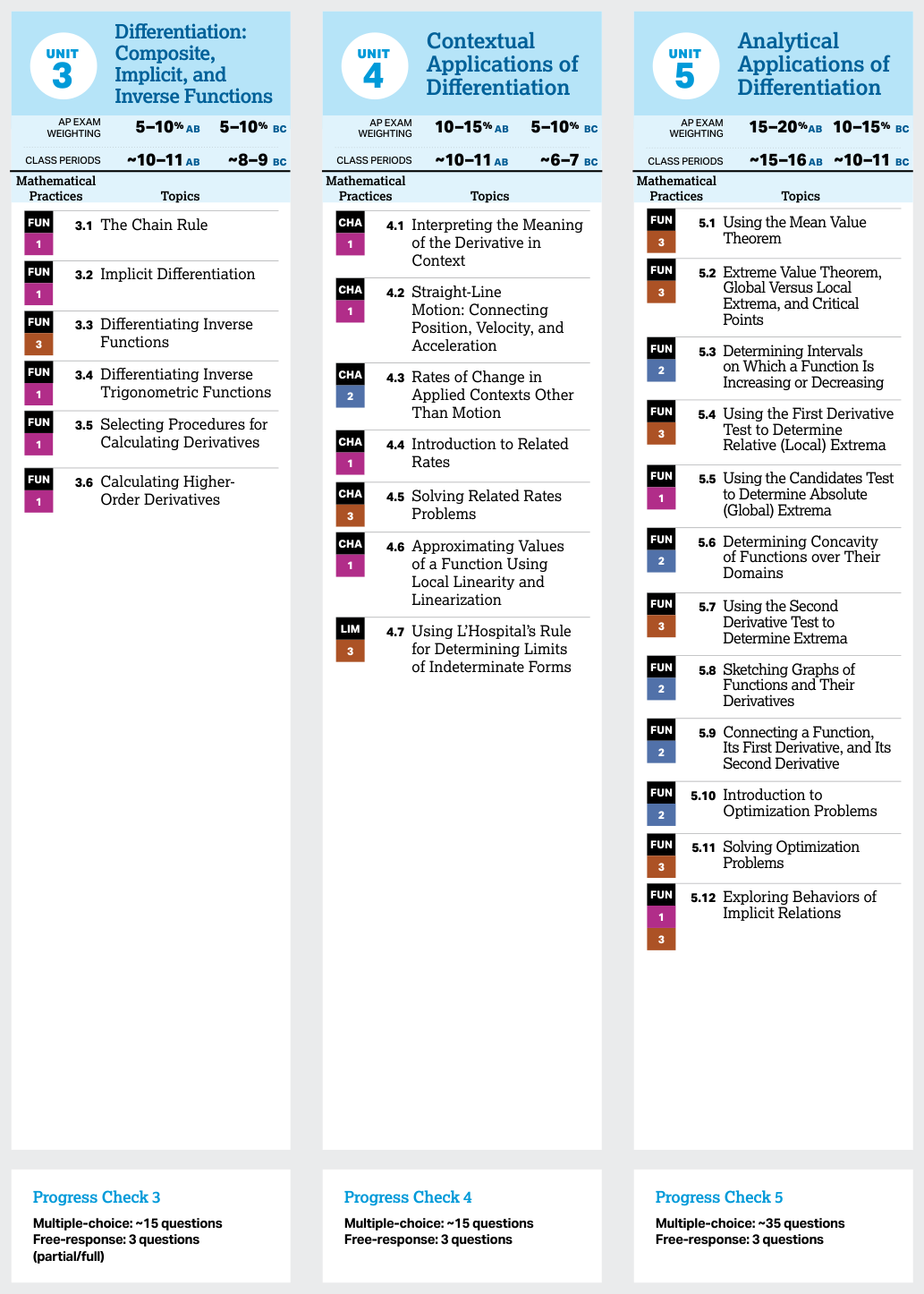
- Units 1–3: Limits and Differentiation lean heavily on Mathematical Practice 1 and Mathematical Practice 2 as students build symbolic procedures and connect them to graphs and numerical evidence.
- Units 4–5: Contextual and Analytical Applications of Differentiation place greater weight on Mathematical Practice 3 and Mathematical Practice 4 because interpretations, conditions, and explanations determine whether an answer is valid.
- Units 6–8: Integration, Differential Equations, and Applications of Integration combine all four practices: students model accumulation, select procedures, interpret signed quantities, and justify conclusions in context.
These practices appear throughout the exam rather than belonging to separate “skill questions.” Multiple-choice questions may ask students to interpret a representation or select a procedure. Free-response questions commonly require a calculation together with a justification, an interpretation with units, or a connection between a function and its derivative or integral.
Instructional model and public transparency
The instructional model shows possible ways to integrate AP resources across the year so that conceptual understanding and mathematical skills grow together. A typical sequence might introduce a unit, use graphical or numerical exploration, practice analytical procedures, apply the ideas to a real situation, and then use formative evidence to decide what needs reinforcement.
AP Classroom supports this cycle with assignments, multiple-choice questions with rationales, free-response questions, scoring information, and Progress Checks. The Reports feature displays student results across assignment types and helps teachers identify class trends rather than relying only on a single test score.
Public course frameworks and sample assessments promote curriculum transparency: students, families, teachers, and schools can see the mathematical expectations before instruction begins. Transparency does not require every classroom to look identical; the framework is a shared destination, while teachers retain responsibility for selecting college-level readings, resources, examples, and pacing.
Course Audit, syllabus evidence, and access
The AP Course Audit requires an AP teacher and the school principal or designated administrator to confirm awareness and understanding of the curricular and resource requirements. A syllabus or course outline must show how those requirements are met, including access to a college-level calculus textbook, coverage of the AP units and big ideas, mathematical practices, graphing-calculator opportunities, and real-world applications.
The framework also supports access and readiness. AP encourages educators to invite students from groups underrepresented in AP and to use Pre-AP coursework to build preparation. The central principle is that access should expand while students receive the conceptual, procedural, representational, and communication support needed for college-level work.
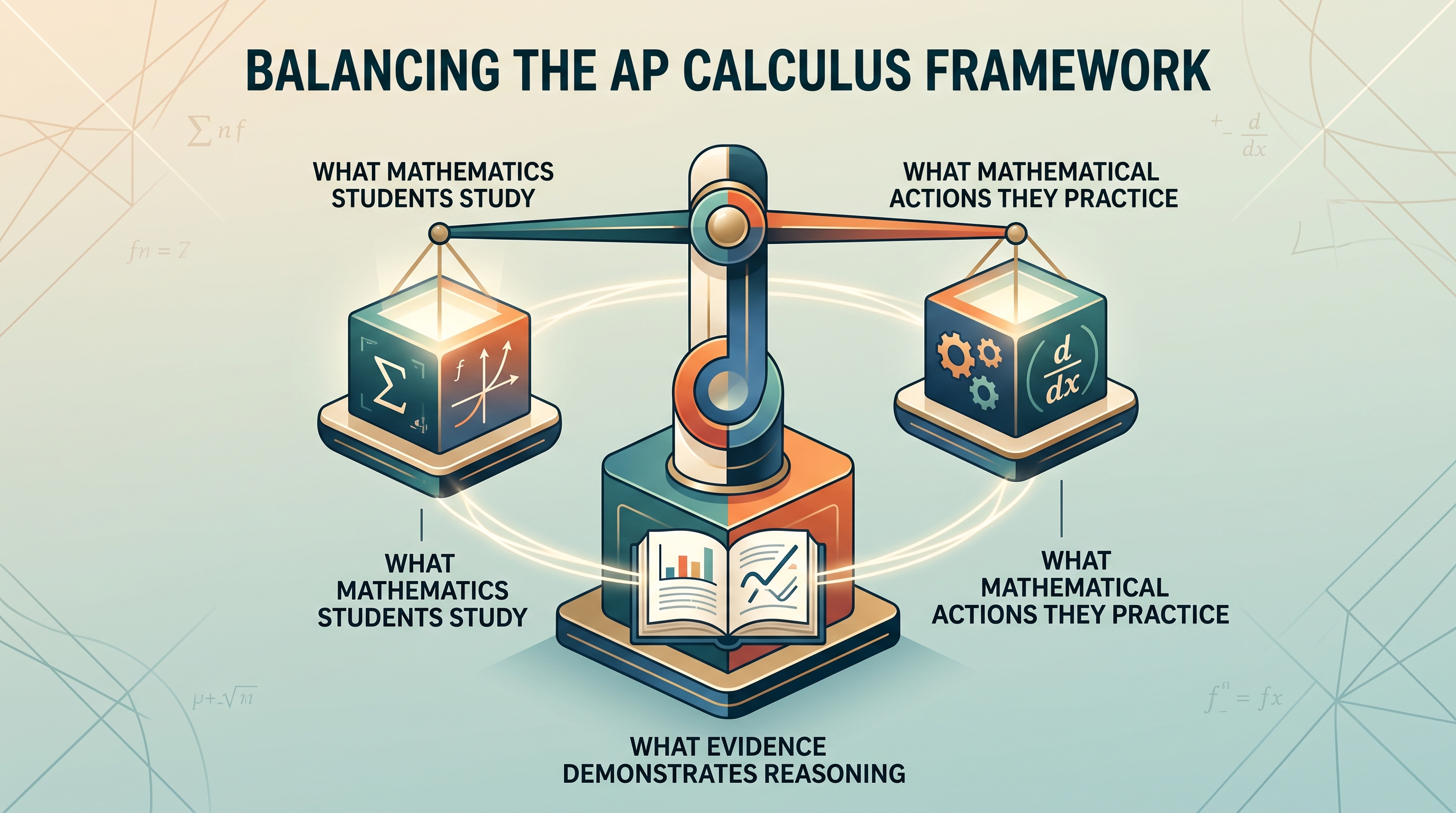
A strong AP Calculus course aligns three things: what mathematics students study, what mathematical actions they practice, and what evidence demonstrates that they can reason with the mathematics.
Retrieval check: A student finds $\int_0^5 v(t),dt=18$ and writes, “The object travels $18$ meters.” Which practice should prompt the correction first? The key issue is Mathematical Practice 4—Communication and Notation, supported by Mathematical Practice 2—Connecting Representations: the integral gives net change in position, not necessarily total distance traveled.
Source Materials
- Learn More (.pdf)
- AP Calculus AB and BC Course and Exam Description
- AP Calculus AB Course Overview
- AP Calculus Course at a Glance
- AP Calculus AB and BC Course at a Glance Poster
- Adopt AP Calculus AB
- AP Calculus AB
- AP Calculus AB
- Figure — AP Calculus AB and BC Course and Exam Description (p. 1)
- Figure — AP Calculus AB and BC Course and Exam Description (p. 14)
- Figure — AP Calculus AB and BC Course and Exam Description (p. 20)
- Figure — AP Calculus AB and BC Course and Exam Description (p. 21)