From the free course AP Calculus AB on Lykke
1.13 Removing Discontinuities
Key concepts: Removing discontinuities · Removable discontinuities · Jump discontinuities · Continuity at a point · Using the definition of continuity · Applying notation for existence theorems · Solving procedures with and without technology
How to find the one value that fills a hole in a graph and makes a function continuous, and why jumps and vertical asymptotes cannot be repaired that way.
1.13 Removing Discontinuities
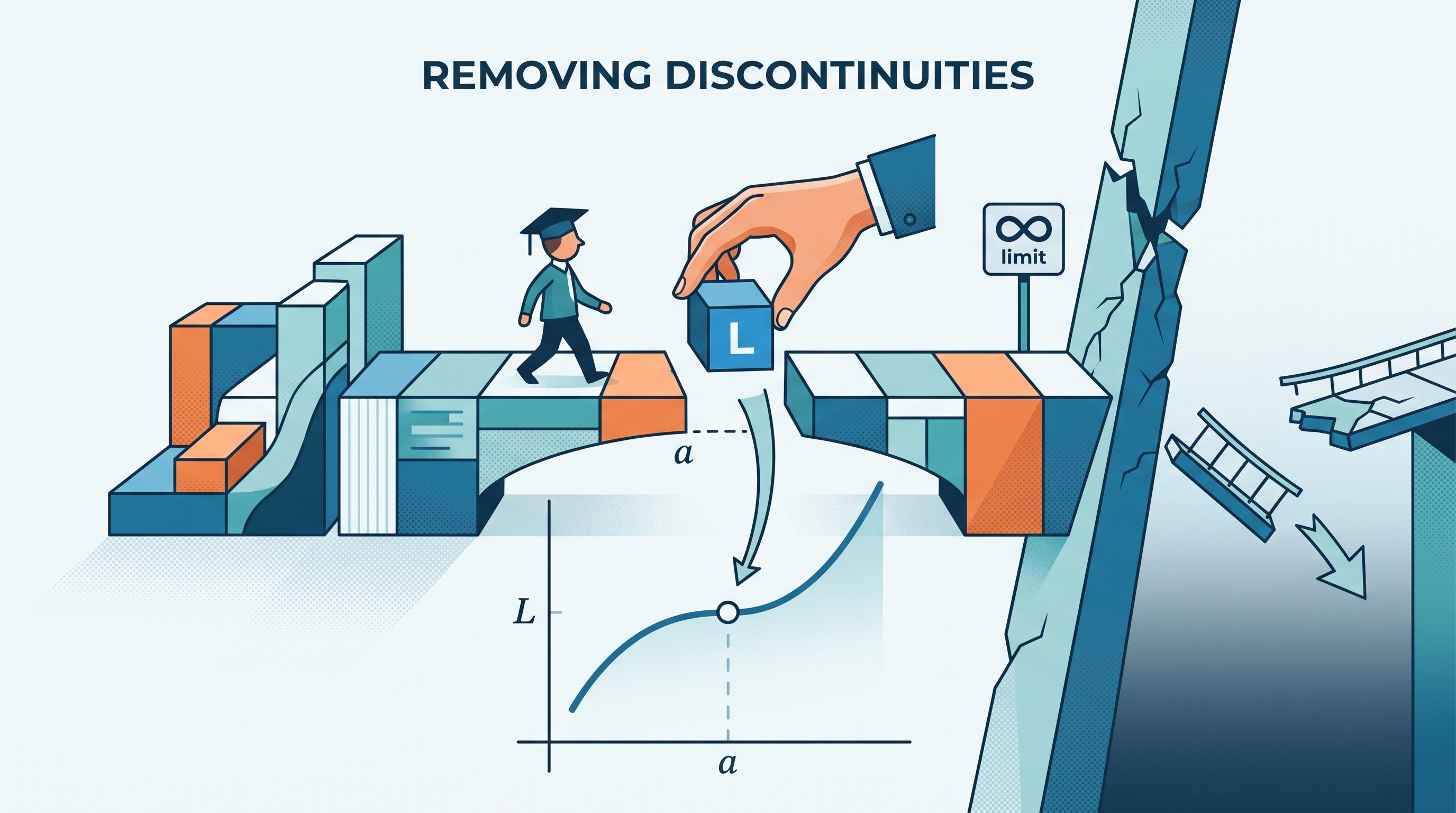
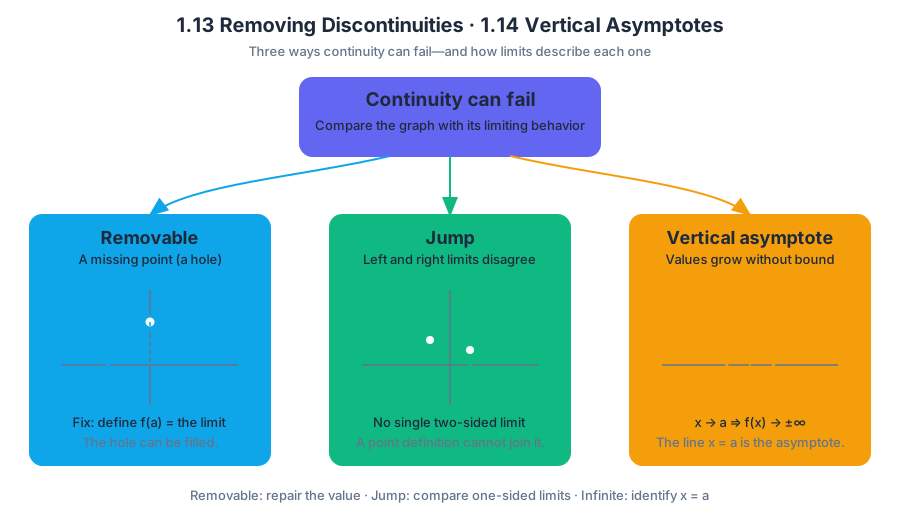
A graph can fail to be continuous in three fundamentally different ways: a missing point, a sudden jump, or an unbounded plunge toward a vertical line. These are removable discontinuities, jump discontinuities, and discontinuities due to vertical asymptotes.
Three ways continuity can fail
| Type | What the graph does near $x=a$ | Can one value of $f(a)$ repair it? |
|---|---|---|
| Removable discontinuity | Both sides approach the same finite number, but the point is missing or assigned incorrectly | Yes, by defining $f(a)$ to equal the common limit |
| Jump discontinuity | The left-hand and right-hand limits approach different finite numbers | No |
| Vertical-asymptote discontinuity | Function values increase or decrease without bound near $x=a$ | No finite value can repair it |
The previously established continuity test is the deciding tool: compare the function’s value at the point with the behavior of the function as $x$ approaches that point. For a removable discontinuity, the limiting behavior is consistent but the assigned point is not. For a jump or vertical asymptote, the surrounding behavior itself prevents continuity.
Removing a removable discontinuity
Suppose
$$ f(x)=\frac{x^2-9}{x-3}. $$
At $x=3$, direct substitution produces $\frac{0}{0}$, but factoring reveals the structure:
$$ f(x)=\frac{(x-3)(x+3)}{x-3}=x+3,\qquad x\ne 3. $$
Thus,
$$ \lim_{x\to 3}f(x)=\lim_{x\to 3}(x+3)=6. $$
The original function has a hole at $(3,6)$. It becomes continuous after defining
$$ f(3)=6. $$
This is a repair, not a change to the nearby rule: every value with $x\ne 3$ remains unchanged. Algebra removes the common factor, while the limit identifies the single value needed to fill the hole.
With and without technology
Without technology, factor, rationalize, or otherwise manipulate the expression before evaluating the limit. With technology, graph the function and use a table whose $x$-values approach $3$ from both sides. A calculator may display values close to $6$, but it cannot by itself prove that the missing point should be assigned exactly $6$; the symbolic reasoning supplies that justification.
A piecewise definition can make the repair explicit:
$$ F(x)= \begin{cases} \dfrac{x^2-9}{x-3}, & x\ne 3,\[6pt] 6, & x=3. \end{cases} $$
Then $F$ is continuous at $x=3$ because the value assigned at the point agrees with the common limiting value.
Jump discontinuities cannot be repaired
Consider
$$ g(x)= \begin{cases} x+1, & x<2,\ x+4, & x\ge 2. \end{cases} $$
The one-sided limits are
$$ \lim_{x\to 2^-}g(x)=3 \qquad\text{and}\qquad \lim_{x\to 2^+}g(x)=6. $$
Because these values differ,
$$ \lim_{x\to 2}g(x)\ \text{does not exist}. $$
Changing $g(2)$ cannot make the two sides agree. This is a jump discontinuity, often used to model an instantaneous change in a rule, price, tax bracket, or control setting.
When invoking the condition for existence of a two-sided limit, use precise notation:
$$ \lim_{x\to a}f(x)\text{ exists} \quad\Longleftrightarrow\quad \lim_{x\to a^-}f(x)=\lim_{x\to a^+}f(x), $$
provided both one-sided limits exist as the same finite value. Writing only “the limit is undefined” is weaker than identifying the unequal one-sided limits.
AP reasoning and retrieval check
This topic develops LIM-2.A and LIM-2.A.1: Justify conclusions about continuity at a point using the definition, especially by classifying the failure and deciding whether it can be repaired. It also uses 3.B: Identify an appropriate mathematical definition, theorem, or test to apply and 3.D: Apply an appropriate mathematical definition, theorem, or test. Strong responses connect a graph, equation, or table to correct one-sided-limit notation and a justified conclusion.
Retrieval check: For
$$ p(x)=\frac{x^2-16}{x-4}, $$
identify the discontinuity at $x=4$, determine whether it is removable, and state the value that repairs it. Then compare with
$$ q(x)=\frac{1}{x-4}. $$
The first function has a removable discontinuity because its simplified rule is $x+4$ and the missing value is $8$. The second has a vertical asymptote at $x=4$ because its one-sided values are unbounded; it cannot be repaired by assigning a finite value.
Source Materials
- Learn More (.pdf)
- AP Calculus AB and BC Course and Exam Description
- AP Calculus AB Course Overview
- AP Calculus Course at a Glance
- AP Calculus AB and BC Course at a Glance Poster
- Adopt AP Calculus AB
- AP Calculus AB
- AP Calculus AB
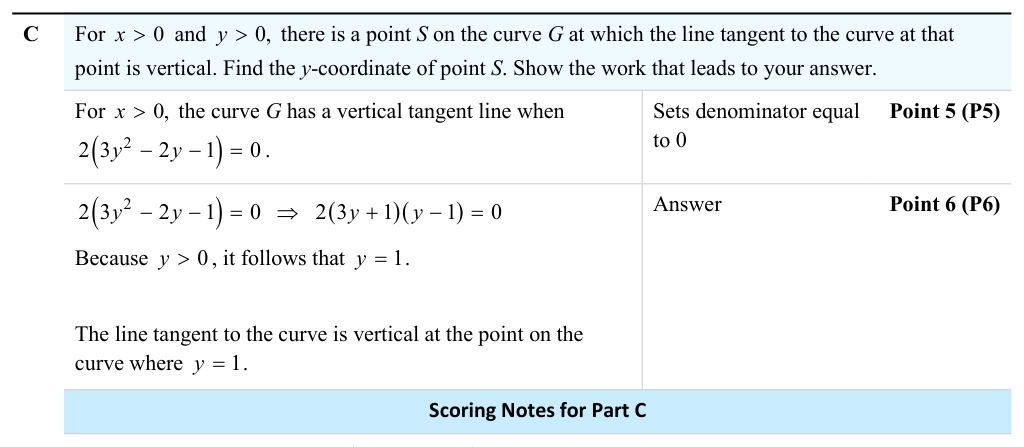
- Total for part (d) 1 point
- linear approximation also earns the first point.
- Total for part (d) 1 point
- • P5 is earned with any of 2 3( y y 2 −2 − = 1) 0 , 3y y 2 −2 − = 1 0 , 2 3 ( y y ± 1)( ± = 1) 0 , or