From the free course AP Calculus AB on Lykke
AP Practice 4
A rate can describe either a change averaged over time or a change occurring at one exact instant. The distinction matters when a tank, population, bank account, or chemical concentration is changing continuously.
AP Practice 4
A rate can describe either a change averaged over time or a change occurring at one exact instant. The distinction matters when a tank, population, bank account, or chemical concentration is changing continuously.
Task type: Calculator-active contextual free response
A water-treatment tank receives water at rate $I(t)$ gallons per hour and drains water at rate $D'(t)$ gallons per hour, where $t$ is measured in hours after 8:00 a.m. The function $D(t)$ gives the total number of gallons drained by time $t$. Values of $D(t)$ are recorded below.
| $t$ | $0$ | $2$ | $4$ | $5$ | $6$ | $8$ |
|---|---|---|---|---|---|---|
| $D(t)$ | $0$ | $430$ | $1{,}200$ | $1{,}440$ | $1{,}690$ | $2{,}100$ |
At exactly $t=5$, the drainage rate is known to be $D'(5)=240$ gallons per hour. The inflow rate at that moment is $I(5)=500$ gallons per hour. Let $V(t)$ represent the amount of water in the tank.
The questions
(a) Find the average rate at which water is drained from the tank over the interval $4\leq t\leq 8$. Include units.
(b) Interpret the meaning of $D'(5)=240$ in the context of the tank.
(c) Find $V'(5)$, the instantaneous rate of change of the amount of water in the tank at $t=5$. Include units.
(d) Is the amount of water in the tank increasing or decreasing at $t=5$? Justify your answer.
Worked solution
Part (a): Average rate from a table
An average rate of change uses two endpoint values:
$$ \text{average rate}
\frac{D(8)-D(4)}{8-4}. $$
Substitute the data from the table:
$$ \frac{2{,}100-1{,}200}{8-4}
\frac{900}{4}
$$
Therefore, the average drainage rate over $4\leq t\leq 8$ is
$$ \boxed{225\text{ gallons per hour}}. $$
The denominator is measured in hours, so the units are gallons per hour. This value describes the entire four-hour interval; it does not claim that the drainage rate was exactly $225$ gallons per hour at every instant.
Part (b): Meaning of a derivative
The derivative $D'(5)$ gives the instantaneous rate of change of the cumulative drained amount at the precise moment $t=5$. Thus,
$$ D'(5)=240 $$
means that, at $1:00$ p.m., water is leaving the tank at an instantaneous rate of $240$ gallons per hour.
A complete contextual response identifies the quantity, the time, the direction, and the units:
At $1:00$ p.m., the total amount of water drained is increasing at a rate of $240$ gallons per hour.
Part (c): Net rate of change
The amount in the tank increases because of inflow and decreases because of drainage. The rate equation is therefore
$$ V'(t)=I(t)-D'(t). $$
At $t=5$,
$$ V'(5)=I(5)-D'(5) =500-240 =260. $$
Hence,
$$ \boxed{V'(5)=260\text{ gallons per hour}}. $$
The value $D'(5)=240$ is supplied directly, so no estimate from the table is needed. The table can estimate an average drainage rate, but it cannot by itself determine the exact instantaneous value $D'(5)$.
Part (d): Increasing or decreasing?
Because
$$ V'(5)=260>0, $$
the amount of water in the tank is increasing at $t=5$. The inflow exceeds the drainage rate by $260$ gallons per hour.
$$ \boxed{\text{The amount of water is increasing at }t=5.} $$
What earns credit
This task combines the AP Mathematical Practices:
- Mathematical Practice 1: Implementing Mathematical Processes — compute an average rate and apply the net-rate equation.
- Mathematical Practice 2: Connecting Representations — move from a numerical table and derivative value to a contextual statement about the tank.
- Mathematical Practice 3: Justification — use the sign of $V'(5)$ to support the increasing/decreasing conclusion.
- Mathematical Practice 4: Communication and Notation — state units, identify the time, and distinguish $D(t)$ from $D'(t)$.
A strong response does not receive full reasoning credit for writing only $260$. It must show the relationship
$$ V'(5)=I(5)-D'(5) $$
and explain what the positive result means.
Misconception check
Average-versus-instantaneous confusion: Using
$$ \frac{D(8)-D(4)}{8-4}=225 $$
as though it were $D'(5)$ is invalid. The number $225$ summarizes the interval from $t=4$ to $t=8$; the exact instantaneous rate at $t=5$ is the separately provided value $D'(5)=240$.
Sign error in a net rate: Since drainage removes water, it must be subtracted:
$$ \text{net change}=\text{inflow}-\text{outflow}. $$
Writing $500+240$ would incorrectly treat drainage as an addition to the tank.
Timing and error review
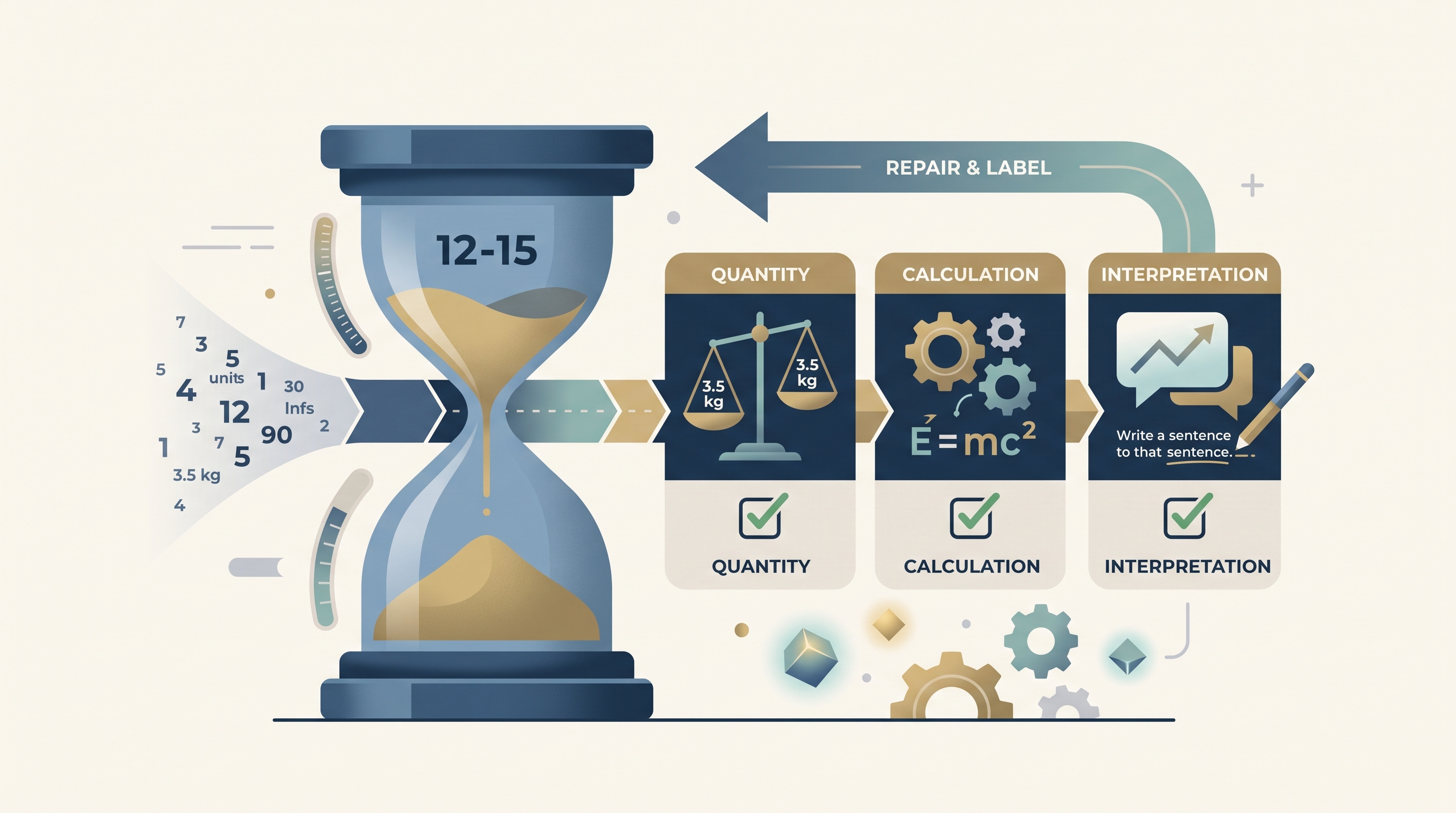
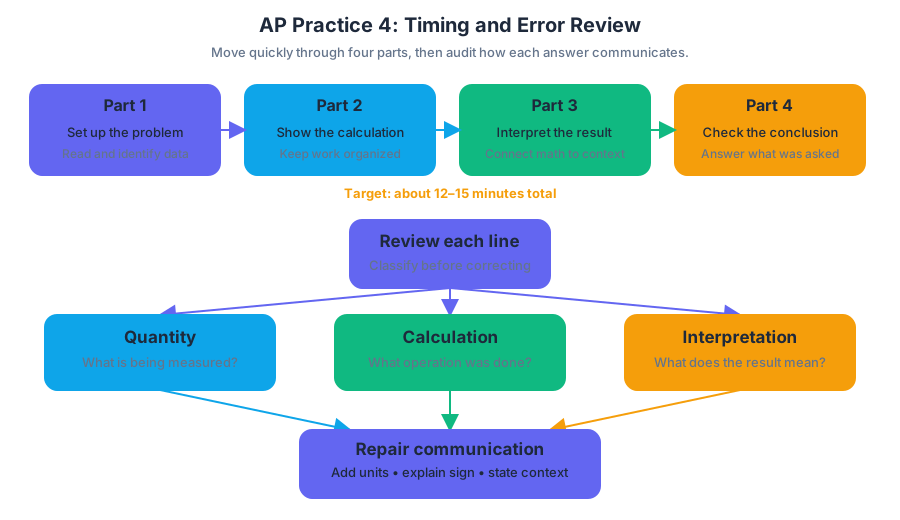
Allow about $12$–$15$ minutes for the four parts. On review, label each line as one of three types: quantity, calculation, or interpretation. If an answer lacks units, a sign explanation, or a contextual sentence, repair that communication even when the numerical work is correct.
Source Materials
- Learn More (.pdf)
- AP Calculus AB and BC Course and Exam Description
- AP Calculus AB Course Overview
- AP Calculus Course at a Glance
- AP Calculus AB and BC Course at a Glance Poster
- Adopt AP Calculus AB
- AP Calculus AB
- AP Calculus AB
- AP Calculus AB-AP Students
- AP/College Calculus AB
- What's the Difference Between AP Calculus AB vs. BC-Princeton Review
- Free AP Calculus Lesson Plans-Math Medic