From the free course AP Calculus AB on Lykke
6.8 Finding Antiderivatives and Indefinite Integrals: Basic Rules and Notation
Key concepts: Antiderivatives as the inverse process of differentiation · Definition of an antiderivative: a function whose derivative is the given function · Indefinite integral notation and the constant of integration · The family of antiderivatives differs by an arbitrary constant C · Finding antiderivatives using basic integration rules · Verifying antiderivatives by differentiating them
What antiderivatives and indefinite integrals are, why they carry a constant of integration, and the basic rules for finding them by reversing derivative rules.
6.8 Finding Antiderivatives and Indefinite Integrals: Basic Rules and Notation
Differentiation starts with a function and produces its rate of change. This topic runs that process backwards: given a rate, find a function it could have come from. That function is an antiderivative, and its notation and basic rules are the working tools for every integral in the rest of the unit.
If $F'(x)=f(x)$, then $F$ is an antiderivative of $f$.
Differentiation and antidifferentiation as inverse processes
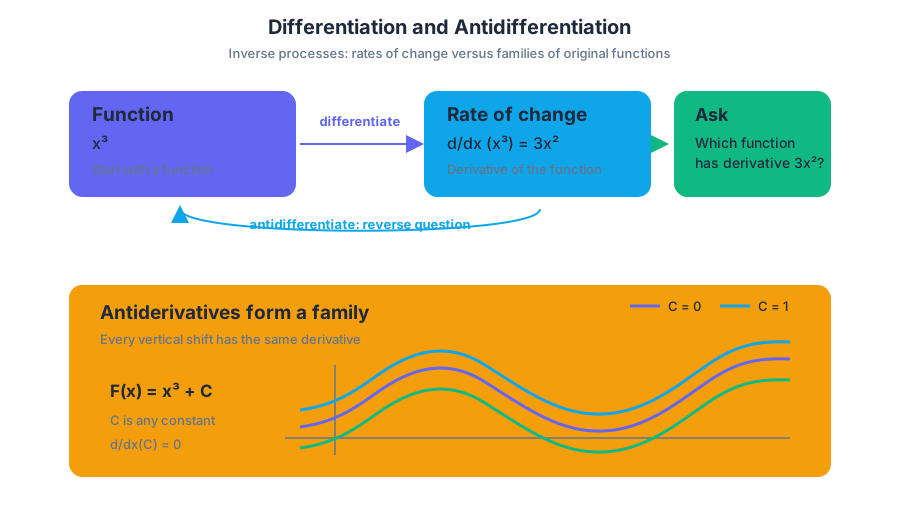
Differentiation takes a function and produces its rate of change. Antidifferentiation asks the reverse question: “Which function has this derivative?” For example, because $$ \frac{d}{dx}\left(x^3\right)=3x^2, $$ the function $x^3$ is an antiderivative of $3x^2$.
The reverse process is not unique. Every function of the form $x^3+C$ has derivative $3x^2$, because the derivative of any constant is zero: $$ \frac{d}{dx}\left(x^3+C\right)=3x^2. $$ Thus, antiderivatives come as a family of functions separated vertically by constant amounts.
Indefinite integrals and the constant of integration
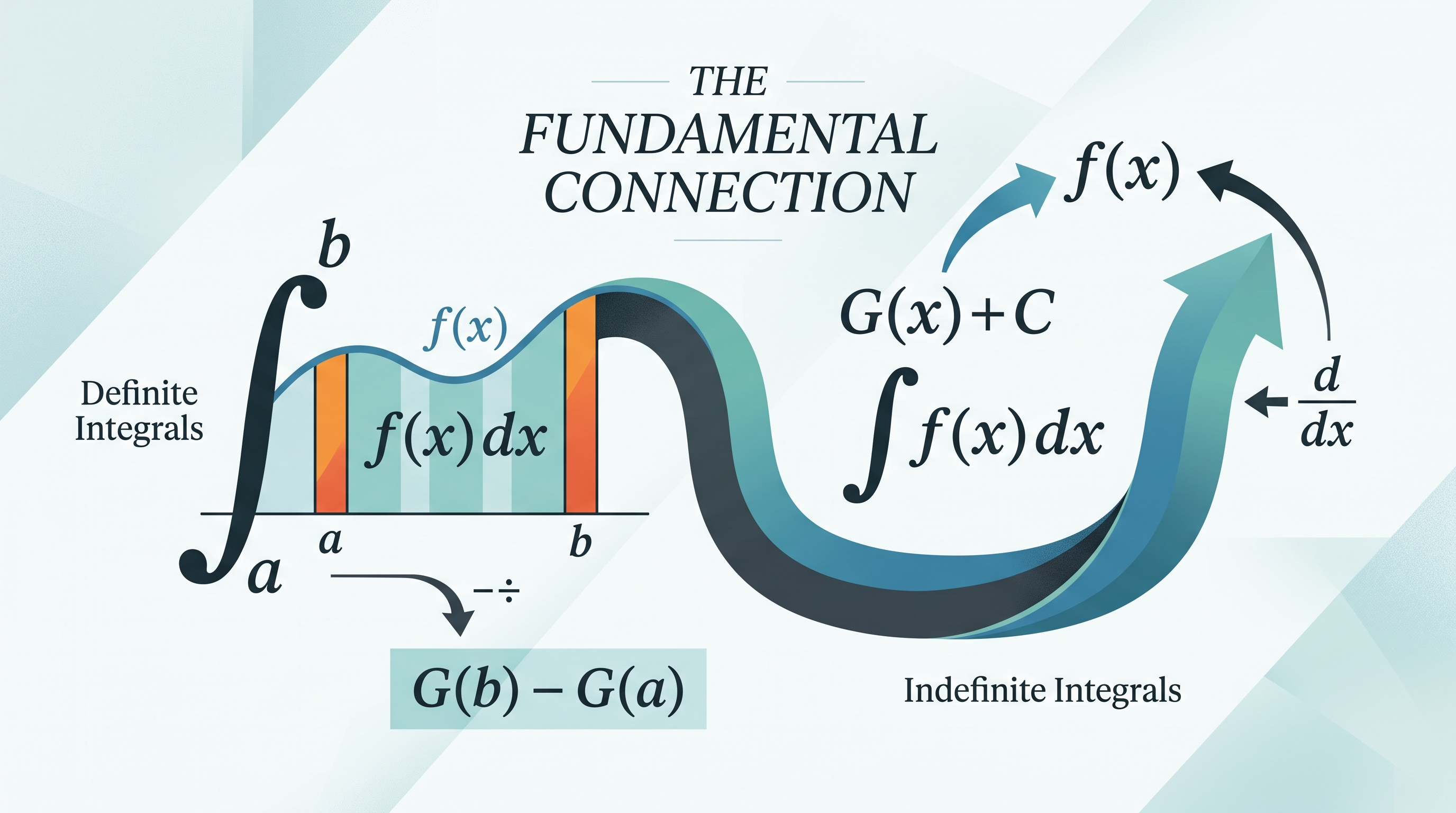
The notation $$ \int f(x),dx $$ is an indefinite integral. It represents the entire family of antiderivatives of $f$, not one particular function. Formally, if $F'(x)=f(x)$, then $$ \int f(x),dx=F(x)+C, $$ where $C$ represents any constant of integration.
For instance, $$ \int 6x^2,dx=2x^3+C, $$ because $$ \frac{d}{dx}\left(2x^3+C\right)=6x^2. $$ The symbol $dx$ identifies the variable of integration. It also reminds us that the operation is connected to reversing differentiation with respect to $x$.
A common misconception is “the constant does not matter, so it can be omitted.” The constant does not affect the derivative, but omitting $+C$ incorrectly turns a family of answers into a single answer. An initial condition, such as $F(2)=5$, can later determine one specific value of $C$.
Basic rules for finding antiderivatives
Differentiation rules provide the foundation for finding antiderivatives. Reverse the power rule: $$ \int x^n,dx=\frac{x^{n+1}}{n+1}+C,\qquad n\ne -1. $$ Use linearity to integrate sums, differences, and constant multiples term by term: $$ \int \left[af(x)+bg(x)\right],dx =a\int f(x),dx+b\int g(x),dx. $$
The basic antiderivatives associated with familiar derivative rules include $$ \int \cos x,dx=\sin x+C, $$ $$ \int \sin x,dx=-\cos x+C, $$ $$ \int e^x,dx=e^x+C, $$ and $$ \int \frac{1}{x},dx=\ln|x|+C. $$
Worked example. Find an indefinite integral: $$ \int \left(4x^3-6x+5\right),dx. $$ Integrate each term: $$ \int 4x^3,dx-\int 6x,dx+\int 5,dx =x^4-3x^2+5x+C. $$ Verification gives $$ \frac{d}{dx}\left(x^4-3x^2+5x+C\right)=4x^3-6x+5, $$ the original integrand, because the constant $C$ has derivative $0$. Therefore, $$ \boxed{\int \left(4x^3-6x+5\right),dx=x^4-3x^2+5x+C}. $$
AP alignment and retrieval check
This topic develops FUN-6.C: Determine antiderivatives of functions and indefinite integrals, using knowledge of derivatives, including FUN-6.C.1 and FUN-6.C.2. The suggested AP skill is 4.C: Use appropriate mathematical symbols and notation. Every basic rule here is a derivative rule read in reverse, and the notation carries meaning: write $dx$, and keep $+C$ on every indefinite integral.
Retrieval check: If a proposed antiderivative of $f(x)$ is $G(x)$, differentiate $G(x)$ and compare the result with $f(x)$. If they match, $G(x)+C$ describes the full indefinite-integral family. For a definite integral, use $G(b)-G(a)$; the two constants cancel.
Source Materials
- Learn More (.pdf)
- AP Calculus AB and BC Course and Exam Description
- AP Calculus AB Course Overview
- AP Calculus Course at a Glance
- AP Calculus AB and BC Course at a Glance Poster
- Adopt AP Calculus AB
- AP Calculus AB
- AP Calculus AB
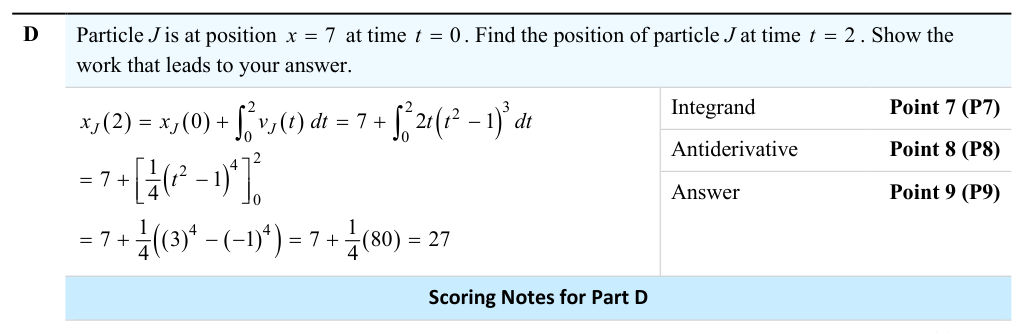
- • To earn P7, a response must present an indefinite or definite integral with an integrand of vJ ( )t or