From the free course AP Calculus AB on Lykke
6.10 Integrating Functions Using Long Division and Completing the Square
Key concepts: Using equivalent algebraic rearrangements to simplify integration · Finding indefinite integrals · Evaluating definite integrals · Integrating functions using polynomial long division · Completing the square before integrating · Applying mathematical rules and procedures with or without technology
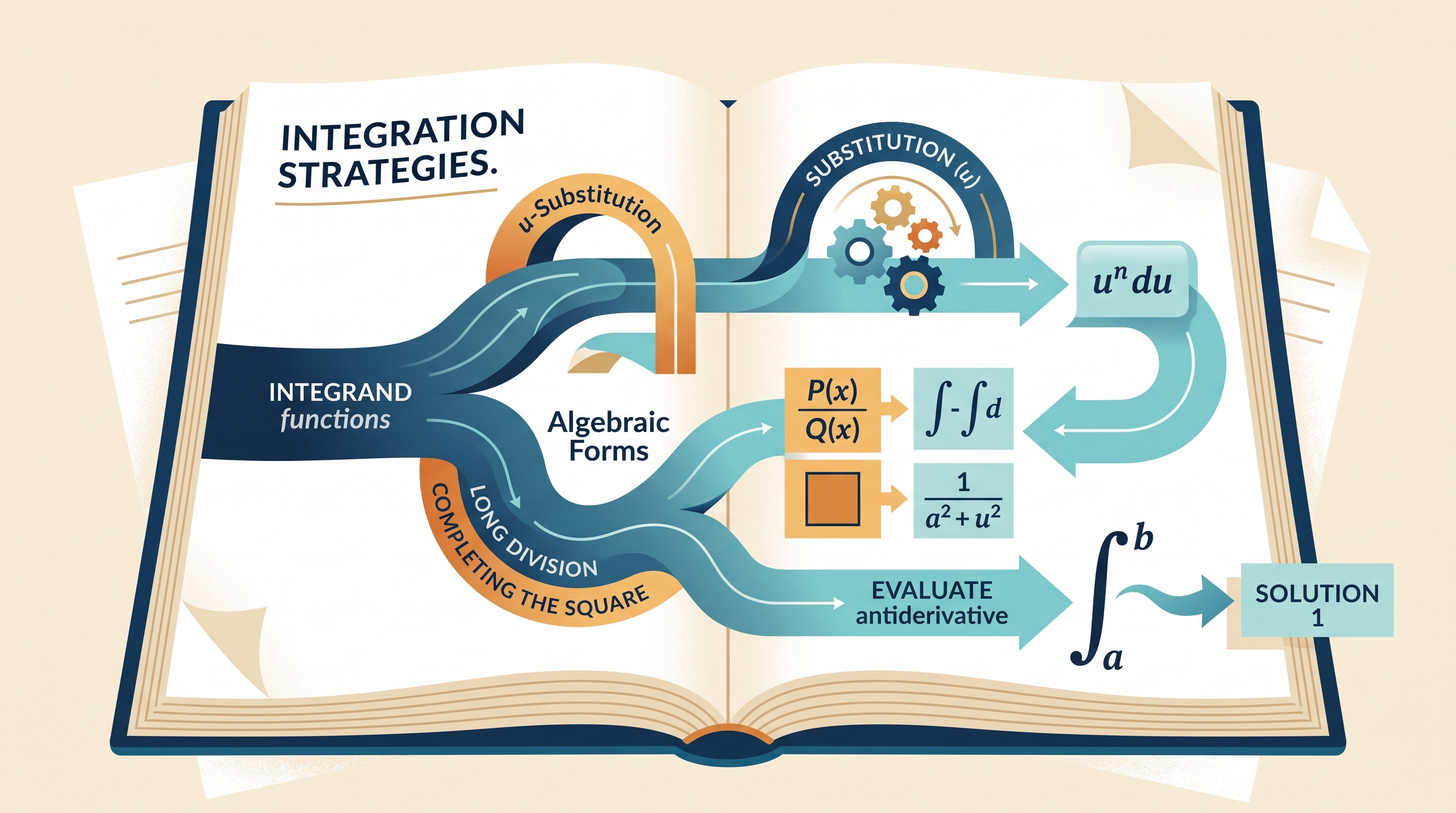
How polynomial long division and completing the square rewrite a rational integrand into forms whose antiderivatives are already known.
6.10 Integrating Functions Using Long Division and Completing the Square
Substitution handles integrands that contain an inner expression together with its derivative. Many rational integrands have no such pair, yet they become routine once the algebra is rewritten. Two rearrangements matter most here: polynomial long division and completing the square.
When algebra must come before integration
Some integrands do not immediately match a basic antiderivative rule. The enduring understanding FUN-6 is that recognizing opportunities to apply mathematical rules can simplify integration. The learning objective FUN-6.D requires determining indefinite integrals and evaluating definite integrals for integrands requiring substitution or rearrangement into equivalent forms. Essential knowledge FUN-6.D.3 specifically includes rearrangements such as polynomial long division and completing the square.
Polynomial long division
When the numerator has degree at least as large as the denominator, divide first. For $$ \int \frac{x^2+3x+2}{x+1},dx, $$ polynomial division gives $$ \frac{x^2+3x+2}{x+1}=x+2. $$ Therefore, $$ \int \frac{x^2+3x+2}{x+1},dx =\int(x+2),dx =\frac12x^2+2x+C. $$ The division exposes an integrand whose terms have familiar antiderivatives.
Division usually leaves a remainder, and a constant remainder over a linear divisor integrates to a logarithm. For example, $\frac{x^2+1}{x+1}=x-1+\frac{2}{x+1}$, so $\int\frac{x^2+1}{x+1},dx=\frac12x^2-x+2\ln|x+1|+C$.
Completing the square
A quadratic can often be rewritten into a form that makes substitution or a standard inverse-tangent pattern visible: $$ x^2+6x+13=(x+3)^2+4. $$ Thus, $$ \int\frac{dx}{x^2+6x+13}
\int\frac{dx}{(x+3)^2+2^2}
\frac12\arctan\left(\frac{x+3}{2}\right)+C. $$ The algebraic rearrangement does not change the function; it changes the function’s appearance so an integration rule can be applied.
AP skill and retrieval check
This topic develops Mathematical Practice 1, Skill 1.E: “Apply appropriate mathematical rules or procedures, with and without technology.” The procedure is not merely calculating: the important decision is selecting substitution, long division, completing the square, or an equivalent algebraic form.
Retrieval check: Which rearrangement comes first for $\int\frac{x^3}{x-1},dx$, and which for $\int\frac{dx}{x^2-4x+8}$? In the first, the numerator's degree exceeds the denominator's, so divide: $\frac{x^3}{x-1}=x^2+x+1+\frac{1}{x-1}$. In the second, complete the square: $x^2-4x+8=(x-2)^2+4$, which gives $\frac12\arctan\left(\frac{x-2}{2}\right)+C$.
Source Materials
- Learn More (.pdf)
- AP Calculus AB and BC Course and Exam Description
- AP Calculus AB Course Overview
- AP Calculus Course at a Glance
- AP Calculus AB and BC Course at a Glance Poster
- Adopt AP Calculus AB
- AP Calculus AB
- AP Calculus AB
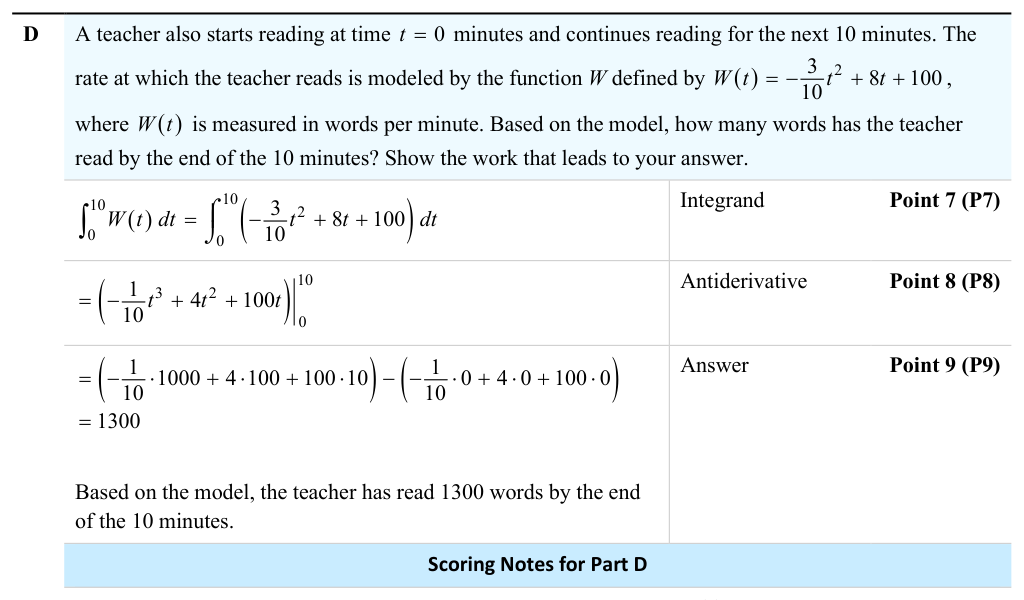
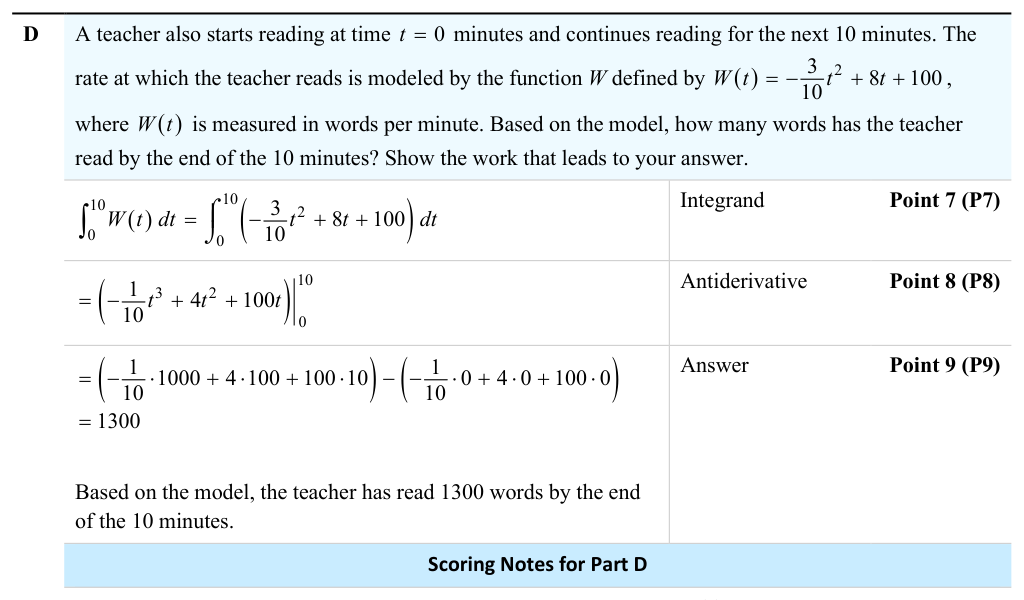
- • P7 is earned for an indefinite or definite integral with integrand W(t) , with or without the
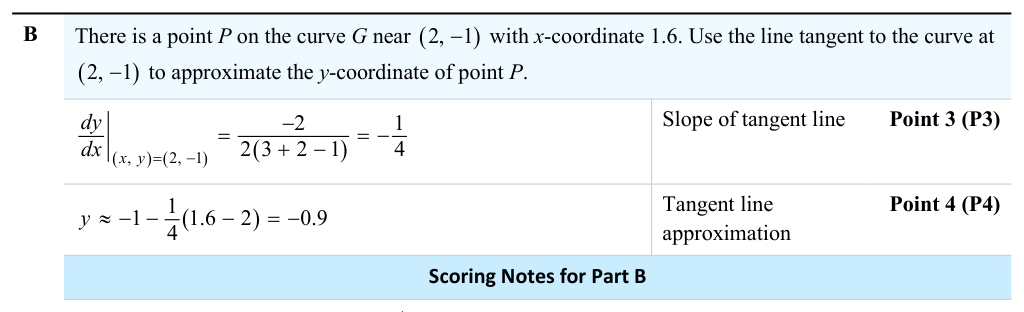
- • A response can earn P3 with dy 1 dy 1 = − , = − dx (x y , )=(2, −1) 4 dx 4 , “slope is 1 −4 ,” or equivalent.
- • P7 is earned for an indefinite or definite integral with integrand W(t) , with or without the