From the free course AP Calculus AB on Lykke
8.13 Arc Length of a Smooth, Planar Curve and Distance Traveled (BC only)
Key concepts: Arc length as the accumulation of infinitesimal changes in length over an interval · Arc length of a smooth planar curve represented as y=f(x) · Arc length of a parametrically represented curve · Particle speed as the magnitude of its velocity vector · Total distance traveled versus displacement · Using different representations to relate mathematical characteristics and properties · Specifying the interval and endpoints when setting up an arc-length integral
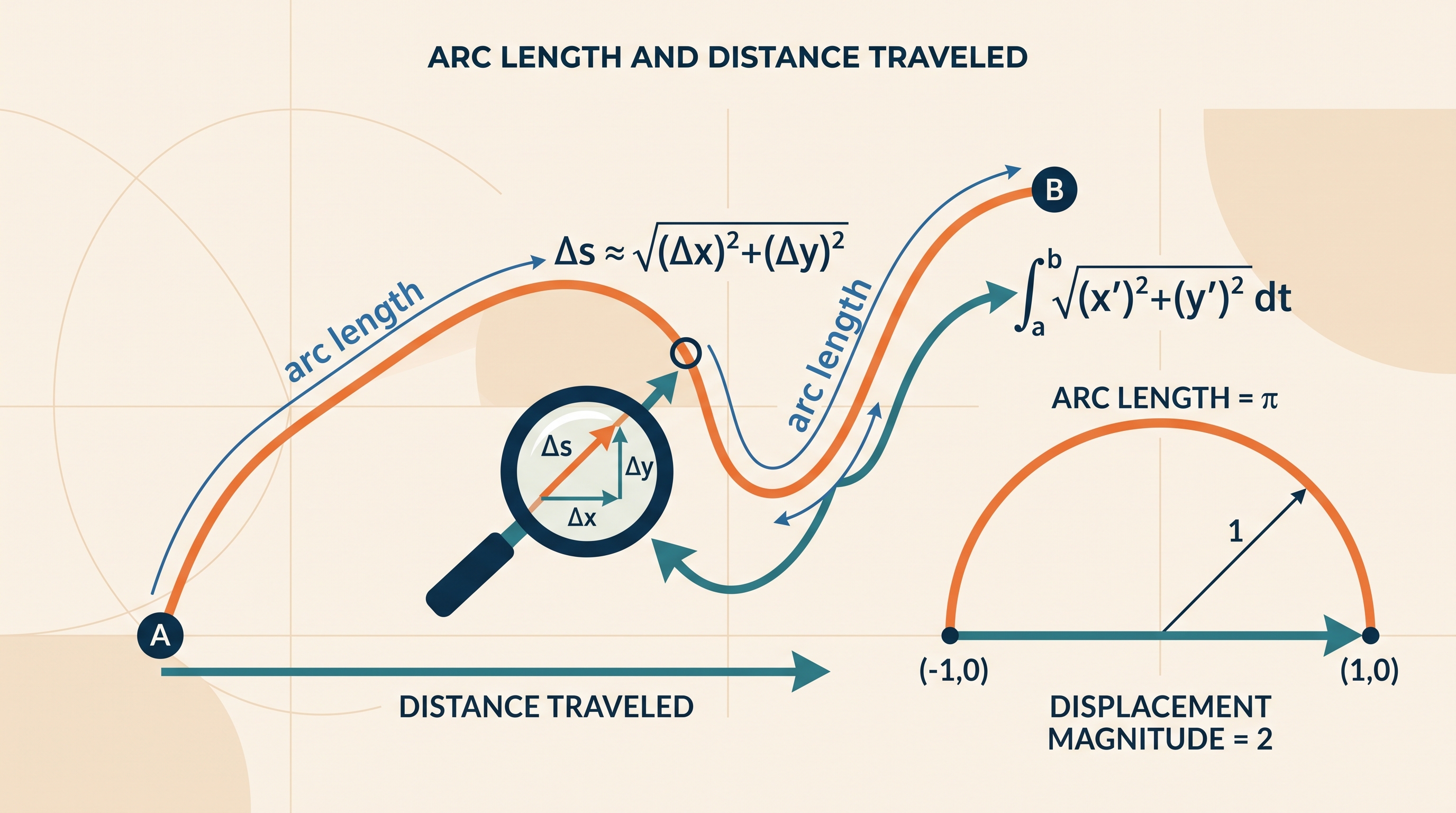
A curve can be much longer than the straight-line distance between its endpoints because every tiny turn contributes additional length. Arc length measures the accumulated length of a smooth planar path, while particle distance measures the accumulated magnitude of motion.
8.13 Arc Length of a Smooth, Planar Curve and Distance Traveled (BC only)
A curve can be much longer than the straight-line distance between its endpoints because every tiny turn contributes additional length. Arc length measures the accumulated length of a smooth planar path, while particle distance measures the accumulated magnitude of motion.
Enduring Understanding CHA-6: Definite integrals allow us to solve problems involving the accumulation of change in length over an interval.
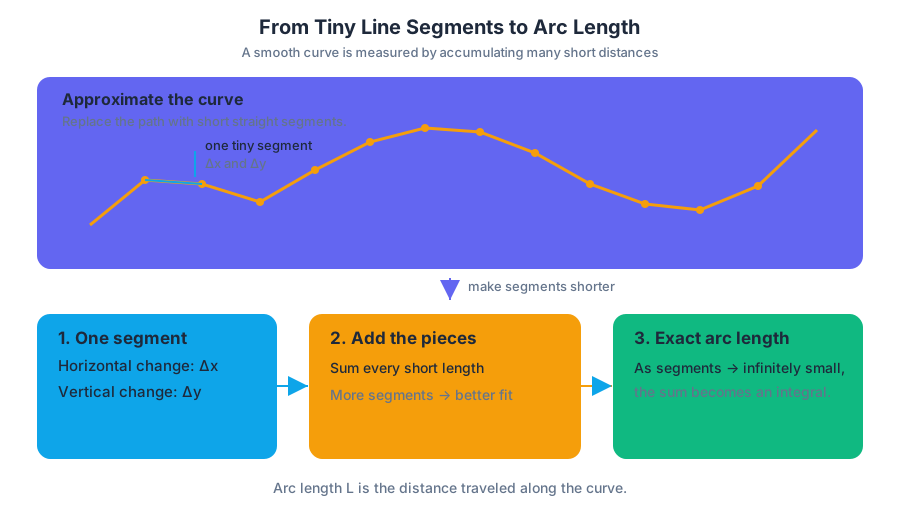
From tiny line segments to arc length
Imagine replacing a curved path with many short straight segments. If one segment changes horizontally by $\Delta x$ and vertically by $\Delta y$, its length is approximately
$$ \sqrt{(\Delta x)^2+(\Delta y)^2}. $$
As the segments become infinitely short, their sum approaches the exact arc length. The definite integral performs this accumulation continuously.
Arc length when $y=f(x)$
For a smooth curve $y=f(x)$ on the interval $[a,b]$, the vertical change associated with a small horizontal change $dx$ is approximately $dy=f'(x),dx$. Substituting these changes into the distance formula gives
$$ ds=\sqrt{(dx)^2+(dy)^2} =\sqrt{1+\left(\frac{dy}{dx}\right)^2},dx. $$
Therefore, the arc length is
$$ \boxed{L=\int_a^b\sqrt{1+[f'(x)]^2},dx}. $$
The interval is part of the answer. Writing only
$$ \int\sqrt{1+[f'(x)]^2},dx $$
does not specify which portion of the curve is being measured.
Worked example: a rising cable
A cable follows the curve $y=x^2$ for $0\le x\le1$. Its derivative is $f'(x)=2x$, so the length is
$$ L=\int_0^1\sqrt{1+(2x)^2},dx =\int_0^1\sqrt{1+4x^2},dx. $$
This integral may require numerical evaluation. A calculator gives
$$ L\approx 1.479. $$
The horizontal distance is only $1$, and the vertical rise is also $1$; the curved cable is longer than either individual change.
Misconception check — “Arc length is just the integral of the derivative.” The integral $\int_a^b f'(x),dx$ gives net vertical change, not path length. Arc length requires the Pythagorean factor $\sqrt{1+[f'(x)]^2}$, which counts both horizontal and vertical changes.
Parametric curves: one formula for length and speed
When a curve is represented parametrically by
$$ x=x(t),\qquad y=y(t),\qquad a\le t\le b, $$
the changes over a small time interval are $dx=x'(t),dt$ and $dy=y'(t),dt$. Thus,
$$ \boxed{L=\int_a^b\sqrt{[x'(t)]^2+[y'(t)]^2},dt}. $$
The same expression has a motion interpretation. For a particle with position vector
$$ \mathbf r(t)=\langle x(t),y(t)\rangle, $$
the velocity vector is
$$ \mathbf v(t)=\langle x'(t),y'(t)\rangle, $$
and its speed, the magnitude of velocity, is
$$ \boxed{\text{speed}=\sqrt{[x'(t)]^2+[y'(t)]^2}}. $$
Consequently, total distance traveled from $t=a$ to $t=b$ is
$$ \boxed{D=\int_a^b\sqrt{[x'(t)]^2+[y'(t)]^2},dt}. $$
Distance traveled versus displacement
Displacement describes the net change from the initial position to the final position:
$$ \Delta\mathbf r=\mathbf r(b)-\mathbf r(a). $$
The magnitude of displacement is the straight-line distance between those two positions. Distance traveled follows the entire path and is therefore generally at least as large as the magnitude of displacement.
For example, let
$$ x(t)=t^2,\qquad y(t)=t,\qquad 0\le t\le1. $$
The particle begins at $(0,0)$ and ends at $(1,1)$, so
$$ |\Delta\mathbf r|=\sqrt{1^2+1^2}=\sqrt2. $$
Its speed is
$$ \sqrt{(2t)^2+1^2}=\sqrt{4t^2+1}, $$
so its total distance is
$$ D=\int_0^1\sqrt{4t^2+1},dt\approx1.479. $$
Thus $D\ne|\Delta\mathbf r|$.
Misconception check — “Integrating velocity gives distance.” Integrating the velocity vector gives displacement. Distance requires integrating speed, the nonnegative magnitude of velocity. In one-dimensional motion this distinction appears as
$$ \text{displacement}=\int_a^b v(t),dt, \qquad \text{distance}=\int_a^b |v(t)|,dt. $$
Recovering position from velocity
If velocity is known, position is recovered by integration. Suppose
$$ \mathbf v(t)=\langle 2t,1\rangle, \qquad \mathbf r(0)=\langle3,-2\rangle. $$
Integrating component by component gives
$$ \mathbf r(t)=\langle t^2+C_1,t+C_2\rangle. $$
Applying the initial-position condition $\mathbf r(0)=\langle3,-2\rangle$ yields $C_1=3$ and $C_2=-2$, so
$$ \mathbf r(t)=\langle t^2+3,t-2\rangle. $$
The initial condition is essential: velocity determines how position changes, but not the starting location.
Representations and AP skill connection
Topic 8.13 develops Suggested Skill 3.D: Apply an appropriate mathematical definition, theorem, or test by selecting the correct arc-length or distance formula and using the full interval. It also develops 2.D: Identify how mathematical characteristics or properties of functions are related in different representations: the graph shows the path, the parametric equations describe coordinates, derivatives give velocity, and the integral accumulates length.
Retrieval check: A particle travels from $t=0$ to $t=\pi$ with
$$ x(t)=\cos t,\qquad y(t)=\sin t. $$
Its speed is
$$ \sqrt{(-\sin t)^2+(\cos t)^2}=1, $$
so the distance traveled is
$$ \int_0^\pi1,dt=\pi. $$
The particle traces a semicircle of radius $1$, whose arc length is also $\pi$. What is the magnitude of its displacement? It is $2$, confirming that path length and displacement magnitude are different quantities.