From the free course AP Calculus AB on Lykke
1.14 Connecting Infinite Limits and Vertical Asymptotes
Key concepts: Connecting infinite limits and vertical asymptotes · Discontinuities caused by vertical asymptotes · Continuity at a point · Using the definition of continuity
What an infinite limit means, how one-sided infinite limits identify a vertical asymptote, and how to tell an asymptote from a removable hole.
1.14 Connecting Infinite Limits and Vertical Asymptotes
Topic 1.13 dealt with discontinuities that one well-chosen value can repair. This page covers a failure that no value can repair: near certain inputs a function's outputs grow without bound. Limit notation is extended to describe that behavior, and on the graph it appears as a vertical asymptote.
Infinite limits and vertical asymptotes
A vertical asymptote is a vertical line $x=a$ that the graph approaches while function values grow without bound. The corresponding notation is an infinite limit:
$$ \lim_{x\to a^-}f(x)=\infty, \qquad \lim_{x\to a^+}f(x)=-\infty, $$
or another appropriate one-sided combination. The symbol $\infty$ describes unbounded behavior; it is not an ordinary number that the function reaches.
For example,
$$ h(x)=\frac{1}{(x-2)^2} $$
satisfies
$$ \lim_{x\to 2^-}h(x)=\infty \qquad\text{and}\qquad \lim_{x\to 2^+}h(x)=\infty. $$
Therefore, $x=2$ is a vertical asymptote. No definition of the single value $h(2)$ can make the function continuous there, because nearby outputs are unbounded rather than approaching one finite target.
For a rational function, a zero of the denominator produces a vertical asymptote only if it survives cancellation: $\frac{x^2-9}{x-3}$ has a hole at $x=3$, while $\frac{1}{x-3}$ has an asymptote there. The sign of a one-sided infinite limit comes from the signs of the pieces. For $r(x)=\frac{x+2}{x-5}$, the numerator is near $7$, and the denominator is small and negative just left of $5$ but small and positive just right of $5$. So $\lim_{x\to5^-}r(x)=-\infty$ and $\lim_{x\to5^+}r(x)=\infty$, and either statement justifies the asymptote $x=5$.
Misconception check — “A vertical asymptote means the limit equals infinity.” More precisely, an infinite limit means that function values exceed every bound as $x$ approaches the input value from the specified side. Since $\infty$ is not a real output, the two-sided limit is not a finite limit even when both sides tend toward $\infty$.
Hole or asymptote?
Retrieval check: For
$$ p(x)=\frac{x^2-16}{x-4}, $$
identify the discontinuity at $x=4$, determine whether it is removable, and state the value that repairs it. Then compare with
$$ q(x)=\frac{1}{x-4}. $$
The first function has a removable discontinuity because its simplified rule is $x+4$ and the missing value is $8$. The second has a vertical asymptote at $x=4$ because its one-sided values are unbounded; it cannot be repaired by assigning a finite value.
Source Materials
- Learn More (.pdf)
- AP Calculus AB and BC Course and Exam Description
- AP Calculus AB Course Overview
- AP Calculus Course at a Glance
- AP Calculus AB and BC Course at a Glance Poster
- Adopt AP Calculus AB
- AP Calculus AB
- AP Calculus AB
- Total for part (d) 1 point
- linear approximation also earns the first point.
- Total for part (d) 1 point
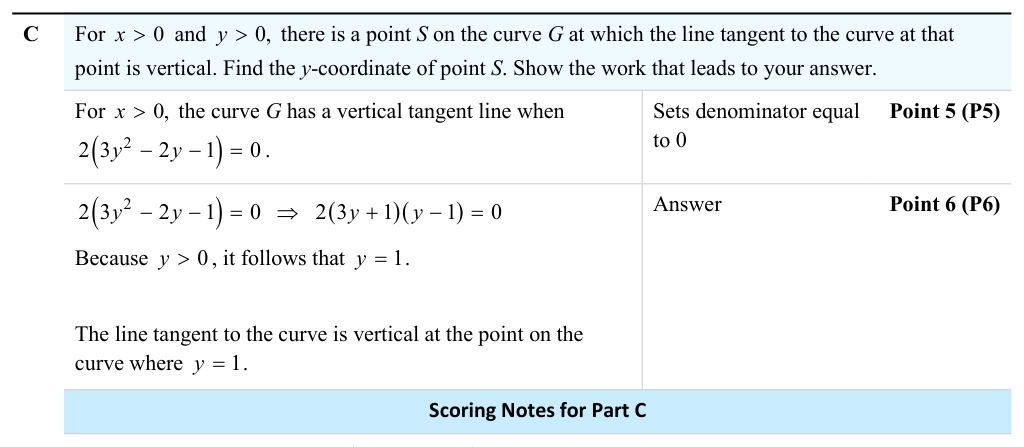
- • P5 is earned with any of 2 3( y y 2 −2 − = 1) 0 , 3y y 2 −2 − = 1 0 , 2 3 ( y y ± 1)( ± = 1) 0 , or