From the free course AP Calculus AB on Lykke
1.15 Connecting Limits at Infinity and Horizontal Asymptotes
Key concepts: Limits at infinity · Horizontal asymptotes · Limits and continuity · Graphical, numerical, analytical, and verbal representations · Geometric series · Finite sums of infinite geometric series
What limits at infinity say about end behavior, how they produce horizontal asymptotes, and how to evaluate them for rational functions and compare growth rates.
1.15 Connecting Limits at Infinity and Horizontal Asymptotes
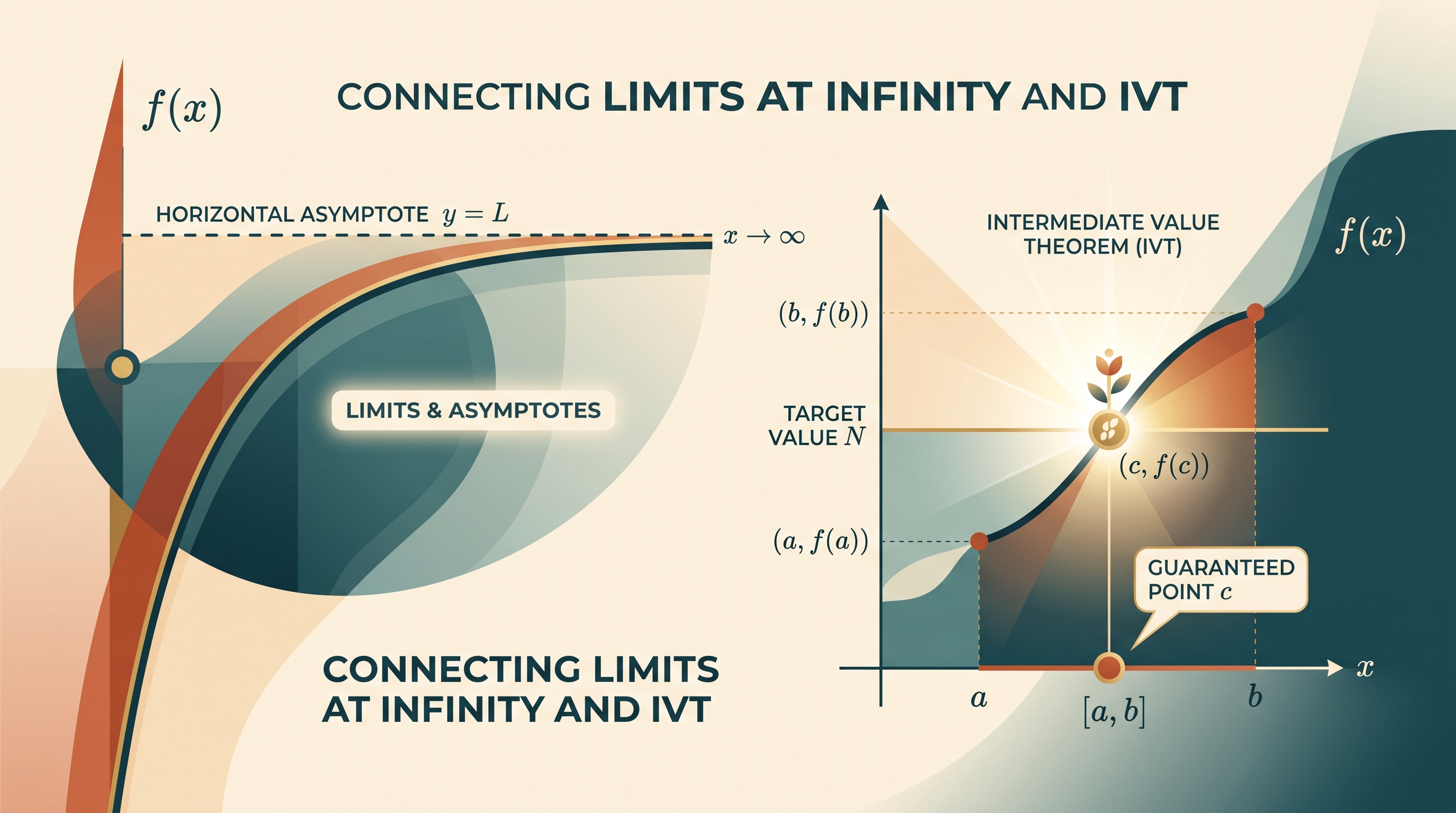
A function can keep changing forever while its output settles toward a fixed value. That “destination” is described by a limit at infinity, and the corresponding graph feature is a horizontal asymptote.
Limits at infinity and end behavior
The statement
$$ \lim_{x\to\infty}f(x)=L $$
means that $f(x)$ approaches $L$ as $x$ increases without bound. Similarly,
$$ \lim_{x\to-\infty}f(x)=L $$
describes what happens as $x$ decreases without bound. These are statements about end behavior, not about the value of the function at any finite input.
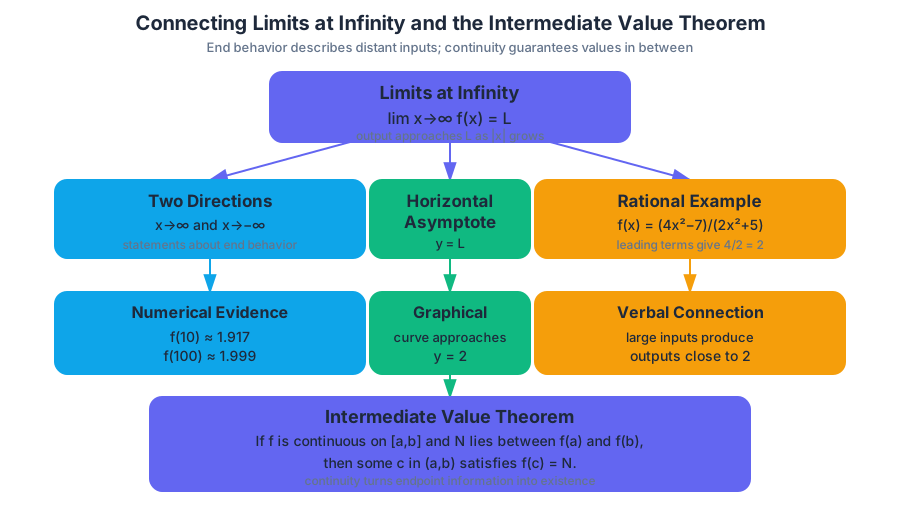
Horizontal asymptote: The line $y=L$ is a horizontal asymptote of $f$ if $\lim_{x\to\infty}f(x)=L$ or $\lim_{x\to-\infty}f(x)=L$.
For example, consider
$$ f(x)=\frac{4x^2-7}{2x^2+5}. $$
Divide numerator and denominator by $x^2$:
$$ f(x)=\frac{4-\frac{7}{x^2}}{2+\frac{5}{x^2}}. $$
As $x\to\infty$ or $x\to-\infty$, both $\frac{7}{x^2}$ and $\frac{5}{x^2}$ approach $0$, so
$$ \lim_{x\to\pm\infty}f(x)=\frac{4}{2}=2. $$
Therefore, $y=2$ is a horizontal asymptote.
The same conclusion appears in several representations:
- Analytical: the highest-degree terms give $\frac{4x^2}{2x^2}=2$.
- Numerical: $f(10)=\frac{393}{205}\approx1.917$, while $f(100)\approx1.999$.
- Graphical: the curve approaches the line $y=2$ at both ends.
- Verbal: for very large positive or negative inputs, the output becomes close to $2$.
This is the suggested skill 2.D Connecting Representations: Identify how mathematical characteristics or properties of functions are related in different representations.
The essential knowledge for Topic 1.15 is LIM-2.D.3, which extends limits to infinity; LIM-2.D.4, which connects limits at infinity with end behavior; and LIM-2.D.5, which uses limits to compare relative magnitudes and rates of change. For instance,
$$ \lim_{x\to\infty}\frac{x^2}{e^x}=0 $$
shows analytically that exponential growth eventually dominates quadratic growth. The graph and a sufficiently far-right table should show the ratio approaching $0$ as well.
A related limit appears when adding a finite number of terms from a geometric pattern. If
$$ S_n=1+r+r^2+\cdots+r^{n-1} =\frac{1-r^n}{1-r}, $$
then for $|r|<1$, the term $r^n$ approaches $0$ as $n\to\infty$. Thus,
$$ \lim_{n\to\infty}S_n=\frac{1}{1-r}. $$
The limit describes the eventual value approached by the finite sums; it is not obtained by simply substituting infinity into the formula.
Retrieval check: Find $\lim_{x\to\infty}\frac{5x+1}{x^2+4}$ and name the horizontal asymptote. Dividing every term by $x^2$ gives $\frac{5/x+1/x^2}{1+4/x^2}$, which approaches $\frac{0}{1}=0$. The asymptote is $y=0$: the denominator's higher degree makes it grow faster than the numerator.
Source Materials
- Learn More (.pdf)
- AP Calculus AB and BC Course and Exam Description
- AP Calculus AB Course Overview
- AP Calculus Course at a Glance
- AP Calculus AB and BC Course at a Glance Poster
- Adopt AP Calculus AB
- AP Calculus AB
- AP Calculus AB
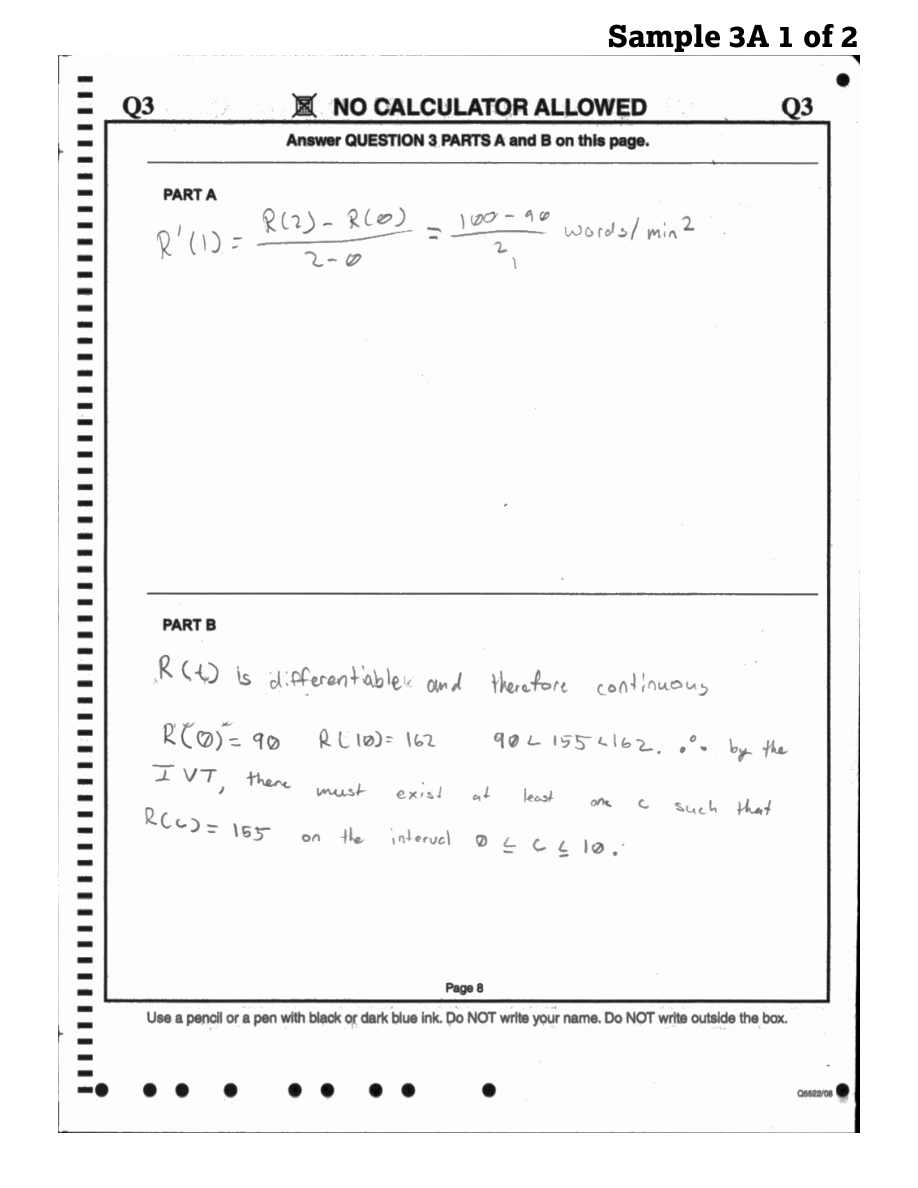
- Figure — Sample Responses Q3 (p. 6)
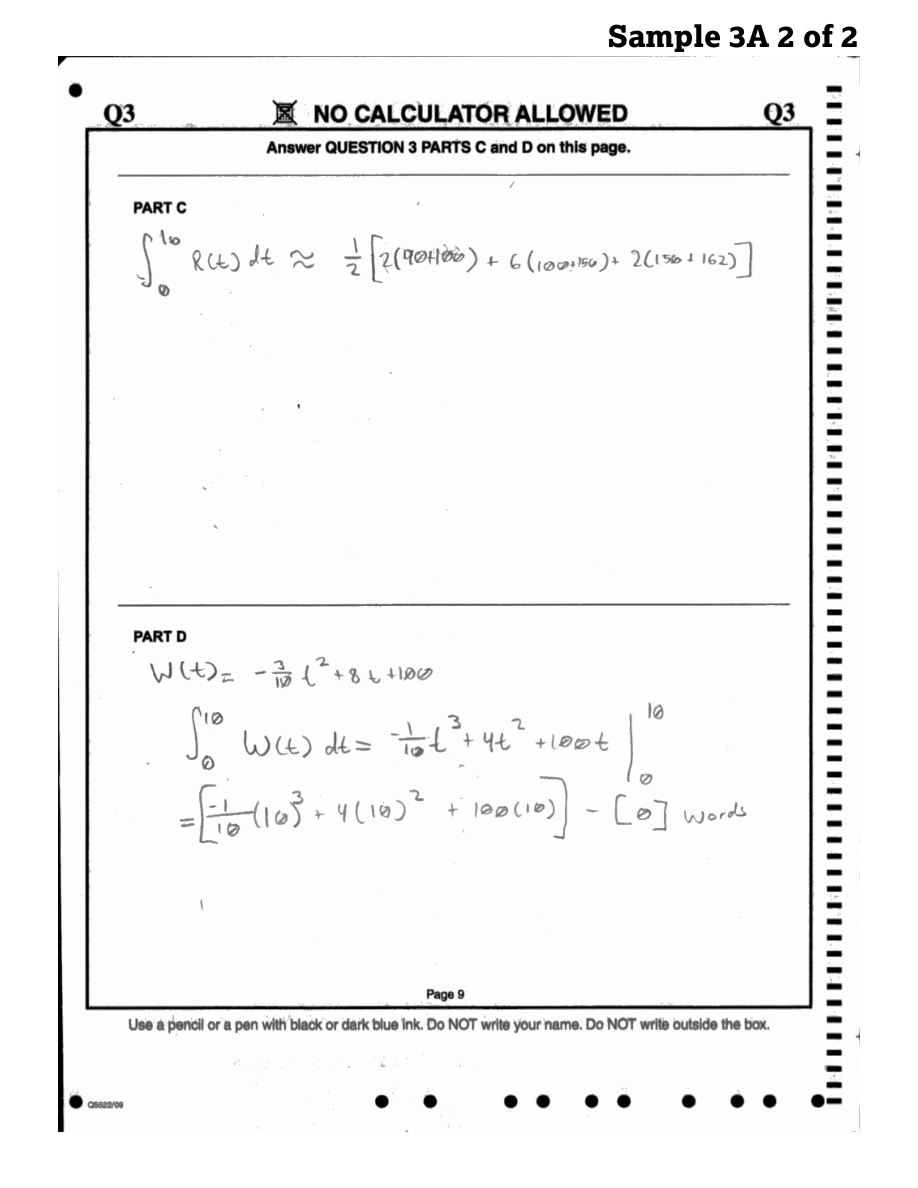
- Figure — Sample Responses Q3 (p. 7)
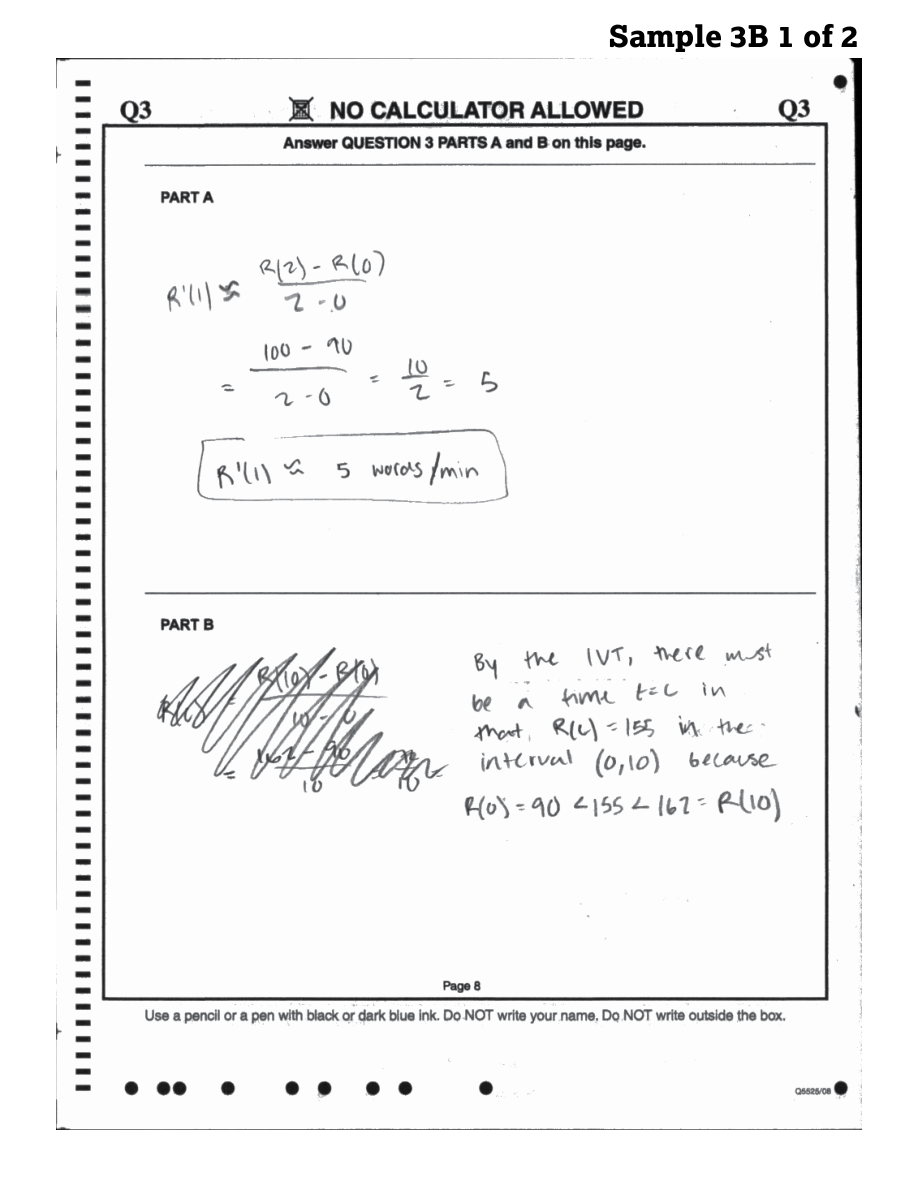
- Figure — Sample Responses Q3 (p. 8)
- Figure — Sample Responses Q3 (p. 9)