From the free course AP Calculus AB on Lykke
5.6 Determining Concavity of Functions over Their Domains
Key concepts: Concavity of functions · Intervals of upward concavity · Intervals of downward concavity · Using derivatives to determine function behavior · Applying mathematical definitions, theorems, and tests · Justifying conclusions about extrema and concavity
How the sign of the second derivative determines the intervals on which a function is concave upward or concave downward.
5.6 Determining Concavity of Functions over Their Domains
Two graphs can both be rising and still look nothing alike: one bends upward and climbs ever faster, while the other bends downward and levels off. Concavity names that bend. This page shows how the sign of $f''$ identifies it on each interval of a function's domain.
A graph’s first derivative tells whether the function is rising or falling; its second derivative tells how that rise or fall is changing. This is the difference between a road climbing at a steady grade and a road whose grade is becoming steeper.
FUN-4: A function’s derivative can be used to understand some behaviors of the function.
FUN-4.A: Justify conclusions about the behavior of a function based on the behavior of its derivatives.
FUN-4.B: Determine intervals on which a function is concave upward or downward.
FUN-4.B.1: The second derivative of a function provides information about the behavior of the first derivative.
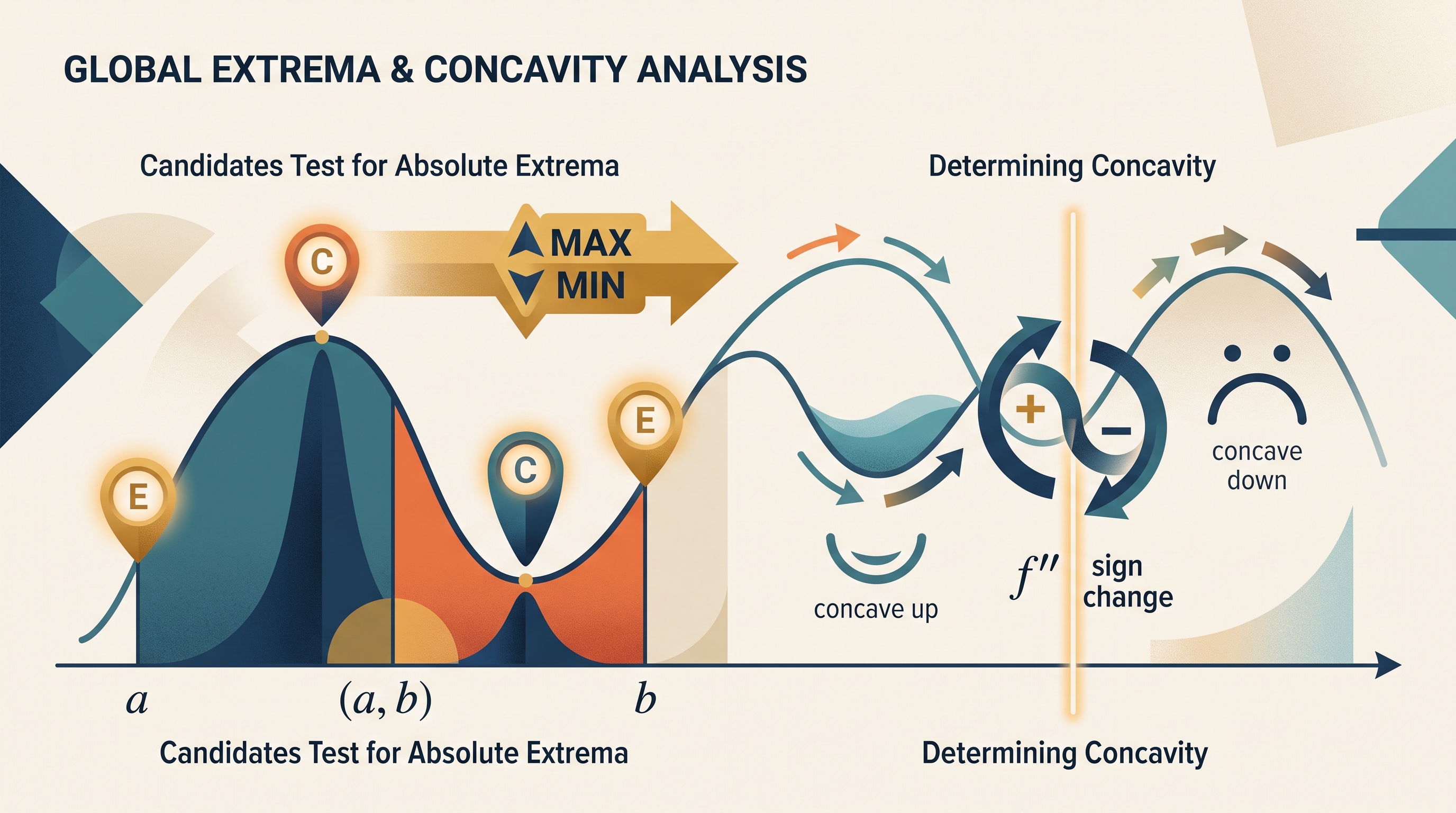
A function is concave upward on an interval when its slopes are increasing from left to right. A function is concave downward when its slopes are decreasing from left to right. When the second derivative exists, the standard test is:
$$ f''(x)>0 \quad \Longrightarrow \quad f\text{ is concave upward}, $$
$$ f''(x)<0 \quad \Longrightarrow \quad f\text{ is concave downward}. $$
Finding intervals of concavity
To determine concavity over the domain, find $f''(x)$, locate values where $f''(x)=0$ or $f''(x)$ does not exist, and use those values to divide the domain into intervals. Then determine the sign of $f''$ on each interval and state the conclusion in words.
Worked example: a concavity sign chart
For
$$ g(x)=x^3-6x^2+4, $$
we have
$$ g'(x)=3x^2-12x \qquad\text{and}\qquad g''(x)=6x-12=6(x-2). $$
The possible concavity boundary is $x=2$. Testing the intervals:
$$ \begin{array}{c|c|c} \text{Interval} & \text{Sign of }g''(x) & \text{Concavity}\ \hline (-\infty,2) & g''(x)<0 & \text{concave downward}\ (2,\infty) & g''(x)>0 & \text{concave upward} \end{array} $$
A precise justification is: “Since $g''(x)=6(x-2)$ is negative for $x<2$, $g$ is concave downward on $(-\infty,2)$. Since $g''(x)$ is positive for $x>2$, $g$ is concave upward on $(2,\infty)$.” The value $x=2$ separates intervals; it is not itself an interval of concavity.
Misconception check — “$f''(x)=0$ means there is an inflection point.” It does not. The sign of $f''$ must change across the value. Here, $g''$ changes from negative to positive at $x=2$, so the graph changes from downward to upward concavity. Merely solving $f''(x)=0$ is not enough.
Retrieval check
For absolute extrema of a continuous function on $[a,b]$, which values must be compared? For concavity, what must happen to the sign of $f''$ before claiming a change in concavity? Answer: compare the function at every critical point in $(a,b)$ and at both endpoints; a concavity change requires the sign of $f''$ to change across the boundary value.