From the free course AP Calculus AB on Lykke
7.1 Modeling Situations with Differential Equations
Key concepts: Modeling situations with differential equations
How to translate a verbal description of a changing quantity into a differential equation, including the sign and units of the proportionality constant.
7.1 Modeling Situations with Differential Equations
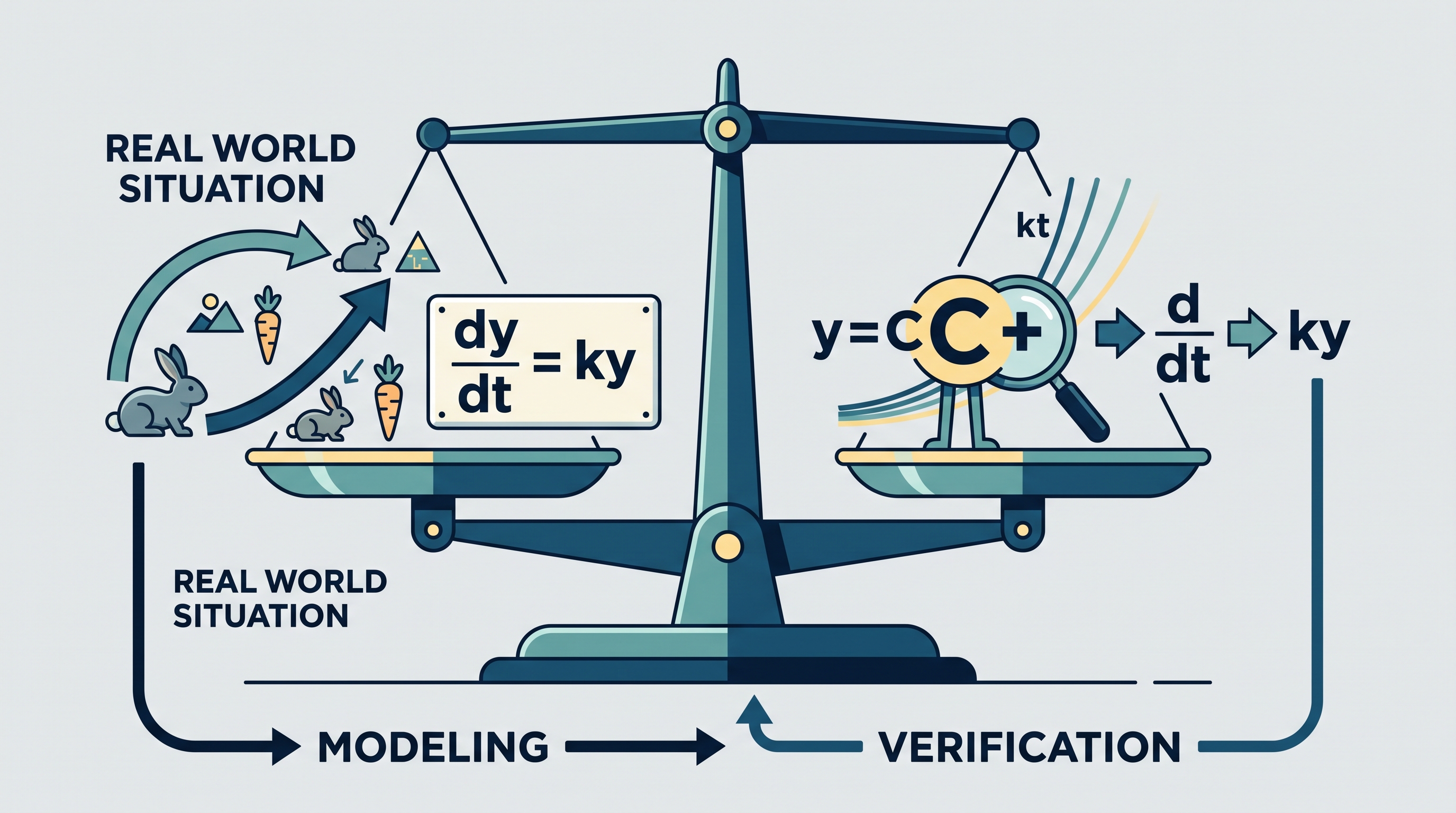
A differential equation does not usually tell you a function directly; it tells you how the function must change. That makes it a compact model of growth, motion, cooling, population change, or any situation in which a quantity’s rate depends on other quantities.
Investigative question: If you know a quantity’s rate of change, how can you describe the quantity itself—and how can you prove that a proposed function really works?
From words to a differential equation
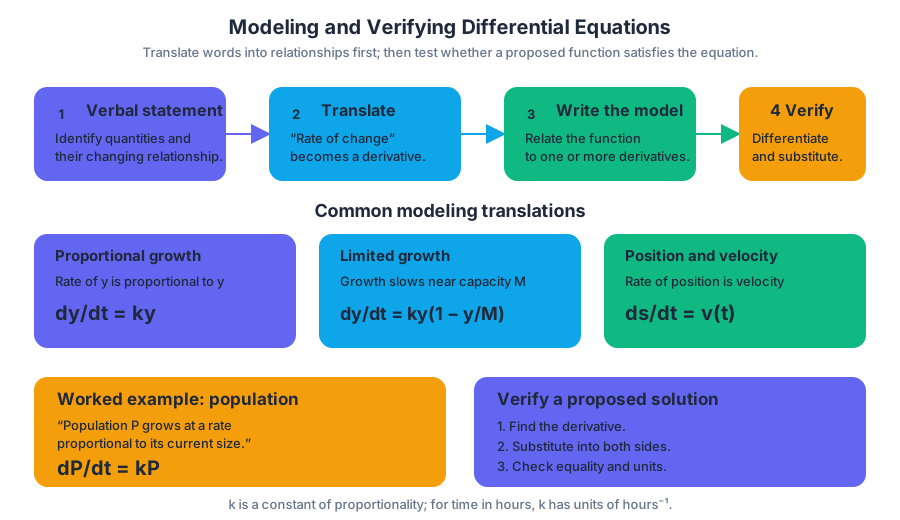
A differential equation is an equation involving an unknown function and one or more of its derivatives. To model a situation, translate the verbal description into relationships among quantities before attempting to solve anything.
| Verbal statement | Mathematical model |
|---|---|
| The rate of change of $y$ with respect to $t$ is proportional to $y$ | $\dfrac{dy}{dt}=ky$ |
| The rate of change of $y$ is proportional to the amount of $y$ and decreases as $y$ approaches a capacity | $\dfrac{dy}{dt}=ky\left(1-\dfrac{y}{M}\right)$ |
| The rate of change of position is velocity | $\dfrac{ds}{dt}=v(t)$ |
In these models, $k$ is a constant of proportionality, $t$ is often time, and $M$ may represent a limiting capacity. The equation $\dfrac{dy}{dt}=ky$ says that the relative rate of change is constant: a larger amount of $y$ produces a larger absolute change.
Worked modeling example. A population $P$ grows at a rate proportional to its current size. Because “rate of change” means a derivative and “with respect to time” means differentiation by $t$, the model is
$$ \frac{dP}{dt}=kP. $$
If the population decreases rather than grows, then $k<0$. If it grows, then $k>0$. The sign and units matter: if $P$ is measured in organisms and $t$ in hours, then $k$ has units of hours$^{-1}$, so that $kP$ has units of organisms per hour.
Writing the equation is the modeling step. Checking that a proposed function actually satisfies it is the work of Topic 7.2.
AP skills in action
Topic 7.1 develops Skill 2.C: Use appropriate mathematical procedures by translating verbal relationships into differential equations and using antidifferentiation appropriately. Topic 7.2 develops Skill 3.G: Confirm that solutions are accurate and appropriate by differentiating a proposed function and checking the original equation.
Retrieval check: A cup of coffee at temperature $T$ cools at a rate proportional to the difference between $T$ and the room temperature of $20$ °C. Write a differential equation for $T$. One model is $\dfrac{dT}{dt}=k(T-20)$ with $k<0$: the derivative is the rate, $T-20$ is the quantity the rate is proportional to, and the negative constant makes a cup that is hotter than the room cool down.
Source Materials
- Learn More (.pdf)
- AP Calculus AB and BC Course and Exam Description
- AP Calculus AB Course Overview
- AP Calculus Course at a Glance
- AP Calculus AB and BC Course at a Glance Poster
- Adopt AP Calculus AB
- AP Calculus AB
- AP Calculus AB
- AP Calculus AB-AP Students
- AP/College Calculus AB
- What's the Difference Between AP Calculus AB vs. BC-Princeton Review
- Free AP Calculus Lesson Plans-Math Medic