From the free course AP Calculus AB on Lykke
2.5 Applying the Power Rule
Key concepts: Applying the power rule · Using appropriate mathematical rules and procedures to calculate derivatives · Differentiating familiar functions · Combining the power rule with sum and difference rules
How to differentiate any power of x, including negative and fractional exponents, by bringing the exponent forward and reducing it by one, and where the rule's domain conditions matter.
2.5 Applying the Power Rule
The power rule turns the derivative of a power function into a mechanical calculation: bring the exponent forward, then reduce the exponent by $1$. Together with the constant, sum, difference, and constant multiple rules, it transforms a complicated-looking polynomial into a short list of familiar derivatives.
The power rule
For a real exponent $r$, on the domain where the expression $x^r$ is defined and differentiable,
$$ \frac{d}{dx}\left(x^r\right)=rx^{r-1}. $$
The domain qualification matters. For example, $x^{1/2}$ is real-valued only when $x\ge 0$, and its derivative formula is applied on the interior of that domain, where the function is differentiable. Likewise, negative or fractional exponents may create excluded inputs or endpoint restrictions.
A useful visual pattern is:
$$ \boxed{x^r} \quad\longrightarrow\quad \boxed{r\cdot x^{r-1}} $$
The exponent moves into the coefficient slot; the exponent itself decreases by $1$.
For a polynomial term such as $7x^5$, first apply the power rule to $x^5$, then preserve the coefficient $7$:
$$ \frac{d}{dx}(7x^5) =7\frac{d}{dx}(x^5) =7(5x^4) =35x^4. $$
For a negative exponent,
$$ \frac{d}{dx}\left(x^{-3}\right) =-3x^{-4}. $$
For a fractional exponent,
$$ \frac{d}{dx}\left(x^{1/2}\right) =\frac12x^{-1/2}. $$
The rule changes the exponent; it does not multiply the entire expression by an unrelated quantity.
Rewrite first, then differentiate
Many expressions are powers in disguise. Rewrite roots and reciprocals with exponents before differentiating: $\sqrt[3]{x}=x^{1/3}$ has derivative $\frac13x^{-2/3}$, and $\frac{1}{x^2}=x^{-2}$ has derivative $-2x^{-3}$. The simplest case follows the same pattern: $\frac{d}{dx}(x)=1\cdot x^0=1$. The rule also agrees with the limit definition: for $x^2$, the difference quotient $\frac{(x+h)^2-x^2}{h}=2x+h$ approaches $2x$.
Misconception check
Misconception: “The derivative of $7x^4$ is $4x^3$.”
The exponent rule gives the derivative of $x^4$, not of the whole term. The coefficient must remain:
$$ \frac{d}{dx}(7x^4)=7(4x^3)=28x^3. $$
Retrieval check
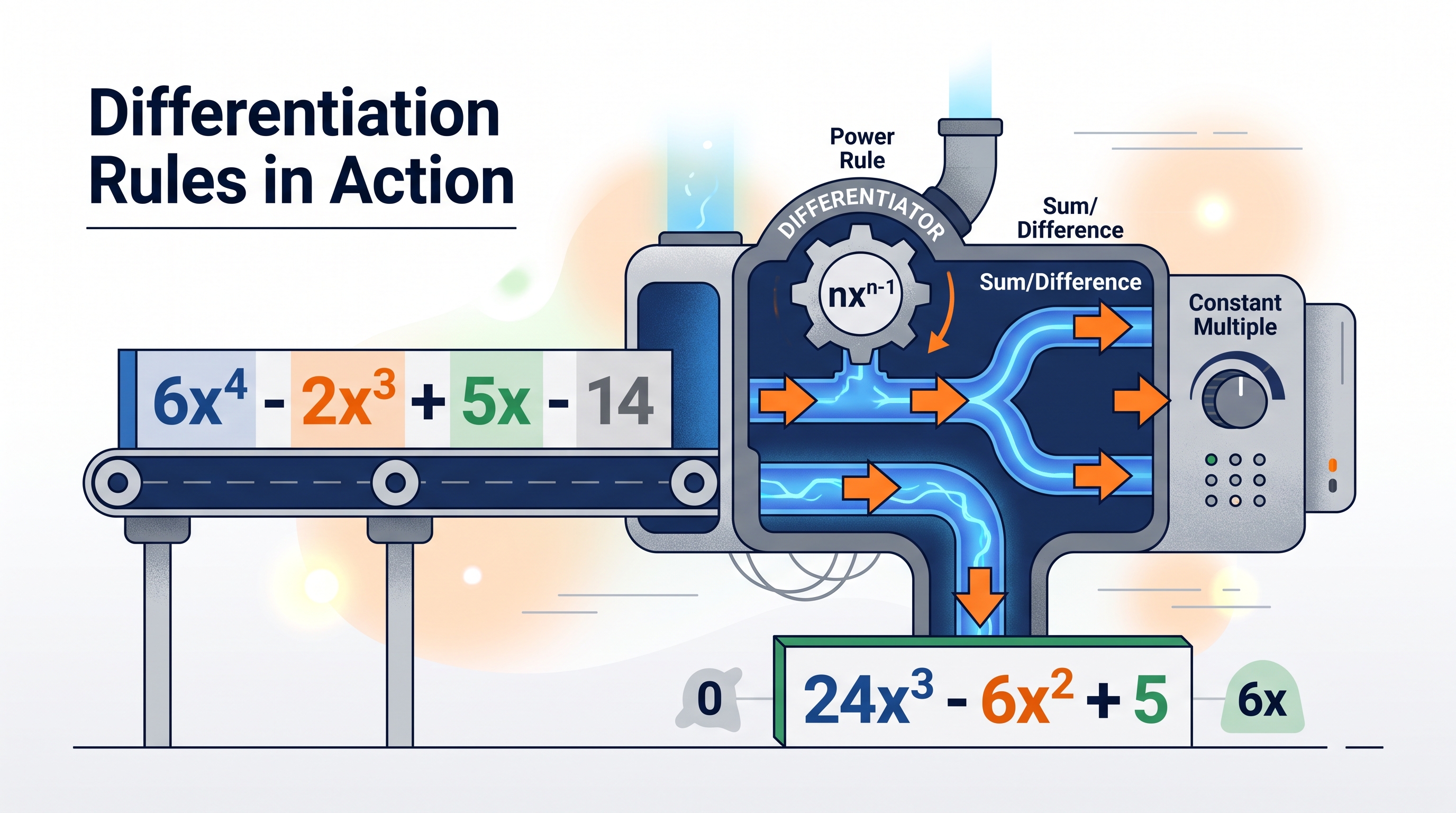
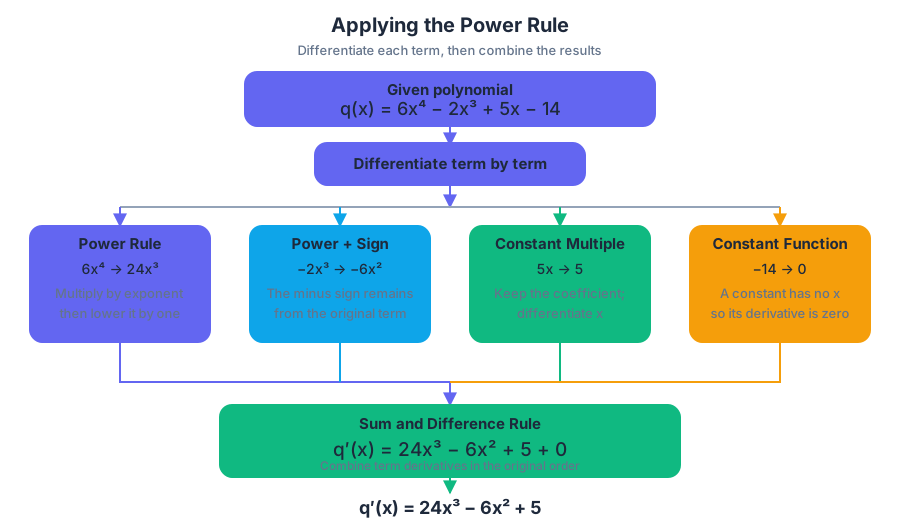
This check is a full polynomial. Its terms are joined by the sum, difference and constant multiple rules of Topic 2.6, but every nonconstant term is a direct use of the power rule.
Differentiate
$$ q(x)=6x^4-2x^3+5x-14. $$
Apply the power rule, sum and difference rules, constant multiple rule, and constant-function rule:
$$ \boxed{q'(x)=24x^3-6x^2+5}. $$
If a coefficient or sign changes in your answer, identify the original term that caused it before continuing.
Source Materials
- Learn More (.pdf)
- AP Calculus AB and BC Course and Exam Description
- AP Calculus AB Course Overview
- AP Calculus Course at a Glance
- AP Calculus AB and BC Course at a Glance Poster
- Adopt AP Calculus AB
- AP Calculus AB
- AP Calculus AB
- • P7 is earned for implicitly differentiating 2xy + ln y 8 = with respect to t with at most one error.