From the free course AP Calculus AB on Lykke
4.1 Interpreting the Meaning of the Derivative in Context
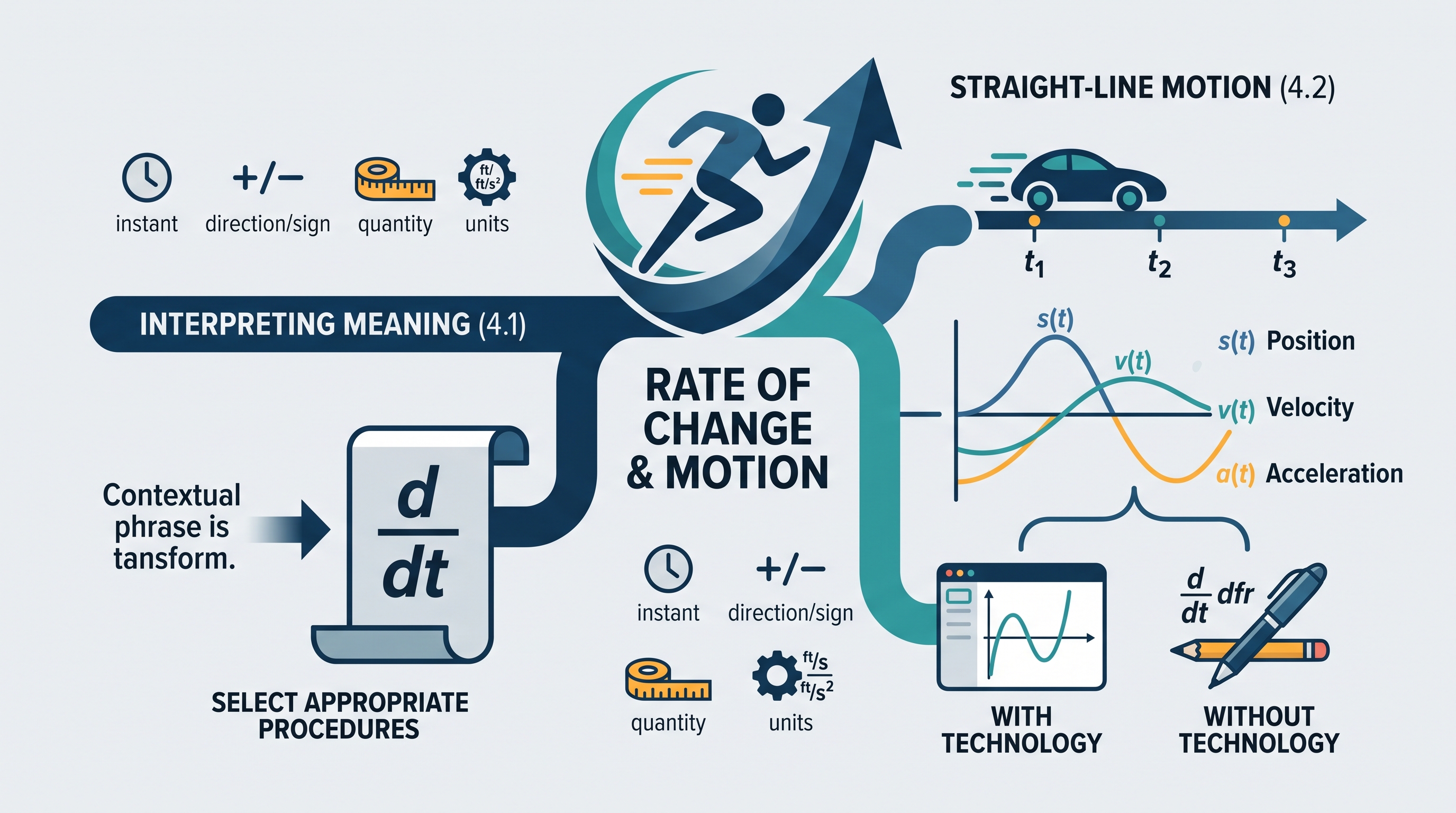
Key concepts: Interpreting the derivative in context · Derivative as a rate of change · Careful reading of contextual language such as “find the rate of change” · Real-world applications of derivatives · Using representations to describe changing quantities
How to read a derivative in a real-world setting as an instantaneous rate, stating the quantity, the instant, the direction of change and the units.
4.1 Interpreting the Meaning of the Derivative in Context
A derivative measures how quickly one quantity changes with respect to another at a particular instant. If $C(t)$ represents acres affected by an invasive species, then $C'(t)$ tells how rapidly the affected area is changing at time $t$—not merely how much area exists.
The derivative is a rate with meaning and units
This topic belongs to CHA-3: Derivatives allow us to solve real-world problems involving rates of change. Its essential knowledge says a derivative is the instantaneous rate of change of a function with respect to its independent variable, that it expresses information about rates of change in applied contexts, and that the unit for $f'(x)$ is the unit for $f$ divided by the unit for $x$.
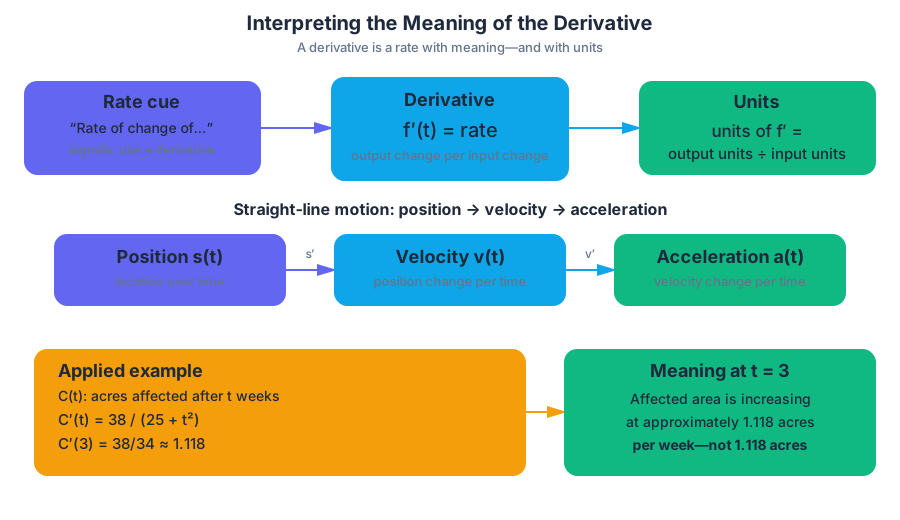
A phrase such as “find the rate of change of…” is a strong cue to use a derivative. The units of the derivative come from dividing the units of the output by the units of the input:
$$ \text{units of } f'(t)=\frac{\text{units of }f}{\text{units of }t}. $$
For example, suppose $C(t)=7.6\arctan(0.2t)$ measures acres affected $t$ weeks after an invasive species appears. If
$$ C'(t)=\frac{38}{25+t^2}, $$
then at $t=3$,
$$ C'(3)=\frac{38}{25+3^2}=\frac{38}{34}\approx 1.118. $$
The correct interpretation is: three weeks after appearing, the affected area is increasing at approximately $1.118$ acres per week. The answer is not $1.118$ acres, because $C'(3)$ measures a rate, not an amount.
A reliable interpretation pattern
When interpreting a derivative in context, identify four parts:
- Quantity: What does the function measure?
- Instant: At what input value is the derivative evaluated?
- Change: Is the quantity increasing or decreasing?
- Units: What units result from output units divided by input units?
The sign matters. If $f'(a)>0$, the quantity is increasing at the instant $a$. If $f'(a)<0$, it is decreasing. If $f'(a)=0$, the quantity has zero instantaneous rate of change—but this alone does not prove that the quantity is at a maximum or minimum.
Misconception check — “decreasing” versus “decreasing faster.” If $f'(t)<0$, then $f$ is decreasing. If $f''(t)<0$, then the rate $f'(t)$ is decreasing. These are different claims: a quantity can still be increasing while its rate of increase becomes smaller.
Choosing the procedure from the wording
The suggested skill for Topic 4.1 is 1.D: Identify an appropriate mathematical rule or procedure based on the relationship between concepts. In this setting, the relationship is “rate of change means derivative,” so a contextual phrase determines the procedure.
Retrieval check: $W(t)$ is the volume of water in a tank, in gallons, $t$ minutes after a valve opens. What are the units of $W'(t)$? If $W'(10)=-3$, state its meaning in context.
Answer: $W'(t)$ is measured in gallons per minute. The value $W'(10)=-3$ means that $10$ minutes after the valve opens, the volume of water in the tank is decreasing at $3$ gallons per minute.
Source Materials
- Learn More (.pdf)
- AP Calculus AB and BC Course and Exam Description
- AP Calculus AB Course Overview
- AP Calculus Course at a Glance
- AP Calculus AB and BC Course at a Glance Poster
- Adopt AP Calculus AB
- AP Calculus AB
- AP Calculus AB
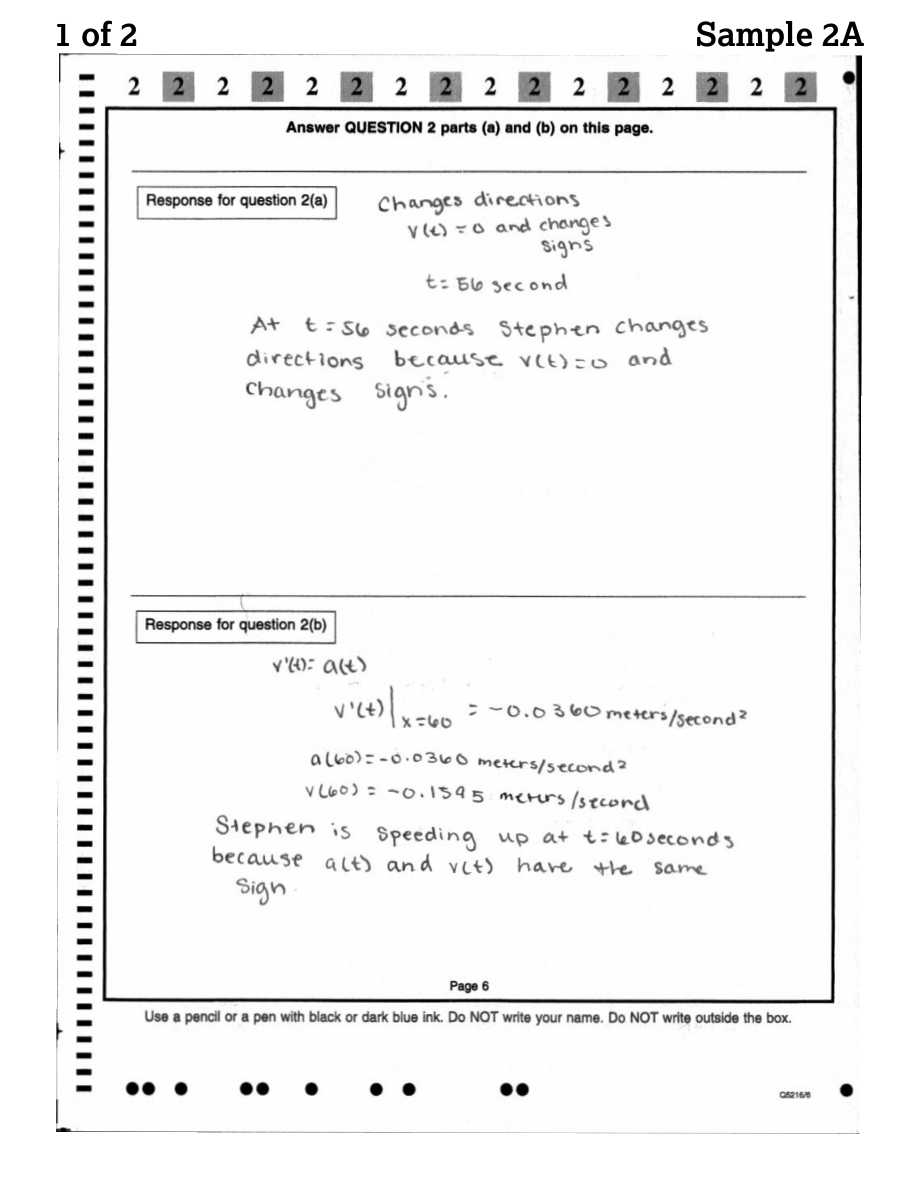
- Figure — Sample Responses Q2 (p. 5)
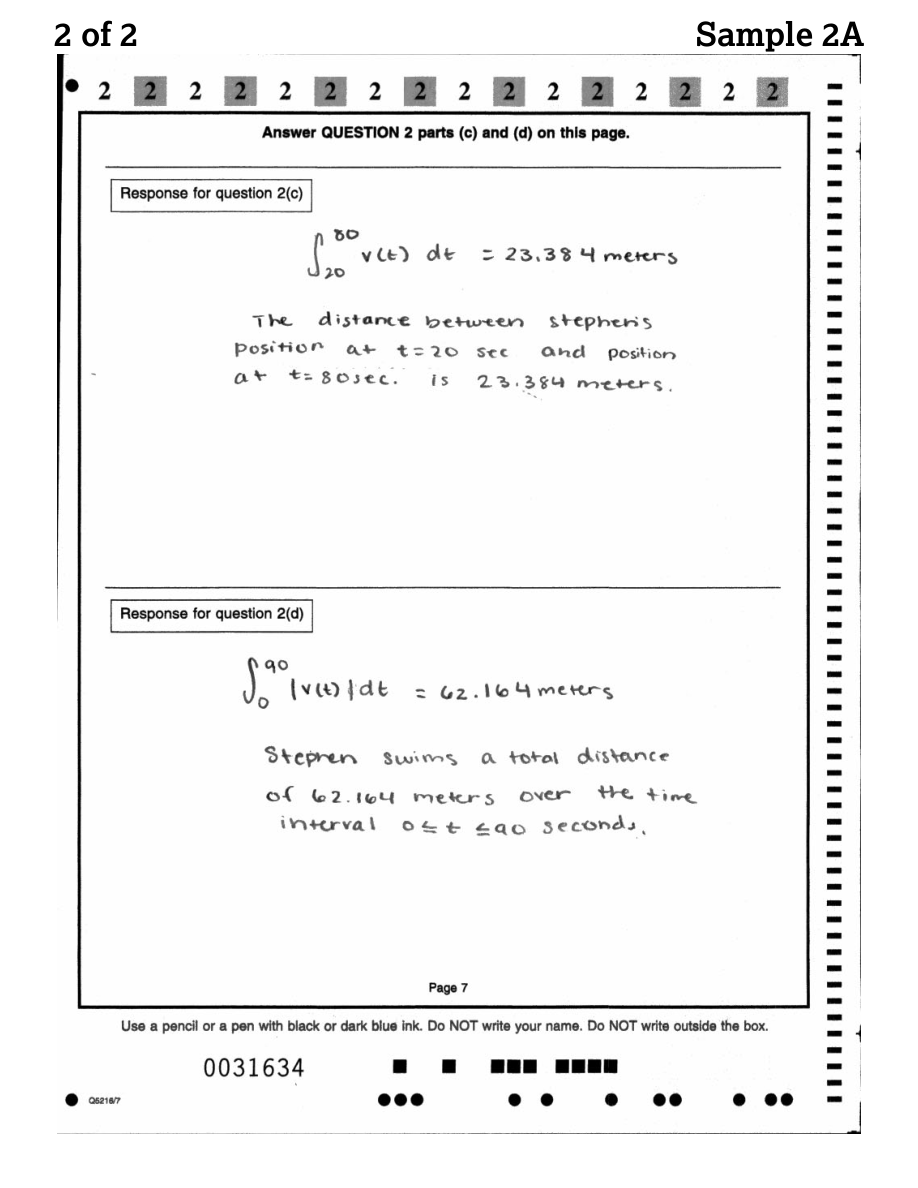
- Figure — Sample Responses Q2 (p. 6)
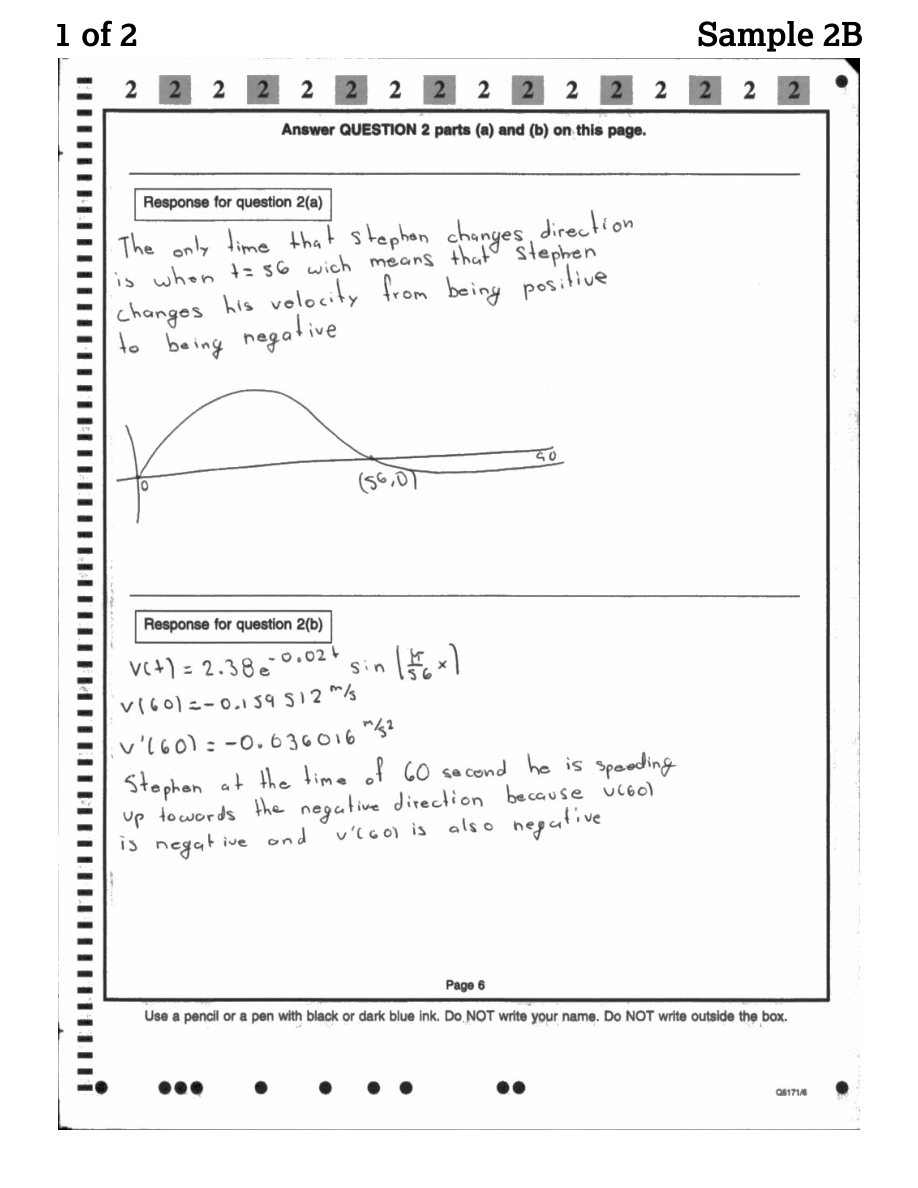
- Figure — Sample Responses Q2 (p. 7)
- Figure — Sample Responses Q2 (p. 8)