From the free course AP Calculus AB on Lykke
5.5 Using the Candidates Test to Determine Absolute (Global) Extrema
Key concepts: Candidates Test for determining absolute (global) extrema · Critical points · Endpoints of a closed interval · Absolute extrema on a closed interval · Using derivatives to determine function behavior · Applying mathematical definitions, theorems, and tests · Justifying conclusions about extrema and concavity
How the Candidates Test finds absolute extrema on a closed interval by comparing function values at interior critical points and at both endpoints.
5.5 Using the Candidates Test to Determine Absolute (Global) Extrema
An absolute maximum is the greatest value a function reaches on a specified domain, while an absolute minimum is the least value it reaches. On a closed interval, these global extrema can occur only at two kinds of locations: critical points inside the interval and the endpoints.
FUN-4.A.3: Absolute (global) extrema of a function on a closed interval can only occur at critical points or at endpoints.
The word candidate matters: a critical point or endpoint is not automatically a maximum or minimum. It is simply a location that must be tested. The Candidates Test turns that idea into a finite comparison.
The Candidates Test on a closed interval
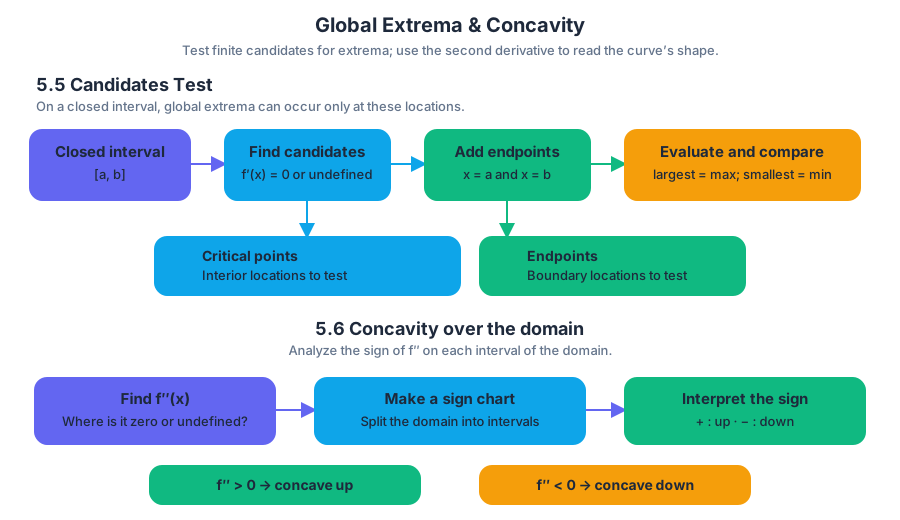
For a function $f$ that is continuous on the closed interval $[a,b]$, use this procedure:
- Find all critical points in $(a,b)$: values of $x$ where $f'(x)=0$ or where $f'(x)$ does not exist.
- Keep only the critical points that lie in the interval.
- Evaluate $f$ at every critical point and at both endpoints, $x=a$ and $x=b$.
- Compare the resulting function values.
The largest value is the absolute maximum, and the smallest value is the absolute minimum. The theorem behind the procedure is the Extreme Value Theorem: continuity on a closed interval guarantees that absolute extrema exist, and the Candidates Test identifies where they can occur.
Worked example: comparing every candidate
Let
$$ f(x)=x^3-3x^2+1 $$
on $[-1,3]$. First differentiate:
$$ f'(x)=3x^2-6x=3x(x-2). $$
Thus the critical points are $x=0$ and $x=2$, both inside $[-1,3]$. Now evaluate all candidates:
$$ \begin{aligned} f(-1)&=-3,\ f(0)&=1,\ f(2)&=-3,\ f(3)&=1. \end{aligned} $$
The absolute maximum value is $1$, occurring at $x=0$ and $x=3$. The absolute minimum value is $-3$, occurring at $x=-1$ and $x=2$. A complete written justification is: “Because $f$ is continuous on $[-1,3]$, its absolute extrema occur at critical points or endpoints. Comparing $f(-1)$, $f(0)$, $f(2)$, and $f(3)$ gives an absolute maximum of $1$ and an absolute minimum of $-3$.”
Misconception check — “The critical point is the answer.” A critical point is only a candidate. In the example, $x=0$ is a critical point and gives the absolute maximum, but $x=2$ is also critical and gives the absolute minimum. The endpoints are equally important: $x=-1$ ties for the minimum, and $x=3$ ties for the maximum.
What changes on an open interval?
The Candidates Test above is specifically a closed-interval method. If the domain is $(a,b)$, the endpoints are not included and cannot be locations where the function attains an absolute extremum. Likewise, if the function is not continuous on $[a,b]$, the Extreme Value Theorem does not apply automatically, so the required justification must address the actual domain and behavior.
Suggested skill 1.E — Apply appropriate mathematical rules or procedures, with and without technology is explicit for Topic 5.5. A calculator may help locate zeros of $f'(x)$ or evaluate complicated expressions, but the mathematical procedure still requires identifying the interval, checking domain membership, evaluating every candidate, and comparing values. A calculator list of values without that structure is not a justification.
Retrieval check. A function $f$ is continuous on $[0,6]$, and its only critical points are $x=2$ and $x=5$. Which values must be compared to find its absolute extrema, and why is $f'(2)=0$ not enough to call $f(2)$ the absolute maximum? Answer: compare $f(0)$, $f(2)$, $f(5)$, and $f(6)$; a critical point is only a candidate until every candidate value has been compared.