From the free course AP Calculus AB on Lykke
8.7 Volumes with Cross Sections: Squares and Rectangles
Key concepts: Volumes with cross sections · Squares and rectangular cross sections · Definite integrals as accumulation · Using a given region as the base of a solid · Area formulas for geometric cross sections · Setting up volume integrals · Calculating total volume · Distinguishing among volume problem types
How to find the volume of a solid whose cross sections are squares or rectangles by writing the slice area from the base region and integrating it.
8.7 Volumes with Cross Sections: Squares and Rectangles
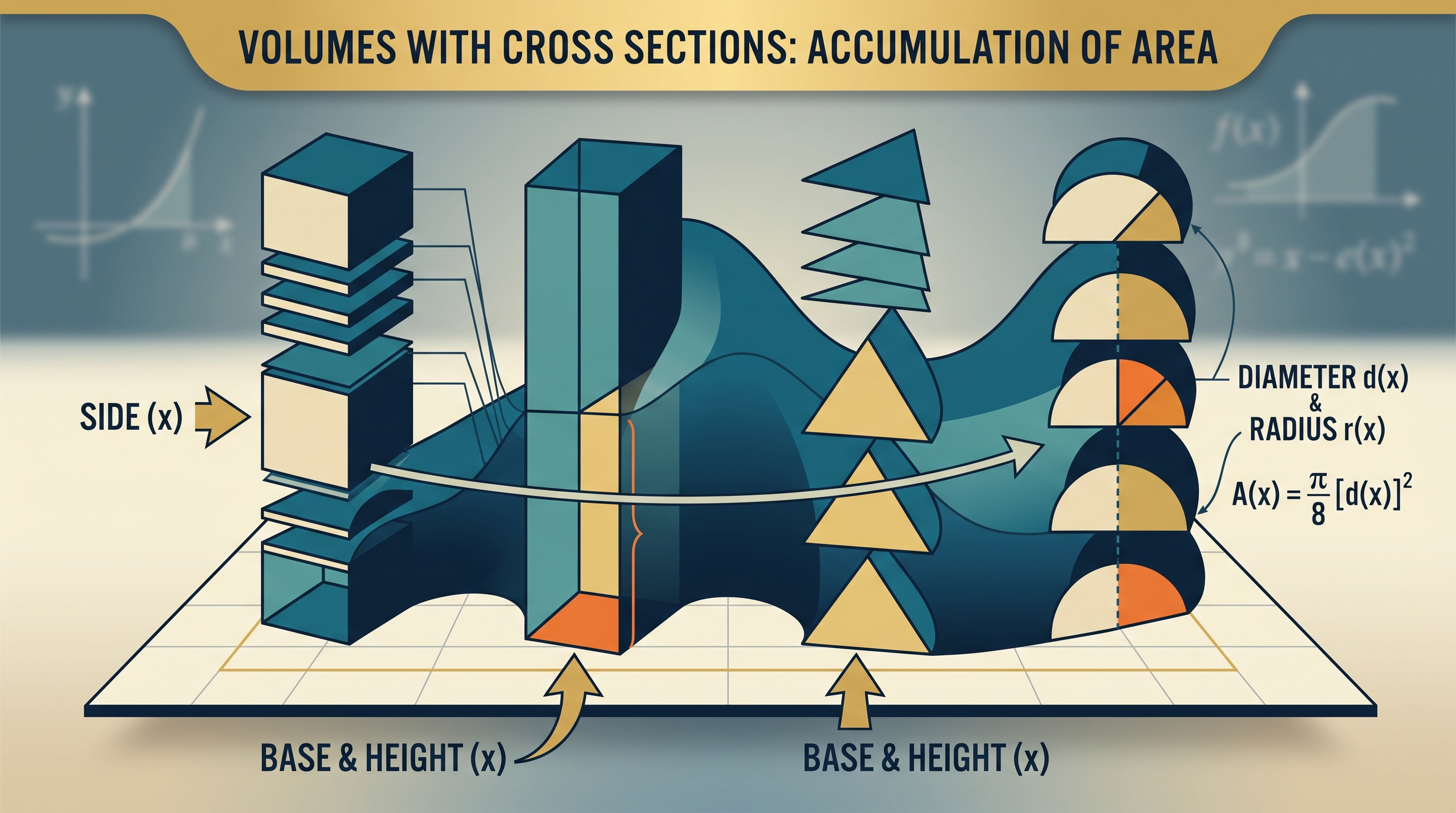
A solid can have a different shape at every horizontal or vertical position, yet its total volume is still an accumulation: add the areas of infinitely many thin slices. If the cross-sectional area at position $x$ is $A(x)$, then
$$ V=\int_a^b A(x),dx. $$
Here, $A(x)$ is not guessed from the three-dimensional picture. It is built from the geometric shape assigned to each slice.
The central translation: from a base region to a solid
A problem begins with a base region, usually bounded by curves. At each $x$-value, a slice through that region has a measurable length. The problem then specifies what two-dimensional shape is erected on that slice: a square, rectangle, triangle, semicircle, or another geometric figure.
The essential workflow is:
- Identify the interval $[a,b]$.
- Find the slice dimensions from the boundary curves.
- Use the specified cross-sectional shape to write $A(x)$.
- Accumulate those areas with $\int_a^b A(x),dx$.
This is different from a problem that merely asks for the area of a planar region. The base region supplies the dimensions of the slices; the specified cross sections determine the three-dimensional volume. Do not replace the stated shape with a rotation formula: use the cross-sectional geometry the problem gives.
Squares and rectangles
For a square whose side length is $s(x)$,
$$ A(x)=[s(x)]^2. $$
For a rectangle with length $l(x)$ and width $w(x)$,
$$ A(x)=l(x)w(x). $$
The required course knowledge is captured by CHA-5.B.1: volumes of solids with square and rectangular cross sections are found by combining definite integrals with the corresponding area formulas.
Worked example: rectangular cross sections
Let the base be the region between $y=x^2$ and $y=2x$ from $x=0$ to $x=2$. At each $x$, the vertical slice has width
$$ w(x)=2x-x^2. $$
Suppose each cross section perpendicular to the $x$-axis is a rectangle whose length is twice its width. Then
$$ l(x)=2w(x)=2(2x-x^2), $$
so its area is
$$ A(x)=l(x)w(x) =2(2x-x^2)^2. $$
Therefore, the volume is
$$ V=\int_0^2 2(2x-x^2)^2,dx =\frac{32}{15}. $$
The important step is not the final antiderivative. It is translating the graph into the slice dimension $2x-x^2$, then translating the rectangle description into $A(x)$.
Square cross sections on the same base. If each cross section perpendicular to the $x$-axis is instead a square whose side is the slice width $w(x)=2x-x^2$, then $A(x)=(2x-x^2)^2$ and $V=\int_0^2(2x-x^2)^2,dx=\int_0^2\left(4x^2-4x^3+x^4\right)dx=\frac{32}{3}-16+\frac{32}{5}=\frac{16}{15}$. Only the area formula changed; the base region, the bounds and the slice length are the same.
Skill focus: justification
The suggested AP skill is 3.D — Apply an appropriate mathematical definition, theorem, or test. In these problems, justification means making the geometry visible in the equation: state the slice dimension, identify whether it is a side, length, base, height, or diameter, and then apply the correct area formula.
Misconception check — “The base region is already the volume.” A planar region has area, not volume. The region only provides the dimensions of infinitely many cross sections. Volume appears after those cross-sectional areas are accumulated with a definite integral.
Retrieval check: A vertical slice of a base region has length $d(x)$. What is the integrand if each cross section is a square with side $d(x)$? What if each is a rectangle with base $d(x)$ and constant height $3$? The answers are $[d(x)]^2$ and $3d(x)$: only a dimension taken from the slice varies with $x$, and a square uses it twice.