From the free course AP Calculus AB on Lykke
5.1 Using the Mean Value Theorem
Key concepts: Mean Value Theorem and its use in drawing conclusions about function behavior · Continuity on a closed interval · Justifying conclusions with mathematical reasoning · Existence theorems and conclusions about behavior without precisely locating values
How the Mean Value Theorem guarantees a point where the instantaneous rate of change equals the average rate over an interval, and how to justify using it.
5.1 Using the Mean Value Theorem
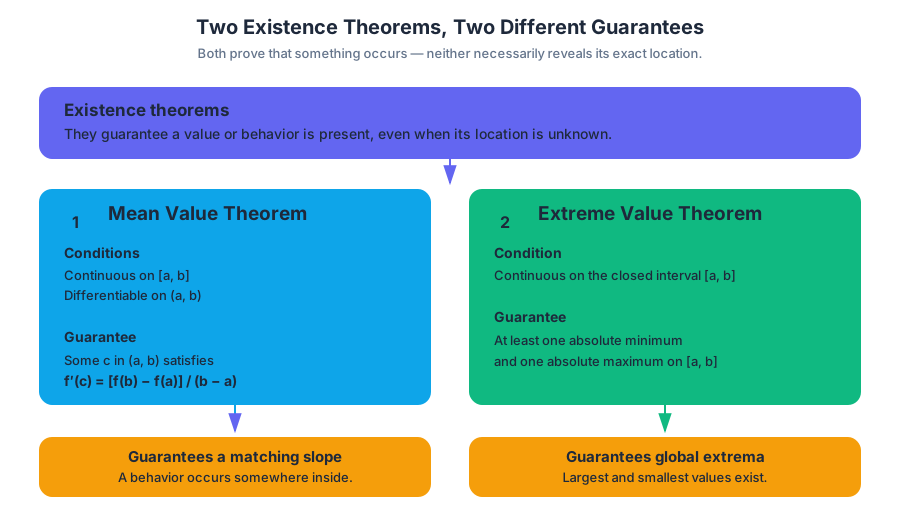
A function can reveal that something must have happened without telling you exactly where it happened. The Mean Value Theorem proves this for rates of change; the Extreme Value Theorem proves that highest and lowest values exist under the right conditions.
Two existence theorems, two different guarantees
| Theorem | Required conditions | Guaranteed conclusion |
|---|---|---|
| Mean Value Theorem | $f$ is continuous on $[a,b]$ and differentiable on $(a,b)$ | At some $c$ in $(a,b)$, $f'(c)=\dfrac{f(b)-f(a)}{b-a}$ |
| Extreme Value Theorem | $f$ is continuous on the closed interval $[a,b]$ | $f$ has at least one absolute minimum and at least one absolute maximum on $[a,b]$ |
Both are existence theorems: they establish that a value or behavior occurs, but they may not identify its exact location. This distinction matters in applications. A theorem may prove that a driver exceeded a speed limit somewhere on a highway without specifying the precise mile marker.
5.1 The Mean Value Theorem: matching an average rate
The average rate of change of $f$ from $x=a$ to $x=b$ is the slope of the secant line:
$$ \frac{f(b)-f(a)}{b-a}. $$
The Mean Value Theorem says that if $f$ is continuous on $[a,b]$ and differentiable on $(a,b)$, then at least one interior point $c$ satisfies
$$ f'(c)=\frac{f(b)-f(a)}{b-a}. $$
In plain language, the function’s instantaneous rate equals its overall average rate at least once.
Worked contextual example. A driver travels $120$ miles in $2$ hours. Let $s(t)$ denote position, in miles, $t$ hours after departure. The average velocity is
$$ \frac{s(2)-s(0)}{2-0}=\frac{120}{2}=60\text{ miles per hour}. $$
If $s$ is continuous on $[0,2]$ and differentiable on $(0,2)$, the Mean Value Theorem guarantees some time $c$ with
$$ s'(c)=60. $$
If the posted speed limit is $55$ miles per hour, an average of $60$ does not by itself say when the driver went fast, but the Mean Value Theorem guarantees an instant at which the driver’s velocity was exactly $60$ miles per hour, which is enough to conclude that the driver was speeding at that moment.
The assessed reasoning process is 3.E Provide reasons or rationales for solutions and conclusions. A complete justification names the hypotheses—continuity on $[a,b]$ and differentiability on $(a,b)$—then states the theorem’s conclusion and connects it to the context.
Misconception check — “The average rate is the rate at the midpoint.”
The Mean Value Theorem guarantees a point $c$, but not usually $c=\dfrac{a+b}{2}$. The matching point may occur anywhere inside the interval.
Retrieval check. A function $f$ is continuous on $[1,5]$ and differentiable on $(1,5)$, with $f(1)=3$ and $f(5)=11$. What does the Mean Value Theorem guarantee? Answer: at least one $c$ in $(1,5)$ with $f'(c)=\dfrac{11-3}{5-1}=2$. The theorem does not say where $c$ is, and there may be more than one.
Source Materials
- Learn More (.pdf)
- AP Calculus AB and BC Course and Exam Description
- AP Calculus AB Course Overview
- AP Calculus Course at a Glance
- AP Calculus AB and BC Course at a Glance Poster
- Adopt AP Calculus AB
- AP Calculus AB
- AP Calculus AB
- About the Advanced Placement Program® (AP®)
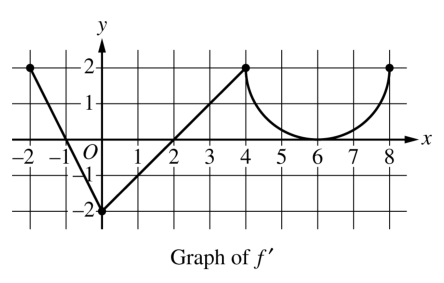
- The function f is defined on the closed interval [ ] 2, 8 − and satisfies ( ) 2 1. f = The graph of , f ′ the derivative of ,f consists of two line segments and a semicircle, as shown in the figure.
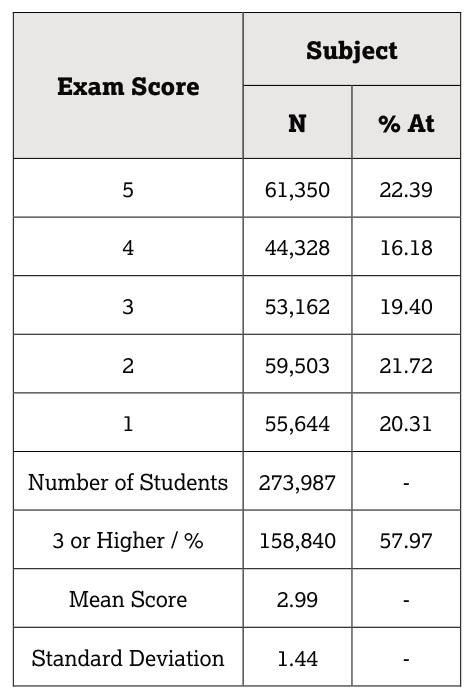
- Figure — Score Distributions (p. 1)
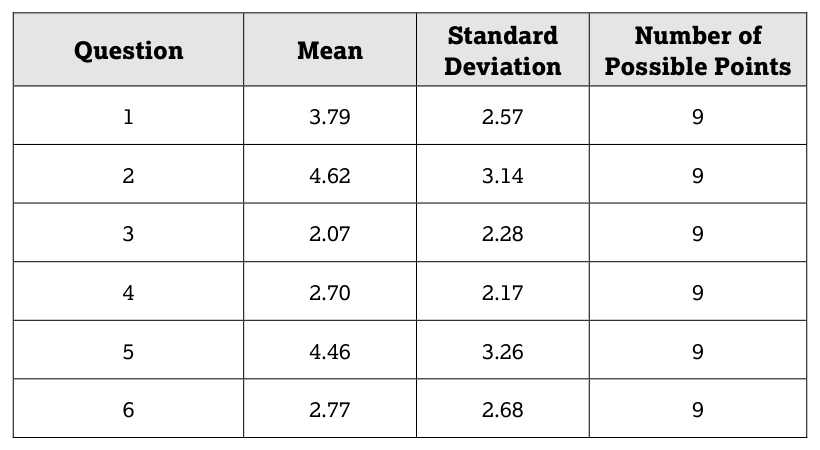
- Figure — Scoring Statistics (p. 1)