From the free course AP Calculus AB on Lykke
6.9 Integrating Using Substitution
Key concepts: Integration by substitution (u-substitution) · Recognizing integrands that involve the chain rule · Finding indefinite integrals · Evaluating definite integrals · Interpreting constants correctly when evaluating definite integrals · Using a structured multistep process for substitution · Applying mathematical rules and procedures with or without technology
How to integrate by $u$-substitution, including changing the bounds of a definite integral and handling constants written outside the integral.
6.9 Integrating Using Substitution
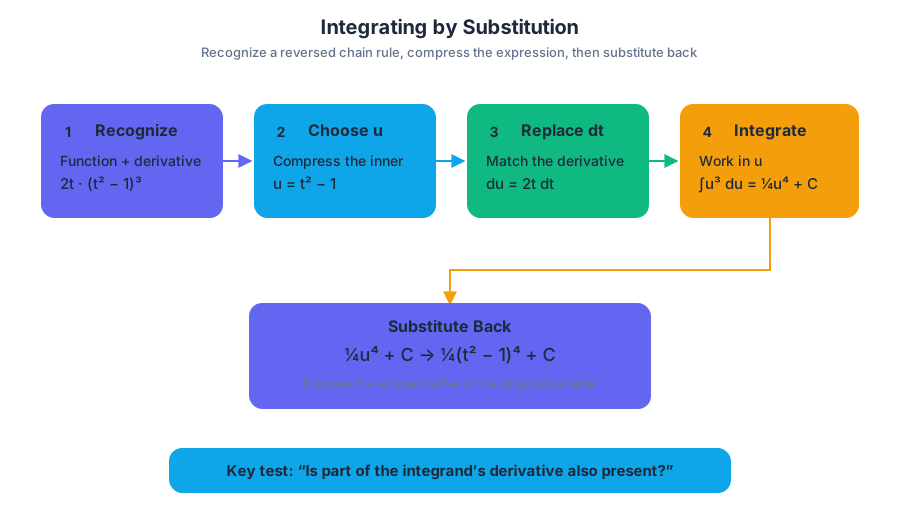
The integral $\int 2t(t^2-1)^3,dt$ looks complicated only until you notice that $2t$ is the derivative of $t^2-1$. Integration by substitution reverses the chain rule by replacing a repeated inner expression with one simpler variable.
The central pattern: recognize a reversed chain rule
If an integrand contains a function and its derivative, substitution is often the cleanest procedure. Let $$ u=t^2-1. $$ Then $$ du=2t,dt. $$ The integral becomes $$ \int 2t(t^2-1)^3,dt =\int u^3,du =\frac14u^4+C =\frac14(t^2-1)^4+C. $$
The substitution works because it compresses the complicated expression $t^2-1$ into the single variable $u$. After integrating in $u$, substitute back so that the antiderivative is expressed in the original variable.
A reliable substitution pipeline
Use the following visual decision path whenever an integrand appears to contain a composite function:
- Identify the repeated inner expression, such as $t^2-1$.
- Set that expression equal to $u$.
- Compute $du$, including its differential factor.
- Rewrite every relevant part of the integral using $u$ and $du$.
- Integrate with respect to $u$.
- Substitute the original expression back.
- Differentiate the result mentally or algebraically to check it.
For example, $$ \int 6x(x^2+4)^2,dx $$ suggests $u=x^2+4$, so $du=2x,dx$ and $6x,dx=3,du$. Therefore, $$ \int 6x(x^2+4)^2,dx =3\int u^2,du =u^3+C =(x^2+4)^3+C. $$
Key insight: A substitution is not a symbol-swapping trick. It is a deliberate attempt to match the structure of the chain rule in reverse.
Definite integrals and the bounds
For a definite integral, substitution can be completed in either of two consistent ways: substitute back into the original variable and use the original bounds, or change the bounds into $u$-values and remain in $u$ throughout.
Evaluate $$ \int_0^2 2t(t^2-1)^3,dt. $$ With $u=t^2-1$ and $du=2t,dt$, the bounds become $$ t=0\Rightarrow u=-1, \qquad t=2\Rightarrow u=3. $$ Thus, $$ \int_0^2 2t(t^2-1)^3,dt =\int_{-1}^{3}u^3,du =\left[\frac14u^4\right]_{-1}^{3} =\frac14(3^4)-\frac14((-1)^4) =20. $$
Alternatively, the antiderivative in terms of $t$ is $$ \frac14(t^2-1)^4, $$ so $$ \left[\frac14(t^2-1)^4\right]_0^2=20. $$ Both methods agree because they describe the same accumulation.
Constants outside versus inside an integral
Parentheses and placement matter. A number written after the definite-integral expression is outside the integral; a number inside the integrand is accumulated over the interval.
Using $v_J(t)=2t(t^2-1)^3$, interpret $$ \int_0^2 v_J(t),dt+7. $$ The $+7$ is outside the integral, so $$ \int_0^2 v_J(t),dt+7
\left[\frac14(t^2-1)^4\right]_0^2+7. $$ It is not $$ \left[\frac14(t^2-1)^4+7t\right]_0^2, $$ because that expression treats $7$ as part of the integrand, effectively integrating $v_J(t)+7$.
Misconception check — “Every term near the integral sign is integrated.”
False. In $\int_a^b f(t),dt+7$, only $f(t)$ is integrated. In $\int_a^b\bigl(f(t)+7\bigr),dt$, both terms are integrated.
AP skill and retrieval check
This topic develops Mathematical Practice 1, Skill 1.E: “Apply appropriate mathematical rules or procedures, with and without technology.” The procedure is not merely calculating: the important decision is selecting substitution, long division, completing the square, or an equivalent algebraic form.
Retrieval check: Evaluate $$ \int_1^3 6x(x^2+4)^2,dx+5. $$ The correct antiderivative is $$ (x^2+4)^3, $$ so, because $+5$ is outside the integral, the result is $$ \left[(x^2+4)^3\right]_1^3+5 =(13^3-5^3)+5 =2187+5 =2192. $$ Writing $\left[(x^2+4)^3+5x\right]_1^3$ would incorrectly place the constant inside the integrand.
Source Materials
- Learn More (.pdf)
- AP Calculus AB and BC Course and Exam Description
- AP Calculus AB Course Overview
- AP Calculus Course at a Glance
- AP Calculus AB and BC Course at a Glance Poster
- Adopt AP Calculus AB
- AP Calculus AB
- AP Calculus AB
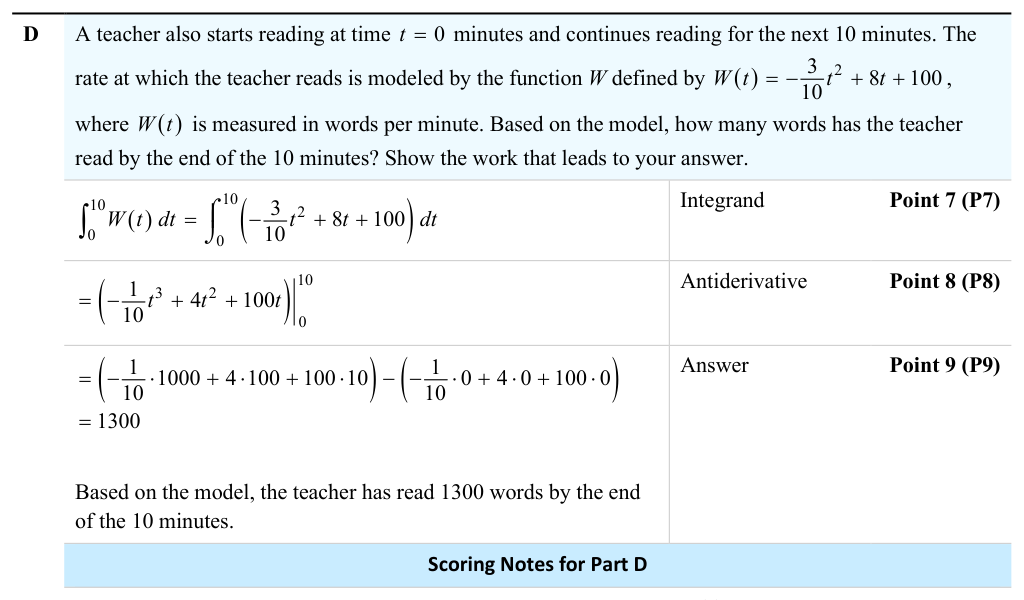
- • P7 is earned for an indefinite or definite integral with integrand W(t) , with or without the
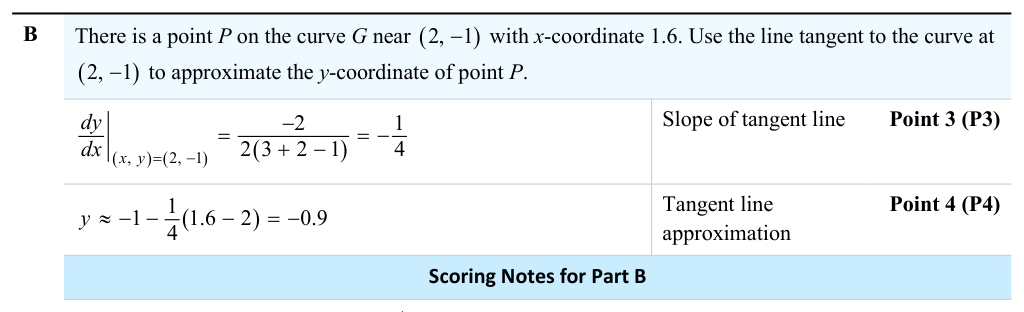
- • A response can earn P3 with dy 1 dy 1 = − , = − dx (x y , )=(2, −1) 4 dx 4 , “slope is 1 −4 ,” or equivalent.
- • P7 is earned for an indefinite or definite integral with integrand W(t) , with or without the