From the free course AP Calculus AB on Lykke
2.3 Estimating Derivatives of a Function at a Point
Key concepts: Estimating a derivative at a point from a graph or table · Derivative as the limit of difference quotients · Interpreting a limit as the derivative of a specific function at a specific x-value
Estimating a derivative at a point from tables and graphs using nearby secant slopes, with correct units, and recognising a limit as the derivative of a particular function at a particular input.
2.3 Estimating Derivatives of a Function at a Point
Using the difference-quotient definition, estimate or identify the limiting slope at the specified point. The key question is not merely “What is the slope?” but “Do the nearby slopes approach one common finite value?”
Estimating a derivative from a table or graph
A derivative at $x=a$ can be estimated from nearby secant slopes, which measure average change over an interval. As the interval narrows around $a$, those secant slopes approximate the tangent slope:
$$ f'(a)=\lim_{h\to 0}\frac{f(a+h)-f(a)}{h}, $$
when the limit exists.
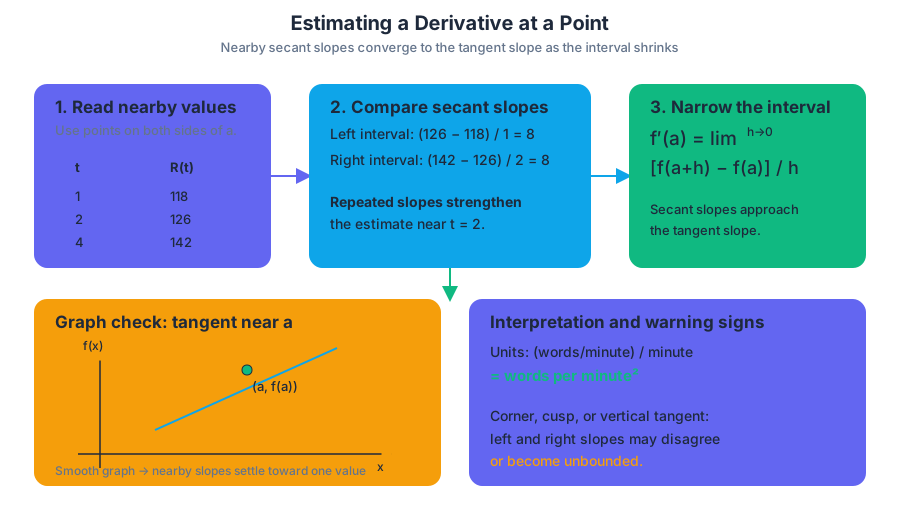
Suppose $R(t)$ gives the number of words per minute read by a student. Nearby measurements are:
| $t$ (minutes) | $R(t)$ (words per minute) |
|---|---|
| $1$ | $118$ |
| $2$ | $126$ |
| $4$ | $142$ |
To estimate $R'(2)$, use values on either side of $t=2$. From $t=1$ to $t=2$,
$$ \frac{R(2)-R(1)}{2-1} =\frac{126-118}{1}=8. $$
From $t=2$ to $t=4$,
$$ \frac{R(4)-R(2)}{4-2} =\frac{142-126}{2}=8. $$
Thus $R'(2)\approx 8$ words per minute per minute. The repeated value strengthens the estimate: the reading rate is increasing at approximately $8$ words per minute each minute at $t=2$.
The units matter. Since $R$ is measured in words per minute and $t$ in minutes, $R'(2)$ has units
$$ \frac{\text{words per minute}}{\text{minute}} =\text{words per minute}^2. $$
On a graph, estimate $f'(a)$ by inspecting the tangent line near $(a,f(a))$. If the graph has a smooth, increasingly flat shape, nearby secant slopes should settle toward one number. If the graph has a corner, cusp, or vertical tangent, the left- and right-hand slopes may fail to agree or may become unbounded.
Technology offers a third route. When a formula is available on a calculator-active question, the calculator’s numerical derivative at $x=a$ is an accepted way to obtain $f'(a)$; it works by evaluating a very narrow difference quotient.
Recognizing a derivative inside a limit
A limit with a denominator approaching $0$ often hides the difference quotient for a particular function. To identify it, match the expression to
$$ \lim_{h\to0}\frac{f(a+h)-f(a)}{h}. $$
Read the numerator as “function value near $a$ minus function value at $a$.”
For example,
$$ \lim_{h\to0}\frac{(3+h)^2-9}{h} $$
is the derivative of $f(x)=x^2$ at $x=3$, because
$$ f(3+h)=(3+h)^2 \qquad\text{and}\qquad f(3)=3^2=9. $$
Therefore,
$$ \lim_{h\to0}\frac{(3+h)^2-9}{h}=f'(3). $$
The important response is not only the numerical value; it is the mathematical identification: this limit represents the instantaneous rate of change of $f(x)=x^2$ at $x=3$.
A shifted form may require more careful reading. In
$$ \lim_{x\to 2}\frac{\sqrt{x+7}-3}{x-2}, $$
the function is $f(x)=\sqrt{x+7}$, the approached point is $a=2$, and $f(2)=\sqrt{9}=3$. Hence the limit is $f'(2)$.
Retrieval check: A table gives $f(2.9)=8.41$, $f(3)=9$ and $f(3.1)=9.61$. Compute the secant slope on each side of $x=3$ and estimate $f'(3)$. Then decide which function and point $\lim_{h\to0}\frac{(3+h)^2-9}{h}$ describes. The slopes $5.9$ and $6.1$ give $f'(3)\approx6$, consistent with the limit, which is $f'(3)$ for $f(x)=x^2$.
Source Materials
- Learn More (.pdf)
- AP Calculus AB and BC Course and Exam Description
- AP Calculus AB Course Overview
- AP Calculus Course at a Glance
- AP Calculus AB and BC Course at a Glance Poster
- Adopt AP Calculus AB
- AP Calculus AB
- AP Calculus AB
- • An evaluation of vJ (2) is not necessary, but if a value is presented, it must be correct. The correct