From the free course AP Calculus AB on Lykke
5.7 Using the Second Derivative Test to Determine Extrema
Key concepts: Relative (local) extrema · Second and higher-order derivatives · Parametric, polar, and vector-valued functions
How the Second Derivative Test uses the sign of the second derivative at a critical point to classify it as a relative maximum or minimum, and when the test is inconclusive.
5.7 Using the Second Derivative Test to Determine Extrema
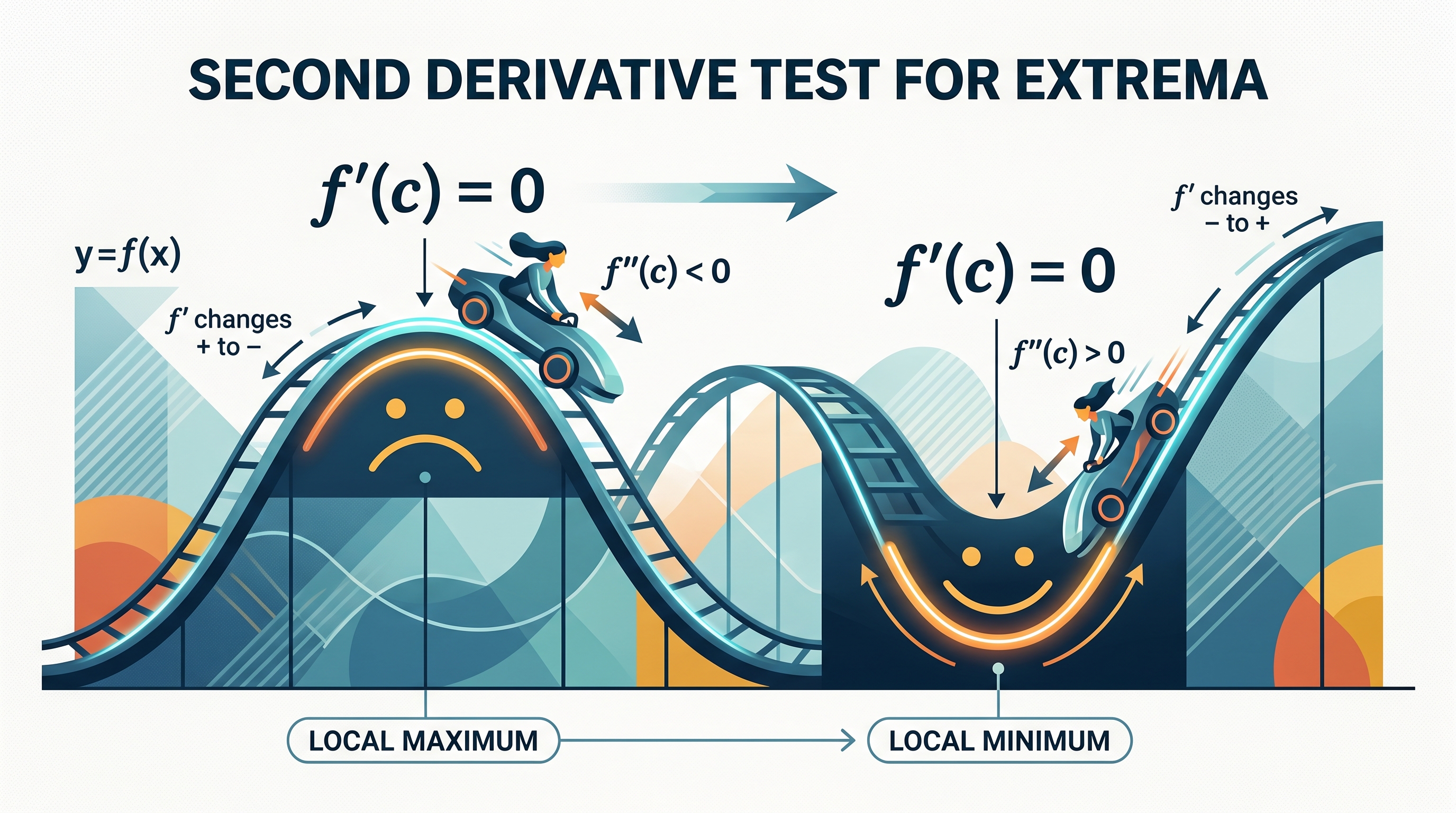
A graph can reveal a local maximum or minimum before any calculation does: near a hilltop, slopes change from positive to negative; near a valley, they change from negative to positive. The Second Derivative Test detects that change in shape by examining $f''$, the derivative of $f'$.
The Second Derivative Test
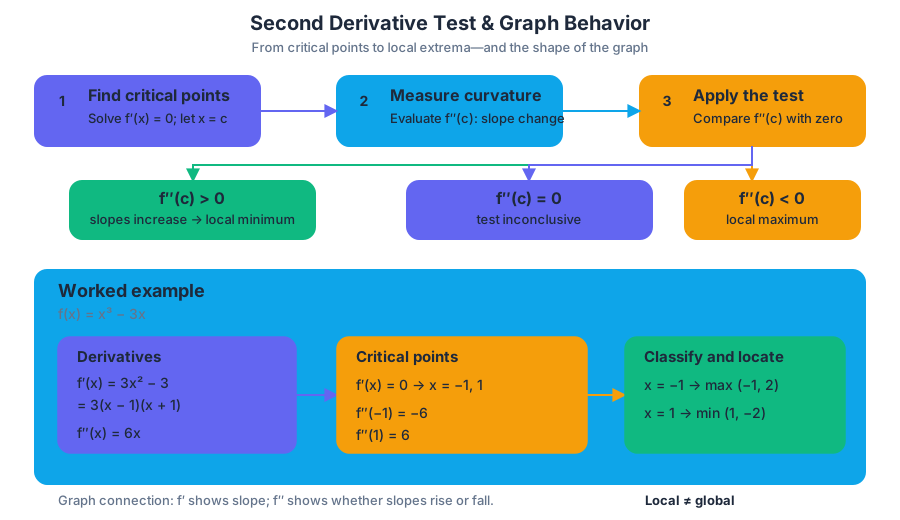
Let $c$ be a critical point where $f'(c)=0$. If $f''$ exists near $c$, then:
If $f''(c)>0$, $f$ has a relative (local) minimum at $x=c$.
If $f''(c)<0$, $f$ has a relative (local) maximum at $x=c$.
If $f''(c)=0$, the test is inconclusive.
The test works because $f''$ describes how the slope $f'$ is changing. A positive value means the slopes are increasing, as they do while the graph bends upward into a valley. A negative value means the slopes are decreasing, as they do while the graph bends downward over a hill.
Worked example. Consider $f(x)=x^3-3x$. Differentiate:
$$ f'(x)=3x^2-3=3(x-1)(x+1). $$
The critical points are $x=-1$ and $x=1$. Differentiating again gives
$$ f''(x)=6x. $$
Now classify each point:
$$ f''(-1)=-6<0, $$
so $f$ has a relative maximum at $x=-1$. Also,
$$ f''(1)=6>0, $$
so $f$ has a relative minimum at $x=1$. Their coordinates are
$$ f(-1)=2 \qquad\text{and}\qquad f(1)=-2. $$
The test identifies relative extrema: behavior compared with nearby points. It does not by itself prove that the maximum value $2$ or minimum value $-2$ is global over the entire domain. That broader conclusion requires comparing all relevant candidates, including endpoints when an interval is specified.
Second and higher-order derivatives
Differentiating $f'$ produces the second derivative:
$$ f''(x)=\frac{d}{dx}\bigl(f'(x)\bigr) =\frac{d^2f}{dx^2}. $$
Further differentiation produces higher-order derivatives:
$$ f'''(x)=\frac{d}{dx}\bigl(f''(x)\bigr), \qquad f^{(4)}(x)=\frac{d}{dx}\bigl(f'''(x)\bigr), $$
and, in general,
$$ f^{(n)}(x)=\frac{d^n f}{dx^n}. $$
For example, if $f(x)=x^4$, then
$$ f'(x)=4x^3,\qquad f''(x)=12x^2,\qquad f'''(x)=24x,\qquad f^{(4)}(x)=24. $$
The Second Derivative Test specifically uses $f''$. Higher derivatives can describe additional behavior, but they are not automatically part of this test.
Misconception check — “$f''(c)=0$ means there is no extremum.”
False. It means only that the Second Derivative Test cannot decide. For $f(x)=x^4$, $f'(0)=0$ and $f''(0)=0$, yet $x=0$ is a relative minimum.
In the course framework, Topic 5.7 is tagged FUN-4.A.7 for the Second Derivative Test and FUN-4.A.8 for relating relative extrema to absolute extrema. The reasoning is Mathematical Practice 3: Justification, especially 3.D, applying an appropriate test: a complete response states that $f'(c)=0$, gives the sign of $f''(c)$, and only then names the extremum, rather than merely labeling the point.
Retrieval check. Suppose $f'(2)=0$ and $f''(2)<0$. What kind of extremum occurs at $x=2$, and which graph feature of $f'$ supports your answer? A relative maximum occurs because $f'$ is decreasing through zero, changing from positive to negative. AP Calculus BC extends these same ideas to parametrically defined curves, polar curves, and vector-valued functions.
Source Materials
- Learn More (.pdf)
- AP Calculus AB and BC Course and Exam Description
- AP Calculus AB Course Overview
- AP Calculus Course at a Glance
- AP Calculus AB and BC Course at a Glance Poster
- Adopt AP Calculus AB
- AP Calculus AB
- AP Calculus AB
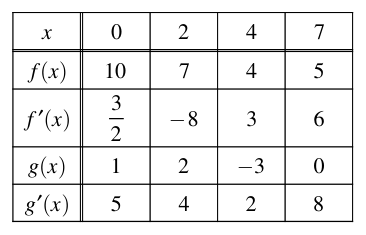
- 5. The functions f and g are twice differentiable. The table shown gives values of the functions and their first