From the free course AP Calculus AB on Lykke
1.16 Working with the Intermediate Value Theorem
Key concepts: Intermediate Value Theorem (IVT) · Limits and continuity · Mathematical definitions, theorems, and properties · Hypotheses of theorems · Continuity of piecewise functions
The Intermediate Value Theorem: its two hypotheses, how to use it to guarantee a solution in an interval, and how to check continuity at a piecewise boundary first.
1.16 Working with the Intermediate Value Theorem
The Intermediate Value Theorem turns continuity into a guarantee: a continuous function cannot get from one output to another without taking every value in between. Because the theorem applies only when a function is continuous on an entire closed interval, this page first checks continuity where it most often fails—at the boundary of a piecewise rule—and then states and applies the theorem.
Continuity at a piecewise boundary
At a boundary point of a piecewise function, evaluating the function and finding the approaching value are separate jobs. For continuity at $x=a$, all three must agree:
$$ \lim_{x\to a^-}f(x)=\lim_{x\to a^+}f(x)=f(a). $$
A graph may approach one height while the function is assigned a different height—or no value at all.
For
$$ g(x)= \begin{cases} x+3, & x<2,\ kx-1, & x\ge 2, \end{cases} $$
continuity at $x=2$ requires the left-hand limit, right-hand limit, and defined value to match. The left side approaches
$$ \lim_{x\to2^-}(x+3)=5. $$
The right-hand value is
$$ g(2)=2k-1, $$
so continuity requires
$$ 2k-1=5, \qquad k=3. $$
This uses 2.B Connecting Representations: Identify mathematical information from graphical, numerical, analytical, and/or verbal representations.
Misconception check — “The limit is the function value.”
A limit describes what outputs approach; $f(a)$ is the output actually assigned at $a$. They are equal only when the continuity condition holds.
The Intermediate Value Theorem
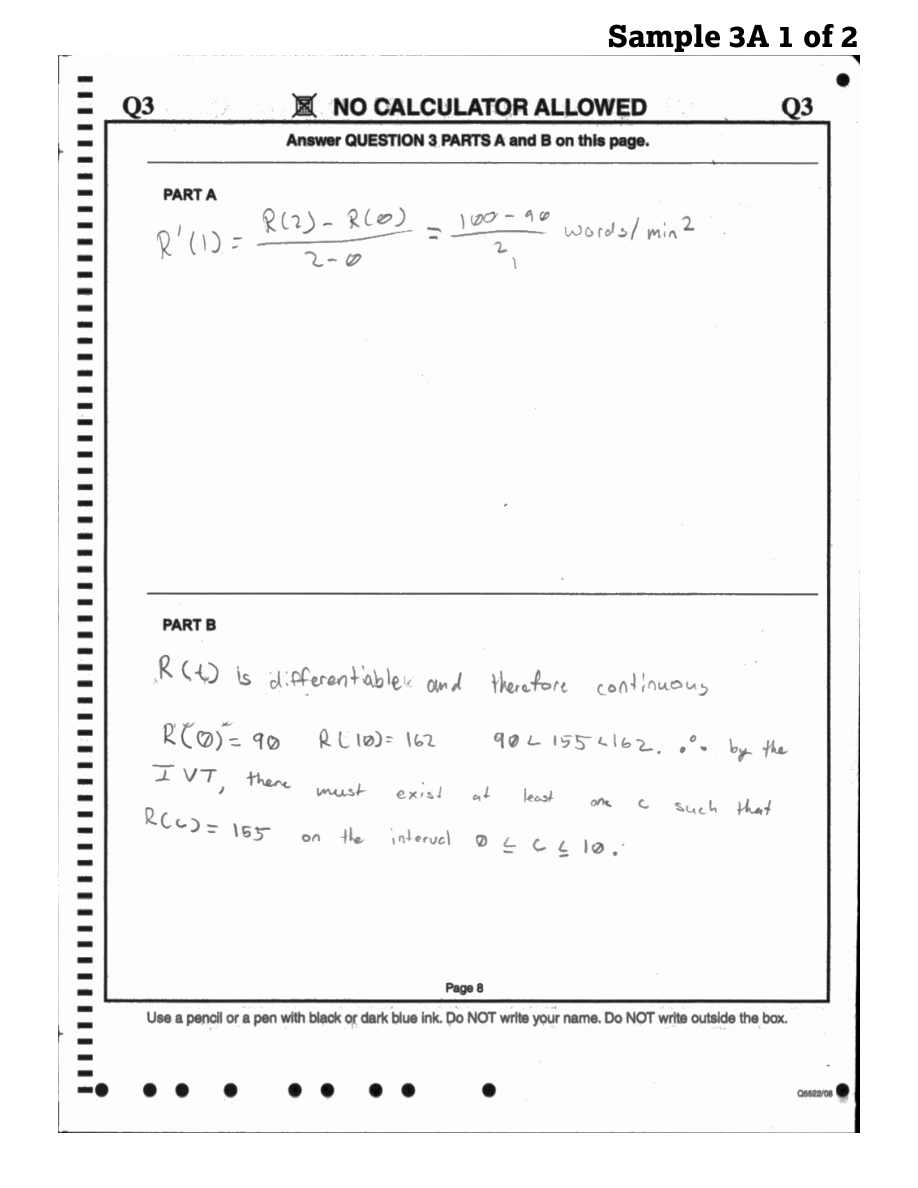
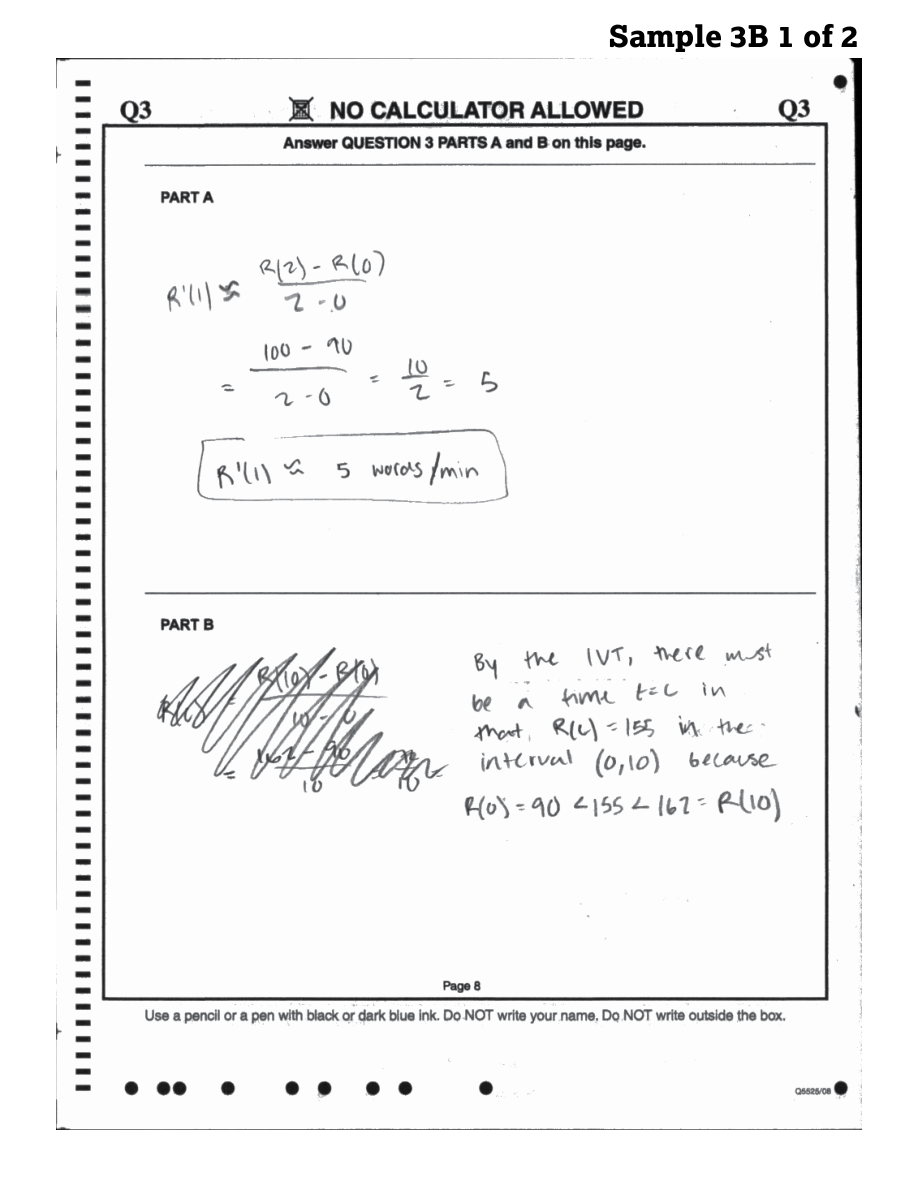
The Intermediate Value Theorem (IVT) guarantees that a continuous function cannot jump over a value. If $f$ is continuous on the closed interval $[a,b]$ and $N$ lies between $f(a)$ and $f(b)$, then there is at least one number $c$ in $(a,b)$ such that
$$ f(c)=N. $$
The hypotheses matter:
- $f$ must be continuous on every point of $[a,b]$.
- The target value $N$ must lie between the endpoint values.
Suppose
$$ h(x)=x^3-4x+1. $$
Because polynomials are continuous everywhere, $h$ is continuous on $[0,2]$. Also,
$$ h(0)=1 \quad\text{and}\quad h(2)=1. $$
These endpoints do not trap the value $0$, so the IVT cannot establish a zero on $[0,2]$. On $[-1,0]$,
$$ h(-1)=4,\qquad h(0)=1, $$
so that interval still does not trap $0$. But on $[0,1]$,
$$ h(0)=1,\qquad h(1)=-2. $$
Since $0$ lies between $1$ and $-2$, the IVT guarantees some $c\in(0,1)$ with $h(c)=0$.
If continuity fails, the conclusion can fail. A function with a jump may have endpoint values on opposite sides of $N$ but never equal $N$ inside the interval. Likewise, if $N$ is outside the endpoint range, continuity cannot force the function to reach it.
Justification pattern: State continuity on $[a,b]$, state the endpoint values, identify the trapped target value, and conclude that a point $c\in(a,b)$ exists.
Retrieval check: If $\lim_{x\to\infty}f(x)=4$, what horizontal asymptote follows? For the IVT, is “$f$ is continuous at $a$ and $b$” enough, or must continuity hold on the entire interval $[a,b]$? The answers are $y=4$ and continuity on the entire interval is required.
Source Materials
- Learn More (.pdf)
- AP Calculus AB and BC Course and Exam Description
- AP Calculus AB Course Overview
- AP Calculus Course at a Glance
- AP Calculus AB and BC Course at a Glance Poster
- Adopt AP Calculus AB
- AP Calculus AB
- AP Calculus AB
- Figure — Sample Responses Q3 (p. 6)
- Figure — Sample Responses Q3 (p. 7)
- Figure — Sample Responses Q3 (p. 8)
- Figure — Sample Responses Q3 (p. 9)