From the free course AP Calculus AB on Lykke
AP Practice 1
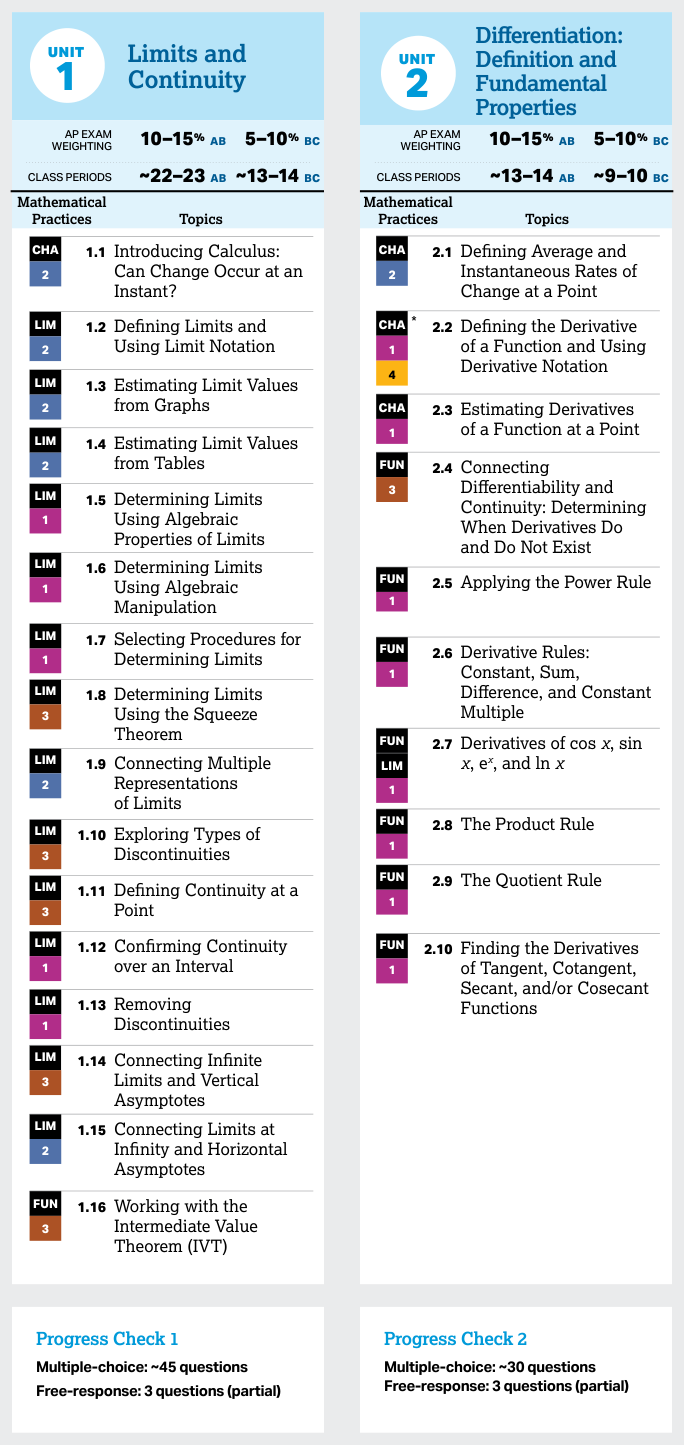
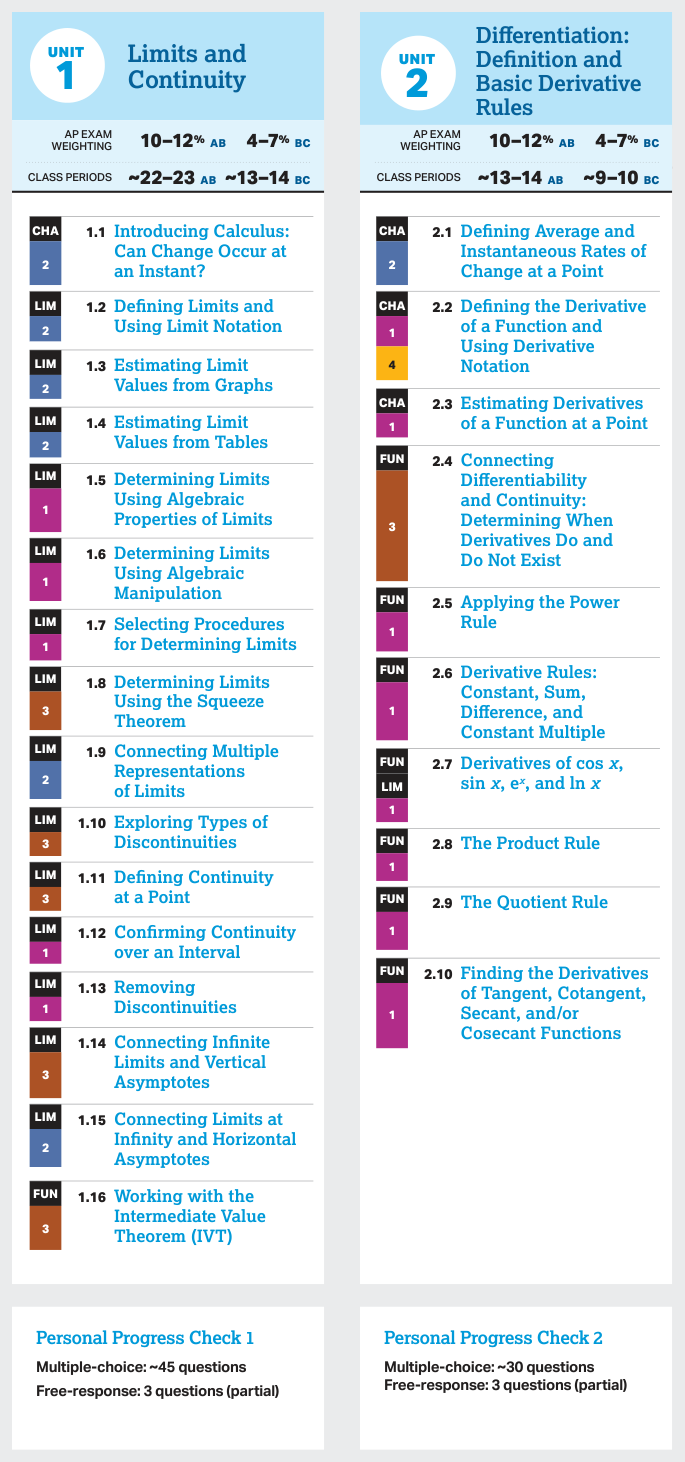
Key concepts: AP course requirements and the AP Course Audit · AP opposition to indoctrination and analysis of multiple perspectives · Respectful, evidence-based debate in AP classrooms · AP Exam scoring by trained college faculty and expert AP teachers · Combination of free-response/performance and computer-scored multiple-choice results · Conversion of raw scores into AP scores of 3, 4, or 5 · AP Reader compensation, travel expenses, and continuing education units · Writing limits in analytical form · Creating representations and comparing different limit expressions · Differentiation and contextual applications of differentiation, including particle motion in the plane
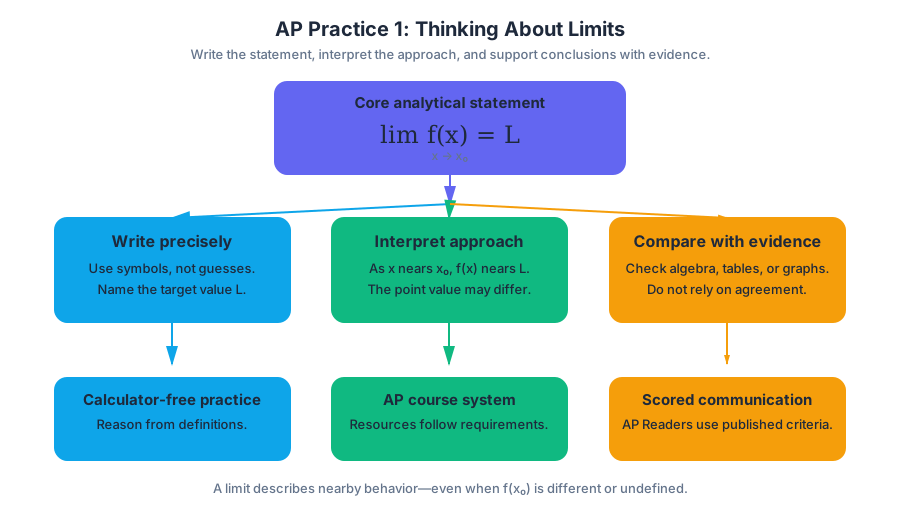
A limit must first be written as an analytical statement, not merely described in words or guessed from a graph. The precise form
AP Practice 1
A limit must first be written as an analytical statement, not merely described in words or guessed from a graph. The precise form
$$ \lim_{x\to x_0} f(x)=L $$
asserts that the values of $f(x)$ approach $L$ as $x$ approaches $x_0$—even if $f(x_0)$ is different from $L$ or does not exist.
This practice set focuses on the calculator-free task of writing, interpreting, and comparing limits. It also connects the mathematics to the larger AP system: authorized courses follow required curricular and resource conditions, classroom arguments rely on evidence rather than personal agreement, and free-response work is evaluated by trained AP Readers using published scoring criteria.
What makes an AP course—and what makes an AP response?
A school may label a course Advanced Placement or AP only after completing the AP Course Audit and satisfying the required curricular and resource expectations. For AP Calculus AB, those expectations include access to a college-level calculus textbook, coverage of the required Course and Exam Description content, opportunities to connect analytical, numerical, graphical, and verbal representations, mathematical justification and communication, graphing-calculator use, and applications of calculus to real-world situations.
The same evidence-centered habit governs classroom discussion. AP students are expected to analyze perspectives different from their own; points are awarded for mathematically correct reasoning, not for agreeing with a particular viewpoint. Students evaluate arguments and evidence—not one another—while respectful debate protects diverse backgrounds, experiences, and viewpoints. Personal attacks do not strengthen an argument and have no place in an AP classroom.
Unofficial calculator-free practice task
Timing guidance: Allow approximately $10$–$12$ minutes. Work without a graphing calculator. Write enough notation and explanation that another reader can follow the reasoning without reconstructing missing steps.
Let
$$ p(x)=\frac{x^2-9}{x-3} \qquad\text{for }x\ne 3. $$
Part A — Write the limit analytically
Write a limit statement that describes the value approached by $p(x)$ as $x$ approaches $3$. Then determine that limit.
Worked reasoning: Factor the numerator for values of $x$ near, but not equal to, $3$:
$$ p(x)=\frac{(x-3)(x+3)}{x-3}=x+3. $$
Therefore,
$$ \lim_{x\to 3}p(x)
\lim_{x\to 3}(x+3)
$$
Unofficial scoring guide, $2$ points: Award one point for the correct analytical form $\lim_{x\to 3}p(x)$ and one point for the correct value $6$. A response that writes only “the limit is $6$” gives the numerical result but does not fully display the required limiting relationship.
Key insight: The limit describes nearby behavior. It does not automatically equal the function’s value at the target input.
Part B — Compare two limit expressions
Compare the following expressions:
$$ \lim_{x\to 3}p(x) \qquad\text{and}\qquad p(3). $$
Are they necessarily equal for this function? Explain.
Worked reasoning: The formula for $p(x)$ is undefined at $x=3$ because its original denominator is zero. Thus $p(3)$ does not exist. However, the simplified expression $x+3$ describes the values of $p(x)$ for every nearby $x\ne3$, so
$$ \lim_{x\to3}p(x)=6 \qquad\text{while}\qquad p(3)\text{ is undefined}. $$
The two expressions are not equal because one exists as a limit and the other is not defined.
Unofficial scoring guide, $2$ points: Award one point for identifying the limit as $6$ and one point for explaining that $p(3)$ is undefined. Merely substituting $x=3$ into the unsimplified formula is not valid.
Part C — Relate one-sided and two-sided limits
Suppose a graph shows that
$$ \lim_{x\to 3^-}q(x)=5 \qquad\text{and}\qquad \lim_{x\to 3^+}q(x)=5. $$
What is $\lim_{x\to3}q(x)$? What conclusion would follow if the two one-sided limits were $5$ and $7$ instead?
Worked reasoning: A two-sided limit exists when the left-hand and right-hand limits agree. Since both one-sided limits equal $5$,
$$ \lim_{x\to3}q(x)=5. $$
If instead
$$ \lim_{x\to3^-}q(x)=5 \qquad\text{and}\qquad \lim_{x\to3^+}q(x)=7, $$
then the two-sided limit does not exist because the function approaches different values from the two sides.
Unofficial scoring guide, $2$ points: Award one point for the correct two-sided limit when the one-sided limits agree and one point for explaining nonexistence when they disagree.
How AP scoring works
On the AP Exam, multiple-choice responses are scored by machine, while free-response work is scored by trained AP Readers. These Readers include college faculty and expert AP teachers. Most scoring occurs during the annual AP Reading, with a smaller portion completed online. Readers receive compensation; traveling Readers have expenses, lodging, and meals covered, and Readers may earn continuing education units.
Free-response results are weighted and combined with computer-scored multiple-choice results to produce a raw score. That raw score is then converted into an AP score using standards for the reported scale, including scores of $3$, $4$, and $5$. The conversion is not simply a percentage grade, so a single missed point does not automatically determine the final AP score.
Retrieval check
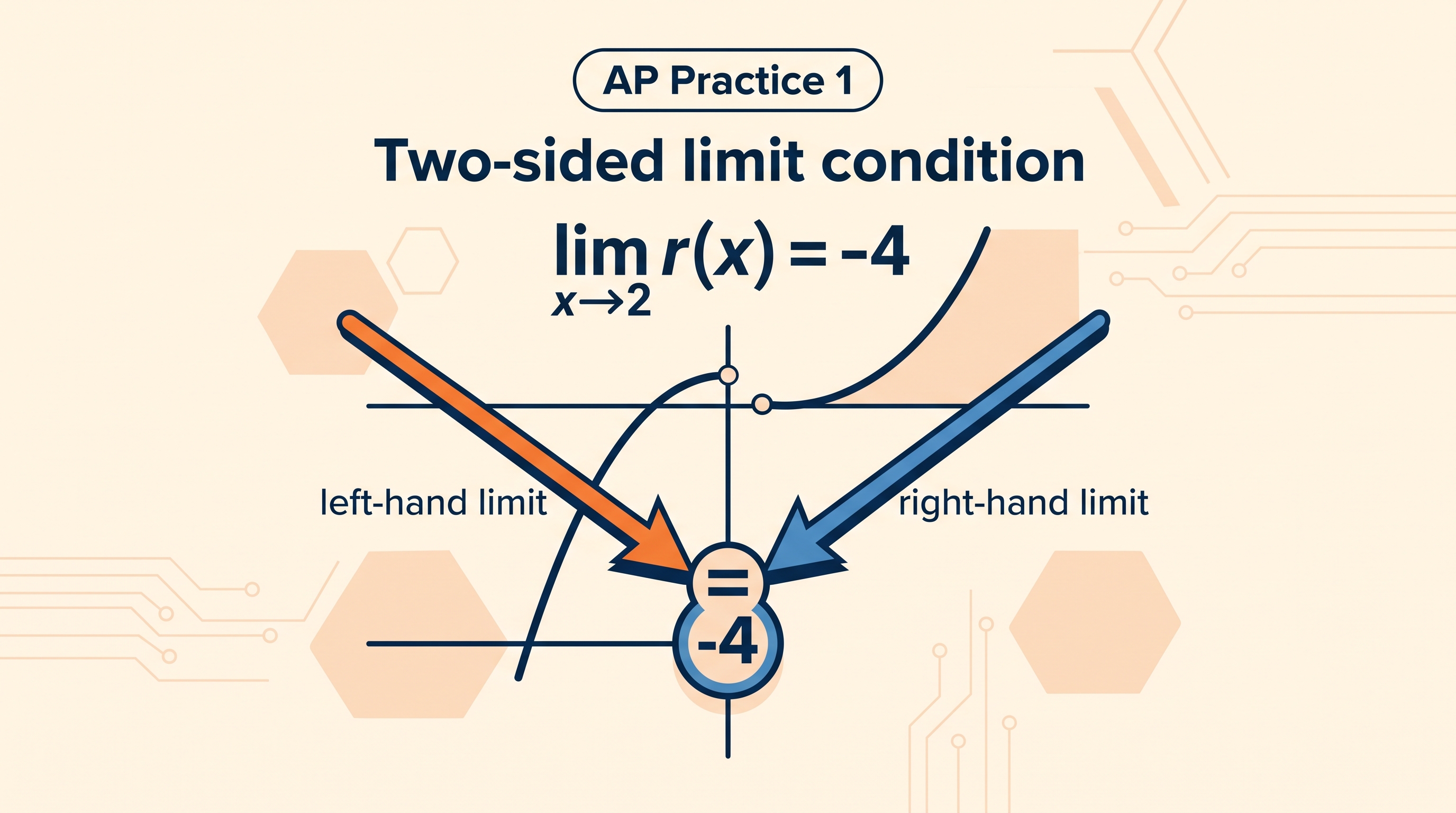
Write the following claim in correct analytical form: “As $x$ approaches $2$, the function $r$ approaches $-4$.” Then state the condition required for a two-sided limit to exist.
Answer:
$$ \lim_{x\to2}r(x)=-4. $$
The left-hand and right-hand limits must both exist and equal the same number. The essential habit is to write the limit relationship first, then support it with comparison, algebra, a table, or a graph.

Source Materials
- Learn More (.pdf)
- AP Calculus AB and BC Course and Exam Description
- AP Calculus AB Course Overview
- AP Calculus Course at a Glance
- AP Calculus AB and BC Course at a Glance Poster
- Adopt AP Calculus AB
- AP Calculus AB
- AP Calculus AB
- NOTE: Partial versions of the free-response questions are provided to prepare students for more complex, full questions that they will encounter on the AP Exam.
- NOTE: Partial versions of the free-response questions are provided to prepare students for more complex, full questions that they will encounter on the AP Exam.
- Scoring notes:
- Scoring notes: