From the free course AP Calculus AB on Lykke
3.3 Differentiating Inverse Functions
Key concepts: Differentiating inverse functions · Unit 3: Differentiation—composite, implicit, and inverse functions · Using differentiation and its inverse process · Checking the accuracy and appropriateness of solutions · Applying procedures with and without technology
How to find the derivative of an inverse function at a point from the original function's derivative, using reciprocal slopes at corresponding points, without solving for the inverse.
3.3 Differentiating Inverse Functions
If a function converts an input into an output, its inverse reverses that conversion: the inverse function answers, “Which input produced this output?” Differentiation reverses in the same spirit—but not by simply copying the original derivative.
The inverse-function derivative rule
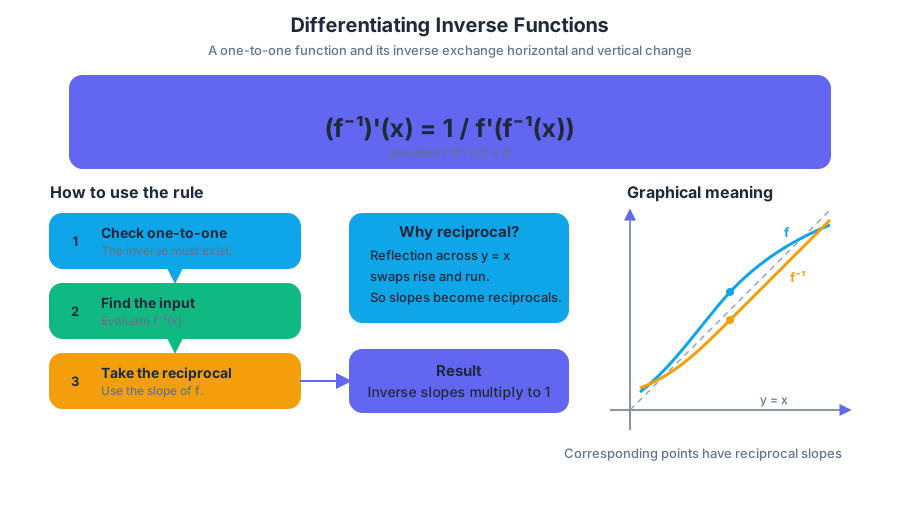
Suppose $f$ is one-to-one, so that its inverse $f^{-1}$ exists. If $y=f(x)$ and $x=f^{-1}(y)$, then the slopes of the two graphs are reciprocal at corresponding points:
If $f$ is differentiable and $f'(f^{-1}(x))\ne0$, then
$$\left(f^{-1}\right)'(x)=\frac{1}{f'\left(f^{-1}(x)\right)}.$$
The notation matters: $f^{-1}(x)$ means the inverse function, not the reciprocal $\frac{1}{f(x)}$. The graphs of $f$ and $f^{-1}$ reflect across the line $y=x$; reflection exchanges horizontal and vertical change, which explains why the slopes become reciprocals.
Where the rule comes from. Because $f(f^{-1}(x))=x$, differentiating both sides with the chain rule gives $f'(f^{-1}(x))\cdot\left(f^{-1}\right)'(x)=1$. Dividing by $f'(f^{-1}(x))$, which must be nonzero, produces the rule above.
Worked example: reversing a calibration curve
A sensor converts an input temperature $x$ into a reading $f(x)=x^3+2x$. To recover temperature from a reading, define $g=f^{-1}$. Find $g'(3)$ without solving explicitly for $g$.
First locate the original input that produces the output $3$:
$$f(1)=1^3+2(1)=3,$$
so $g(3)=1$. Differentiate the original function:
$$f'(x)=3x^2+2.$$
Now apply the inverse-function rule at the corresponding point:
$$g'(3)=\frac{1}{f'(g(3))} =\frac{1}{f'(1)} =\frac{1}{3(1)^2+2} =\frac15.$$
The recovered-temperature function changes at $\frac15$ temperature units per sensor-reading unit when the reading is $3$. Notice that no explicit formula for $f^{-1}$ was required.
Checking an inverse-function derivative
Topic 3.3 explicitly assesses 3.G Confirm that solutions are accurate and appropriate. For an inverse-function derivative, check three things: $f'$ was evaluated at the matching input $f^{-1}(a)$, not at $a$ itself; $f'$ is nonzero there; and the sign is sensible, because an increasing $f$ has an increasing inverse. In the calibration example, $f'(1)=5$ and $g'(3)=\frac15$ multiply to $1$, as reciprocal slopes at corresponding points must.
The procedure represented by 1.E Apply appropriate mathematical rules or procedures, with and without technology requires both symbolic work and technology-supported verification. A graphing calculator can compare a numerical derivative or graph slope, but it does not replace identifying the correct inverse, domain, sign, or missing factor.
Retrieval check: Let $f(x)=x^3+x$ and $g=f^{-1}$. Given that $f(2)=10$, find $g(10)$ and $g'(10)$. Why does the answer use $f'(2)$ rather than $f'(10)$?