From the free course AP Calculus AB on Lykke
4.7 Using L’Hospital’s Rule for Determining Limits of Indeterminate Forms
Key concepts: L’Hospital’s Rule · Limits of indeterminate forms · The indeterminate form 0/0 · The indeterminate form ∞/∞ · Verifying an indeterminate form before applying L’Hospital’s Rule · Determining limits of functions that produce indeterminate forms · Indeterminate-form labels represent a limiting state, not a value · AP Calculus AB and BC scope for L’Hospital’s Rule
A quotient such as $\dfrac{0}{0}$ does not equal zero, and $\dfrac{\infty}{\infty}$ is not a numerical fraction. These symbols label an indeterminate form: direct substitution has not revealed the limit, because different functions with the same apparent form can approach different values.
4.7 Using L’Hospital’s Rule for Determining Limits of Indeterminate Forms
A quotient such as $\dfrac{0}{0}$ does not equal zero, and $\dfrac{\infty}{\infty}$ is not a numerical fraction. These symbols label an indeterminate form: direct substitution has not revealed the limit, because different functions with the same apparent form can approach different values.
Enduring Understanding — LIM-4: L’Hospital’s Rule allows us to determine the limits of some indeterminate forms.
The learning objective is LIM-4.A: Determine limits of functions that result in indeterminate forms. Essential knowledge LIM-4.A.1 identifies $\dfrac{0}{0}$ and $\dfrac{\infty}{\infty}$ as indeterminate forms. Essential knowledge LIM-4.A.2 connects these forms with L’Hospital’s Rule as a possible method.
First diagnose the form
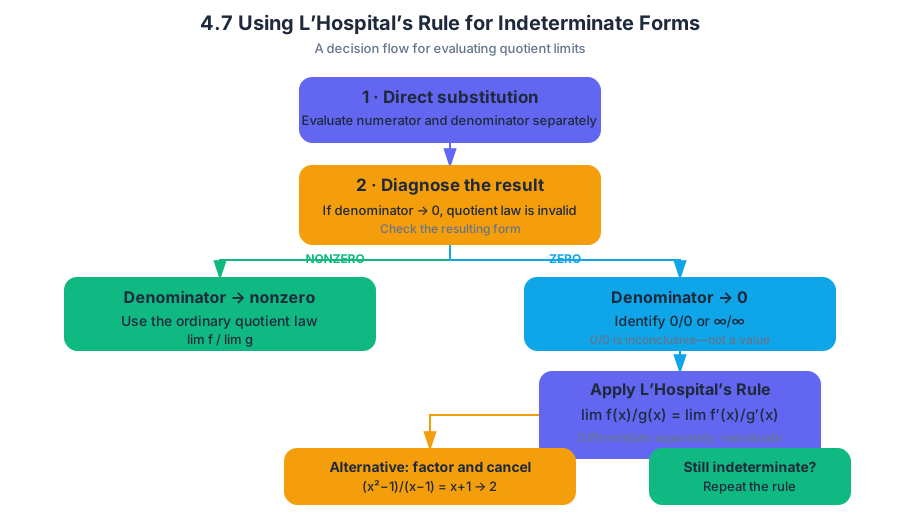
When ordinary limit laws apply and the denominator approaches a nonzero number, a quotient can be evaluated by dividing the separate limits. But if the denominator approaches zero, that quotient rule cannot be used:
$$ \lim_{x\to a}\frac{f(x)}{g(x)} \neq \frac{\lim_{x\to a}f(x)}{\lim_{x\to a}g(x)} \qquad\text{when}\qquad \lim_{x\to a}g(x)=0. $$
The correct first move is direct substitution, not immediate differentiation.
- Compute the limiting behavior of the numerator.
- Compute the limiting behavior of the denominator.
- Apply L’Hospital’s Rule only if the result is $\dfrac{0}{0}$ or $\dfrac{\infty}{\infty}$.
- Differentiate the numerator and denominator separately.
- Reevaluate the new limit.
For example,
$$ \lim_{x\to 1}\frac{x^2-1}{x-1} $$
produces
$$ \frac{1^2-1}{1-1}=\frac{0}{0}. $$
This does not mean the limit equals $\dfrac{0}{0}$. It means direct substitution is inconclusive. In this particular case, factoring is enough:
$$ \frac{x^2-1}{x-1}
\frac{(x-1)(x+1)}{x-1}
x+1 \qquad (x\ne1), $$
so
$$ \lim_{x\to1}\frac{x^2-1}{x-1}
\lim_{x\to1}(x+1)=2. $$
L’Hospital’s Rule
L’Hospital’s Rule says that, under the appropriate differentiability and existence conditions, if
$$ \lim_{x\to a}f(x)=\lim_{x\to a}g(x)=0 $$
or both functions approach infinity, then
$$ \lim_{x\to a}\frac{f(x)}{g(x)}
\lim_{x\to a}\frac{f'(x)}{g'(x)}, $$
provided the limit on the right exists or approaches infinity in a suitable way.
The rule compares rates of approach. It does not say that a quotient of limits may be replaced mechanically by a quotient of derivatives in every problem. The indeterminate form must be verified first.
The $\dfrac{0}{0}$ form
Consider
$$ \lim_{x\to0}\frac{\sin x}{x}. $$
Direct substitution gives
$$ \frac{\sin 0}{0}=\frac{0}{0}, $$
so L’Hospital’s Rule is eligible:
$$ \lim_{x\to0}\frac{\sin x}{x}
\lim_{x\to0}\frac{\cos x}{1}
\frac{\cos0}{1}
$$
The same limit can be established by other calculus methods; L’Hospital’s Rule is useful because differentiation removes the indeterminate quotient.
The $\dfrac{\infty}{\infty}$ form
Now examine
$$ \lim_{x\to\infty}\frac{3x^2+1}{2x^2-5}. $$
As $x\to\infty$, both the numerator and denominator approach infinity, so the expression has the form $\dfrac{\infty}{\infty}$. Applying the rule gives
$$ \lim_{x\to\infty}\frac{6x}{4x}
\lim_{x\to\infty}\frac{3}{2}
\frac{3}{2}. $$
Here the rule exposes the dominant growth rates of the two functions.
A scope and notation warning
Misconception — “The limit equals $\dfrac{0}{0}$.” Writing
$$ \lim_{x\to a}\frac{f(x)}{g(x)}=\frac{0}{0} $$
is incorrect. Instead write: “Direct substitution gives the indeterminate form $\dfrac{0}{0}$,” and then continue with an appropriate method.
For AP Calculus AB and BC, $\dfrac{0}{0}$ and $\dfrac{\infty}{\infty}$ are recognized as indeterminate forms, but L’Hospital’s Rule is not required as an AP-exam method. Treat it as an enrichment technique unless a particular course or teacher explicitly assesses it. Other forms, including $\infty-\infty$, are outside the assessed AP Calculus AB and BC scope described here.
When L’Hospital’s Rule is used in a setting that permits it, the reasoning must include the diagnosis:
“Because the numerator and denominator both approach $0$, the expression has the indeterminate form $\dfrac{0}{0}$; therefore L’Hospital’s Rule may be applied.”
This explicitly demonstrates Skill 3.D: Use mathematical reasoning to solve problems by checking the condition before executing the procedure.
Retrieval check
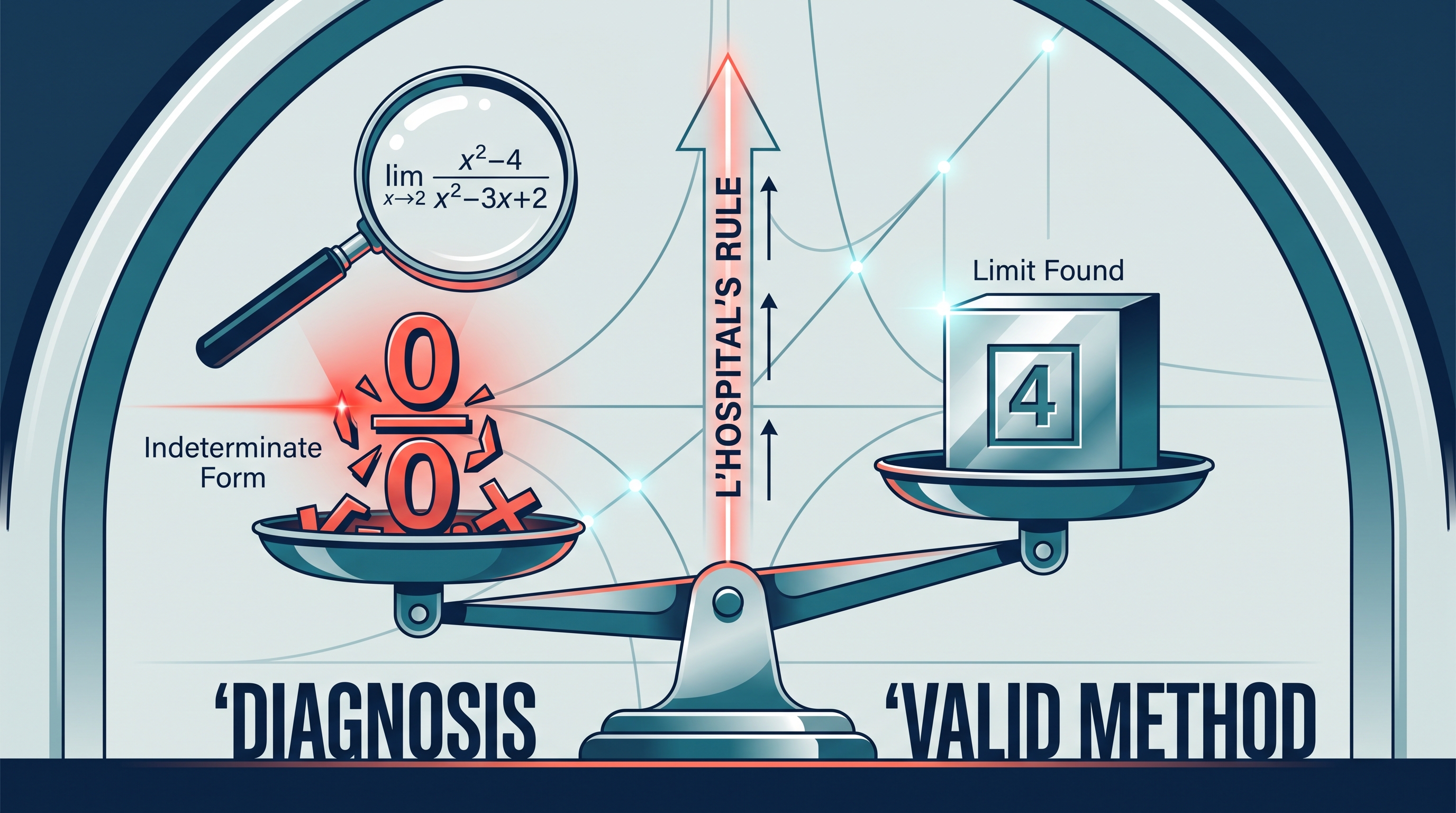
For
$$ \lim_{x\to2}\frac{x^2-4}{x^2-3x+2}, $$
direct substitution gives $\dfrac{0}{0}$. Is that the answer? No: it is only a diagnosis. Factoring produces
$$ \frac{(x-2)(x+2)}{(x-2)(x-1)}
\frac{x+2}{x-1}, $$
so the limit is
$$ \boxed{4}. $$
The essential habit is: verify the indeterminate form first, then choose a valid method.
Source Materials
- Learn More (.pdf)
- AP Calculus AB and BC Course and Exam Description
- AP Calculus AB Course Overview
- AP Calculus Course at a Glance
- AP Calculus AB and BC Course at a Glance Poster
- Adopt AP Calculus AB
- AP Calculus AB
- AP Calculus AB
- 0 < t < π and at a single value in π < t < 5. It is not necessary to state that -dH dt does not change
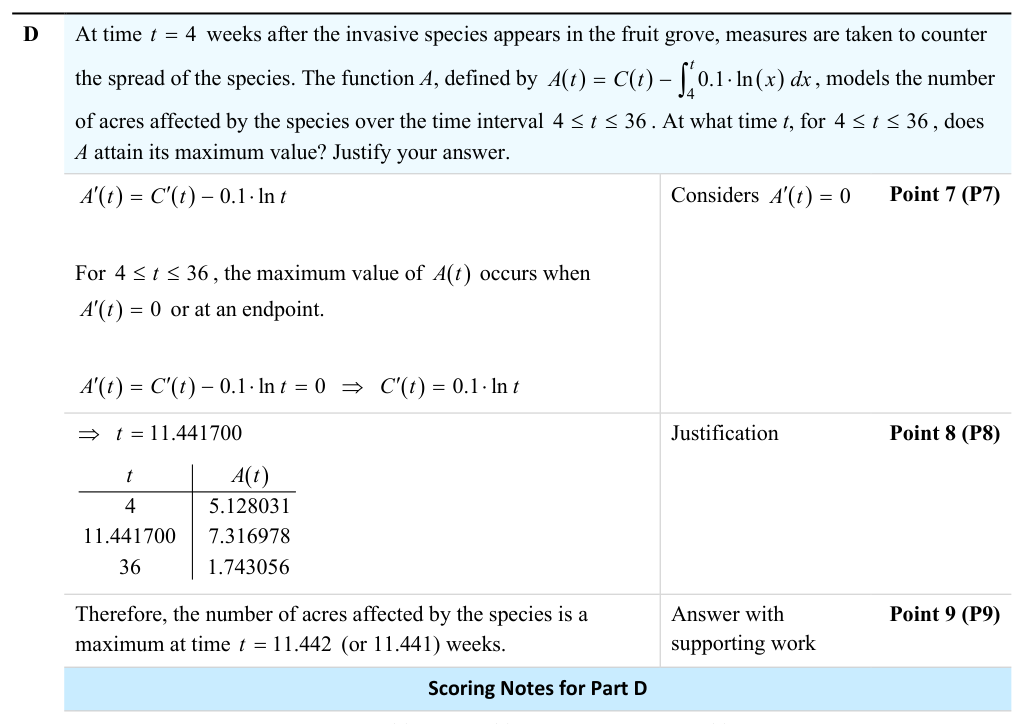
- • P7 is earned for considering A t ′( ) = 0 , C t ′( ) − ⋅ 0.1 ln t = 0, or C t ′( ) = 0.1⋅ln t . P7 is not earned
- • P7 is earned for considering g x ′( ) = 0 or f (x) = 0 . P7 is not earned by just presenting x = 0 and
- • P7 is earned for considering A t ′( ) = 0 , C t ′( ) − ⋅ 0.1 ln t = 0, or C t ′( ) = 0.1⋅ln t . P7 is not earned