From the free course AP Calculus AB on Lykke
AP Practice 5
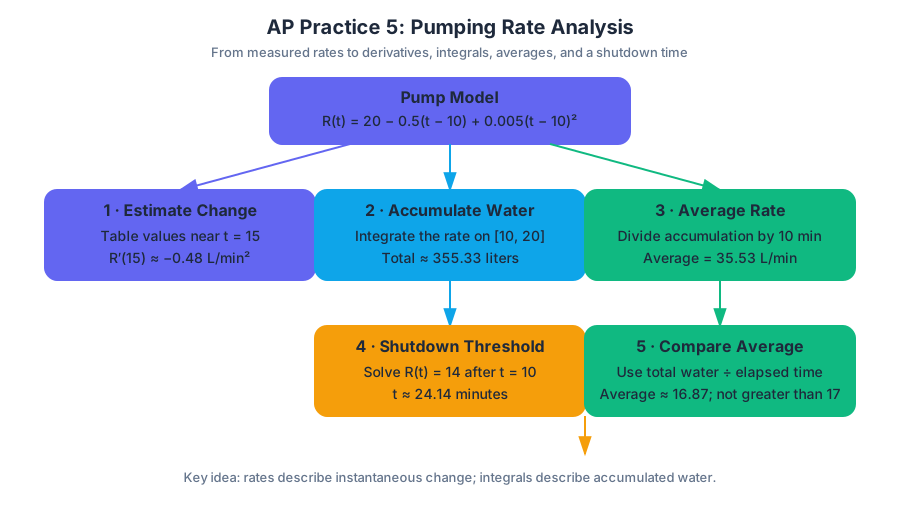
A pump’s changing flow rate can be analyzed in four representations at once: a table of measurements, a polynomial model, a derivative, and a definite integral.
AP Practice 5
A pump’s changing flow rate can be analyzed in four representations at once: a table of measurements, a polynomial model, a derivative, and a definite integral. This practice targets an original calculator-allowed free-response question, where correct procedures matter—but so do interpretation, justification, and notation.
Task profile
| Feature | Guidance |
|---|---|
| Task type | Calculator-allowed free-response question |
| Suggested time | About $15$ minutes |
| Main skills | Mathematical Practice 1: Implementing Mathematical Processes; Mathematical Practice 2: Connecting Representations; Mathematical Practice 3: Justification; Mathematical Practice 4: Communication and Notation |
| Typical evidence | Numerical derivative, definite integral, equation solving, units, and contextual conclusions |
| Calculator role | Numerical differentiation, integration, graphing, and solving are appropriate, but the mathematical setup must still be visible |
Original practice problem
Water flows through a treatment plant’s pump at a rate $R(t)$ liters per minute, where $t$ is measured in minutes. The pump begins operating at $t=10$. Measurements of the rate are shown below.
| $t$ | $10$ | $12$ | $15$ | $20$ | $25$ | $30$ |
|---|---|---|---|---|---|---|
| $R(t)$ | $20.0$ | $19.0$ | $17.6$ | $15.5$ | $13.6$ | $12.0$ |
For this problem, the plant uses the model
$$ R(t)=20-0.5(t-10)+0.005(t-10)^2 $$
for $10\le t\le 30$.
(a) Use the table to estimate $R'(15)$. Interpret your answer in context.
(b) Find the total amount of water pumped from $t=10$ to $t=20$.
(c) Find the average pumping rate on the interval $10\le t\le 20$.
(d) The pump is turned off when its rate first decreases to $14$ liters per minute after $t=10$. Find the time when the pump is turned off.
(e) Is the average pumping rate from $t=10$ until the pump is turned off greater than $17$ liters per minute? Justify your answer.
Worked solution
Part (a): Connect the table to a derivative
A centered difference around $t=15$ uses the closest available times on either side:
$$ R'(15)\approx \frac{R(20)-R(12)}{20-12} =\frac{15.5-19.0}{8} =-0.4375. $$
Therefore,
$$ R'(15)\approx -0.44\text{ liters per minute per minute}. $$
The negative sign means that at $t=15$, the pumping rate is decreasing by approximately $0.44$ liters per minute each minute.
Rubric-aligned evidence: The response earns the process credit by using a valid difference quotient, and it earns interpretation credit by explaining both the sign and the units. Writing only $-0.44$ is not a complete contextual answer.
Part (b): Accumulation through a definite integral
Because $R(t)$ is a rate in liters per minute, integrating it over a time interval gives an amount in liters:
$$ \text{Water pumped}=\int_{10}^{20}R(t),dt. $$
Using the model,
$$ \int_{10}^{20}\left[20-0.5(t-10)+0.005(t-10)^2\right]dt \approx 176.67. $$
The total amount pumped is therefore approximately
$$ \boxed{176.67\text{ liters}}. $$
A calculator may evaluate the integral, but the setup must show the correct rate function and bounds.
Part (c): Average value of a rate
The average pumping rate is not the total amount. It is the accumulated amount divided by elapsed time:
$$ R_{\text{avg}} =\frac{1}{20-10}\int_{10}^{20}R(t),dt =\frac{176.67}{10} \approx 17.67. $$
Thus the average pumping rate is
$$ \boxed{17.67\text{ liters per minute}}. $$
Part (d): First time the rate reaches $14$
Set the model equal to the shutdown rate:
$$ 20-0.5(t-10)+0.005(t-10)^2=14. $$
A numerical solver gives
$$ t\approx 22.55 $$
as the first solution after $t=10$. The pump is turned off at approximately
$$ \boxed{t=22.55\text{ minutes}}. $$
The model is decreasing on the relevant interval because
$$ R'(t)=-0.5+0.01(t-10), $$
and $R'(t)<0$ for $10\le t\le30$. Therefore, the first solution is the physically relevant shutdown time.
Part (e): Compare the average rate with $17$
Let $t_*=22.55$ be the shutdown time. The average rate from startup until shutdown is
$$ \frac{1}{t_-10}\int_{10}^{t_}R(t),dt \approx 17.13\text{ liters per minute}. $$
Since
$$ 17.13>17, $$
the average pumping rate is greater than $17$ liters per minute.
A complete conclusion states the comparison and refers to the calculated quantity: “Yes; the average rate is approximately $17.13$ liters per minute, which is greater than $17$ liters per minute.”
Common misconceptions
Confusing $R(t)$ with $R'(t)$. The function $R(t)$ measures water flow; its derivative measures how quickly that flow rate changes. Their units are different.
Forgetting the factor in an average value. The integral gives total water, not average rate. Divide by the interval length.
Using inconsistent models. The table and polynomial here describe the same rate pattern: the polynomial gives approximately $R(12)=19.02$, $R(15)=17.625$, and $R(20)=15.5$, matching the displayed rounded data.
Reporting a calculator output without justification. A numerical answer is strongest when accompanied by the equation, integral, or derivative expression that produced it.
Error-review routine
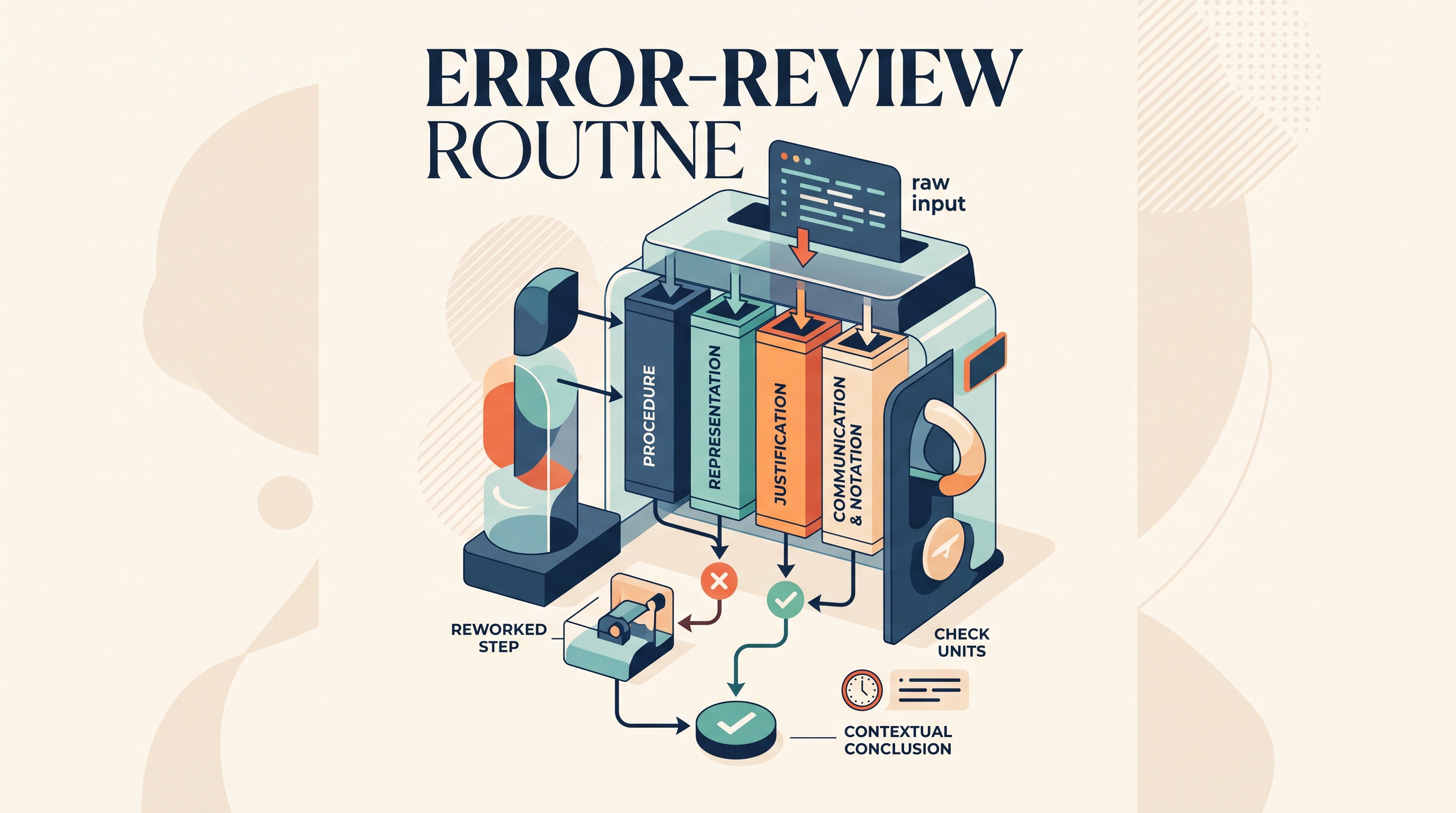
After completing the problem, label each error as one of four types: procedure, representation, justification, or communication and notation. Rework only the failed step, then check units and whether every requested contextual conclusion includes a sentence—not merely a number.
Retrieval check: If $R(t)$ is measured in liters per minute, what units must $\int_a^bR(t),dt$ have, and what units must $R'(t)$ have?
Source Materials
- Learn More (.pdf)
- AP Calculus AB and BC Course and Exam Description
- AP Calculus AB Course Overview
- AP Calculus Course at a Glance
- AP Calculus AB and BC Course at a Glance Poster
- Adopt AP Calculus AB
- AP Calculus AB
- AP Calculus AB
- AP Calculus AB-AP Students
- AP/College Calculus AB
- What's the Difference Between AP Calculus AB vs. BC-Princeton Review
- Free AP Calculus Lesson Plans-Math Medic