From the free course AP Calculus AB on Lykke
1.2 Defining Limits and Using Limit Notation
Key concepts: The concept of a limit · Limit notation · Evaluating limits graphically · Evaluating limits numerically · Evaluating limits analytically · Evaluating limits verbally · Using limits to analyze functions and justify conclusions · The connection between limits and continuity
What a limit means, how to write it, and how to read one from a graph, a table or algebra, including when it differs from the function's value.
1.2 Defining Limits and Using Limit Notation
Topic 1.1 found an instantaneous velocity by watching what average velocities approach as the time interval shrinks. That idea of approaching a value, without needing to arrive at it, is the limit. This page gives it a precise meaning and the notation used for it everywhere else in the course.
What a limit means
A limit describes the value that a function approaches as its input approaches a particular number. The notation
$$ \lim_{x\to a}f(x)=L $$
means that $f(x)$ approaches $L$ as $x$ approaches $a$.
The arrow in $x\to a$ describes the input’s motion; it does not require $x=a$. This distinction matters because the function may be undefined at $a$, or its actual value $f(a)$ may differ from the value approached nearby.
Consider
$$ f(x)=\frac{x^2-4}{x-2}. $$
At $x=2$, the expression is undefined because its denominator is $0$. For $x\ne2$, factor and simplify:
$$ f(x)=\frac{(x-2)(x+2)}{x-2}=x+2. $$
Therefore,
$$ \lim_{x\to2}\frac{x^2-4}{x-2}
\lim_{x\to2}(x+2)
4, $$
even though $f(2)$ does not exist.
Reading a limit from representations
A graph gives a visual limit procedure: locate $x=a$, then inspect the $y$-values the curve approaches as $x$ moves toward $a$ from the left and from the right. If both sides approach the same number $L$, then $\lim_{x\to a}f(x)=L$; if they approach different values, the two-sided limit does not exist.
A removable hole illustrates the distinction clearly: a curve may approach $y=4$ from both directions while displaying an open circle at $(2,4)$ and a filled point elsewhere—or no filled point at all. The limit is still $4$ because the limit concerns nearby behavior, not necessarily the point’s plotted value.
Nearby numerical values can also support a limit estimate. The reliable question is not “What is the value at $x=a$?” but “What values does $f(x)$ approach when $x$ is chosen increasingly close to $a$?” Extended table-based estimation belongs to Topic 1.4.
Reasoning and representation
These topics emphasize CHA 1.1 Introducing Calculus: Can Change Occur at an Instant? and LIM 1.2 Defining Limits and Using Limit Notation, each associated with Mathematical Practice 2—Connecting Representations. A strong conclusion connects a graphical, numerical, analytical, or verbal observation rather than reporting an unsupported number.
The work also uses Mathematical Practice 1—Implementing Mathematical Processes, when algebraic limit properties or simplification are selected; Mathematical Practice 3—Justification, when left- and right-hand behavior is checked; and Mathematical Practice 4—Communication and Notation, when the limit is written with correct symbols, units, and a clear interpretation. When a calculator is used for a numerical estimate, keep appropriate precision during computation and round the final reported value appropriately.
Misconception check — “The limit equals $f(a)$.”
Not always. The limit is the value approached near $a$; $f(a)$ is the function’s actual assigned value at $a$. They are equal only when the function is defined there with that same value.
Retrieval check: If a graph approaches $y=-3$ from both sides as $x\to5$, but the filled point at $x=5$ has height $2$, state $\lim_{x\to5}f(x)$ and $f(5)$. Why are the two answers different?
Source Materials
- Learn More (.pdf)
- AP Calculus AB and BC Course and Exam Description
- AP Calculus AB Course Overview
- AP Calculus Course at a Glance
- AP Calculus AB and BC Course at a Glance Poster
- Adopt AP Calculus AB
- AP Calculus AB
- AP Calculus AB
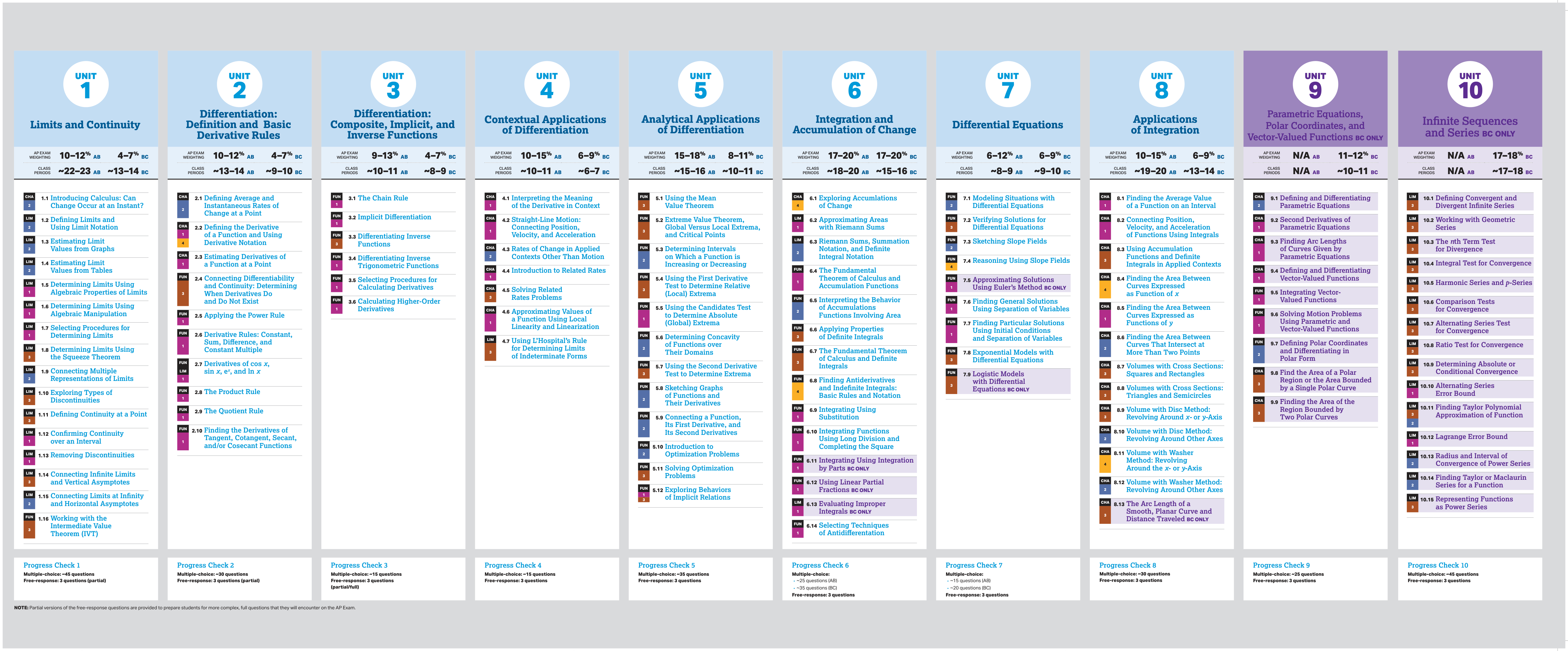
- Figure — AP Calculus AB and BC Course at a Glance Poster (p. 1)
- AP Calculus AB-AP Students
- AP/College Calculus AB
- What's the Difference Between AP Calculus AB vs. BC-Princeton Review