From the free course AP Calculus AB on Lykke
6.4 The Fundamental Theorem of Calculus and Accumulation Functions
Key concepts: Unit 6: Integration and Accumulation of Change · The relationship between integration and differentiation · The Fundamental Theorem of Calculus · Accumulation functions · Definite integrals · Modeling real-world behavior through accumulation and change · AP Calculus AB and BC course expectations
How accumulation functions are built from a moving upper limit, and how the Fundamental Theorem of Calculus ties their derivative back to the rate.
6.4 The Fundamental Theorem of Calculus and Accumulation Functions
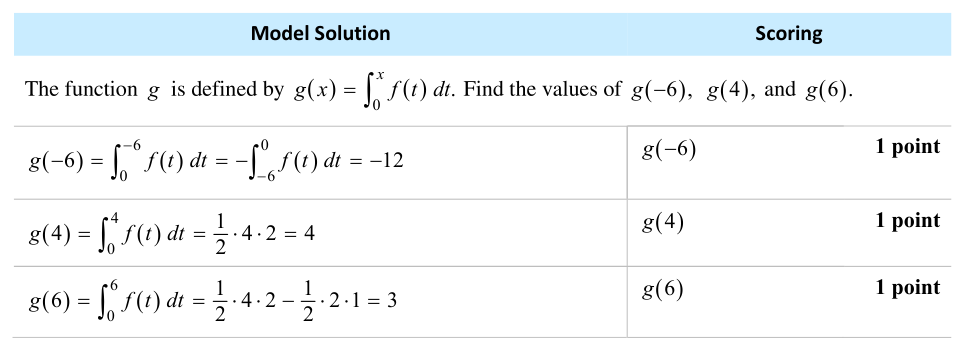
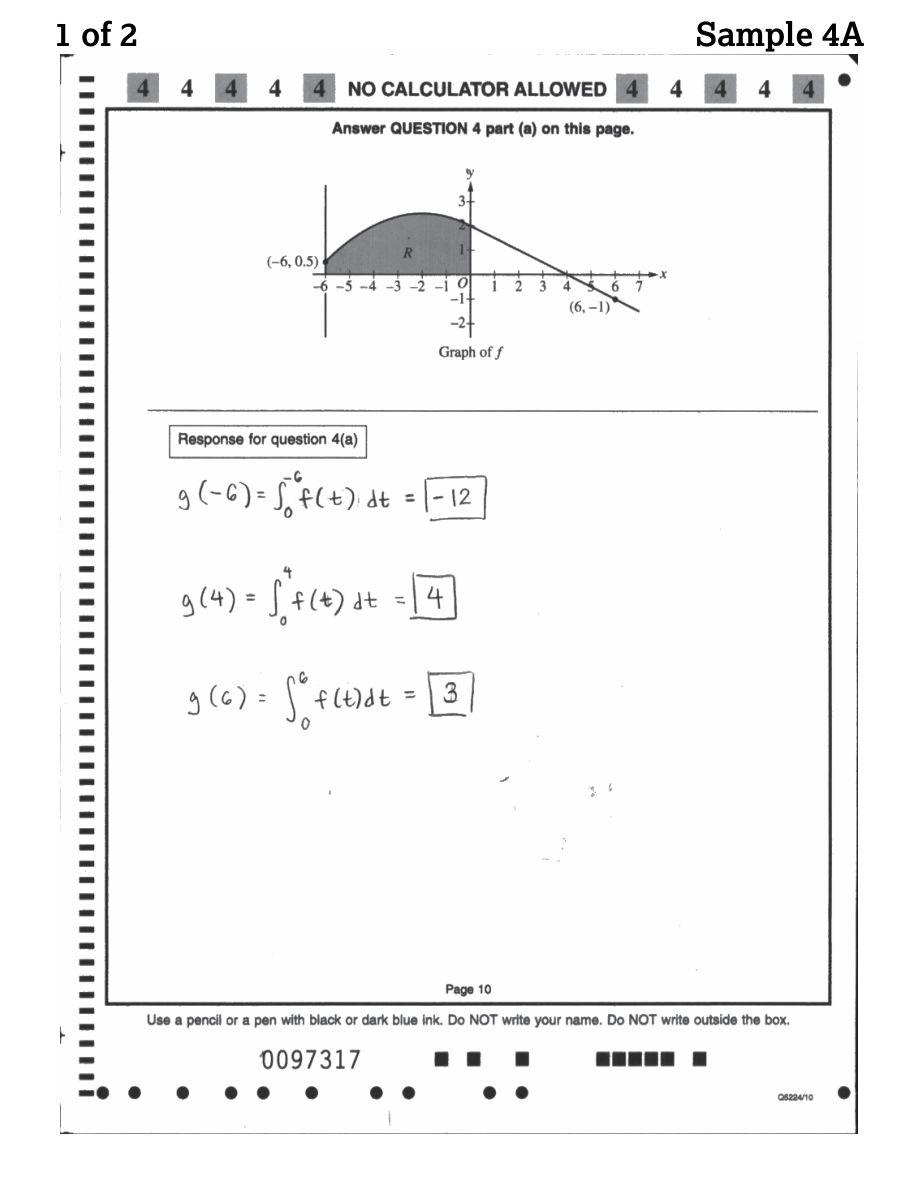
A definite integral $\int_a^b f(x),dx$ gives one number: the net accumulation over a fixed interval. Let the upper endpoint move and the integral becomes a function. The Fundamental Theorem of Calculus says how fast that function changes, and in doing so it links integration to differentiation.
Accumulation functions
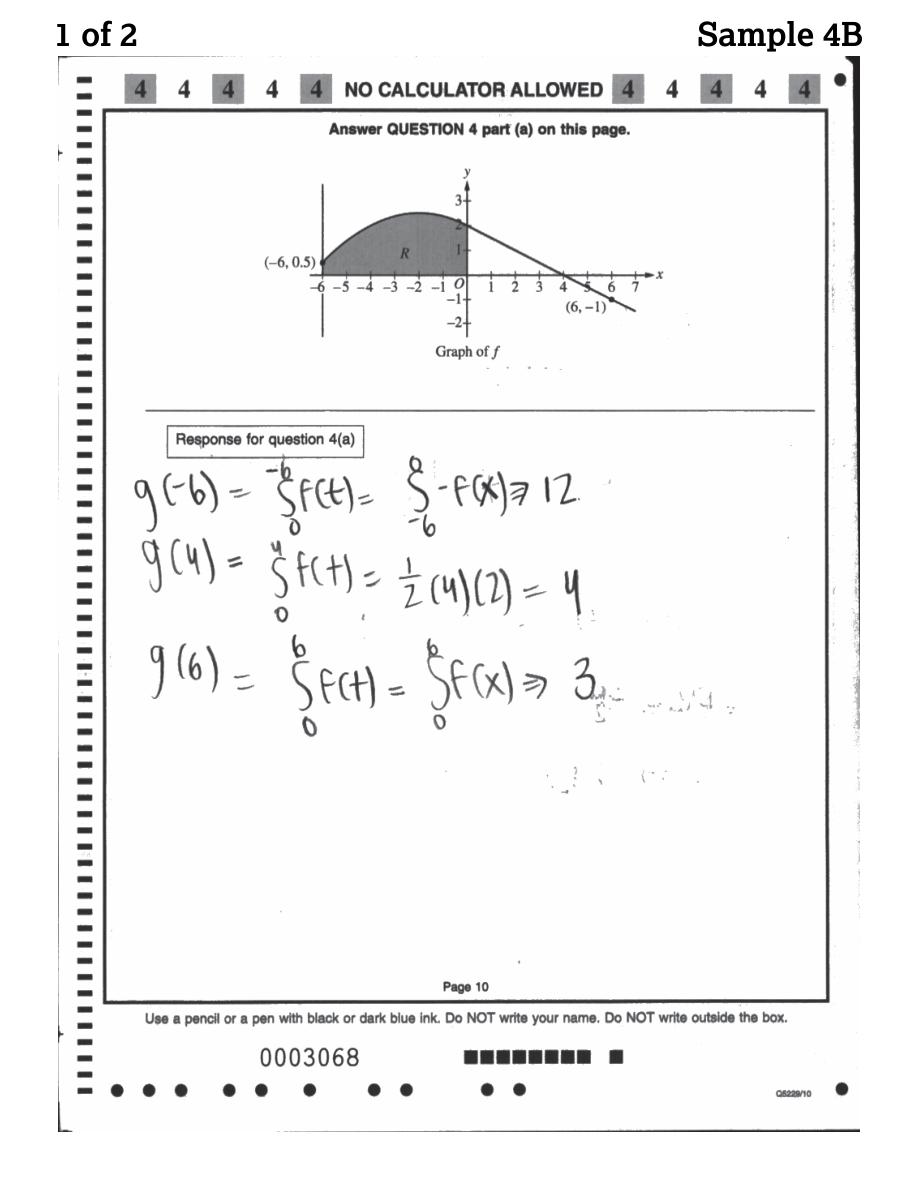
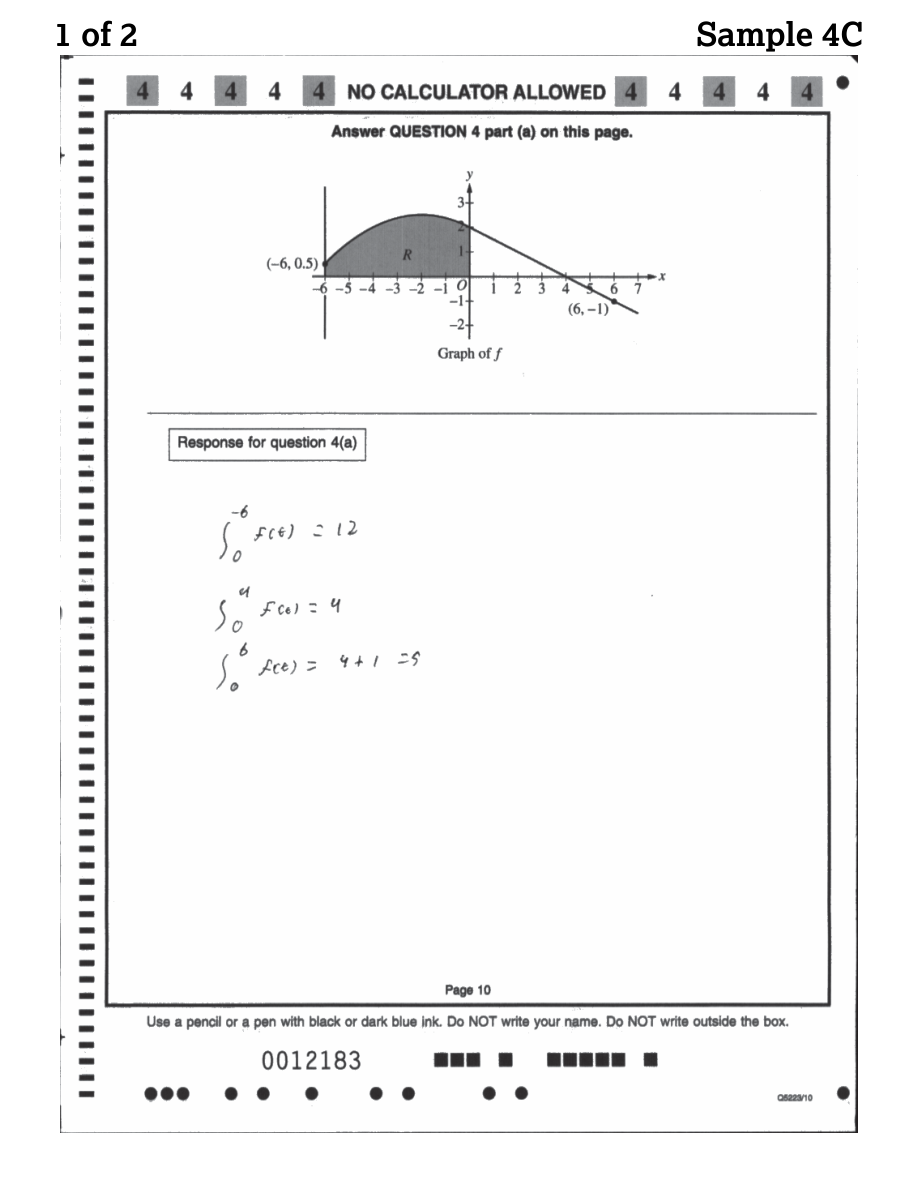
An accumulation function records how much change has built up from a fixed starting point. Given a rate function $f$, define
$$ A(x)=\int_a^x f(t),dt. $$
Here, $a$ is fixed while $x$ varies. The variable $t$ is a dummy variable: it identifies the input inside the integral, while $x$ identifies the current endpoint and therefore the input of the new function $A$.
For example, let $q(t)$ be the flow rate of water into a tank, in gallons per hour, and define
$$ V(t)=200+\int_0^t q(s),ds. $$
The tank begins with $200$ gallons. The integral gives the net volume added after $t$ hours, so $V(t)$ gives the tank’s total volume. Notice the structural relationship:
$$ V'(t)=q(t). $$
The derivative of the accumulated total is the current rate of accumulation.
The Fundamental Theorem of Calculus
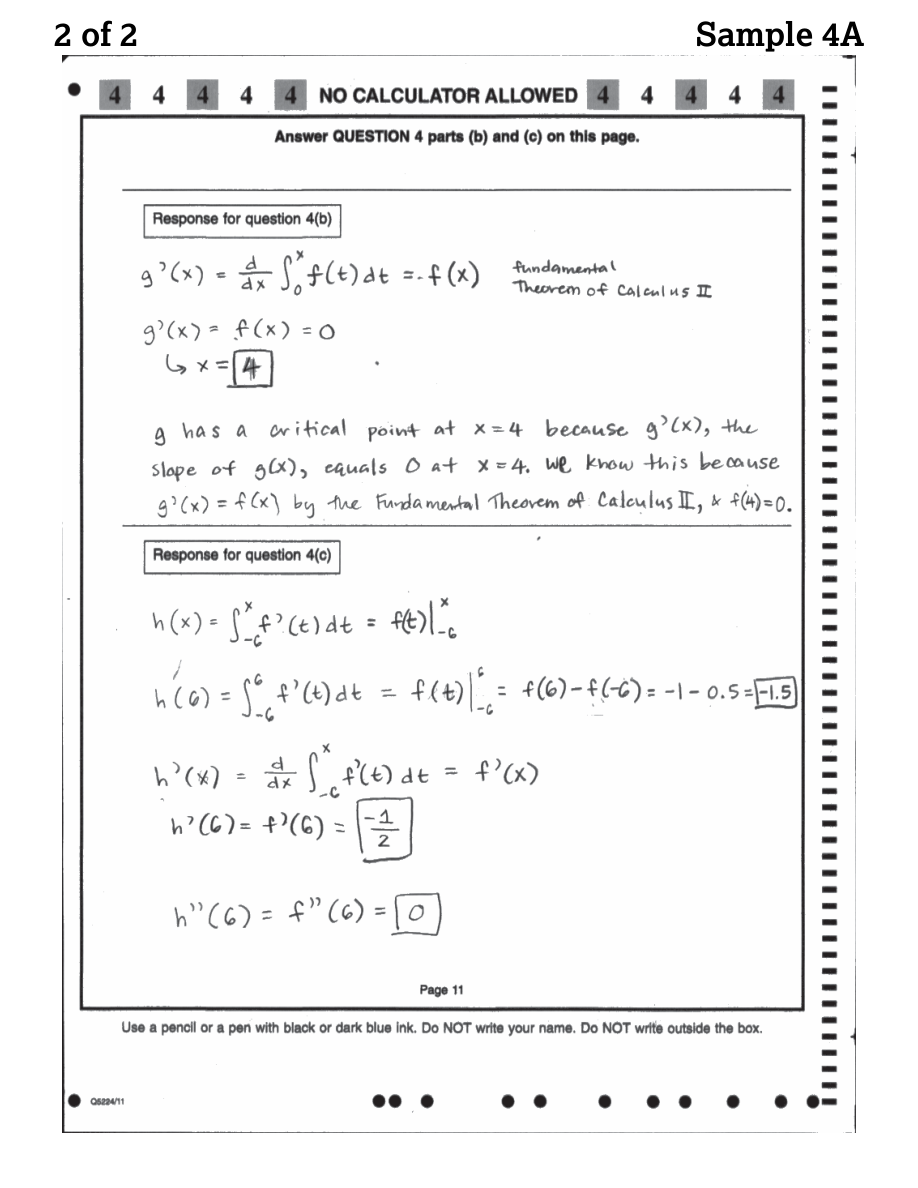
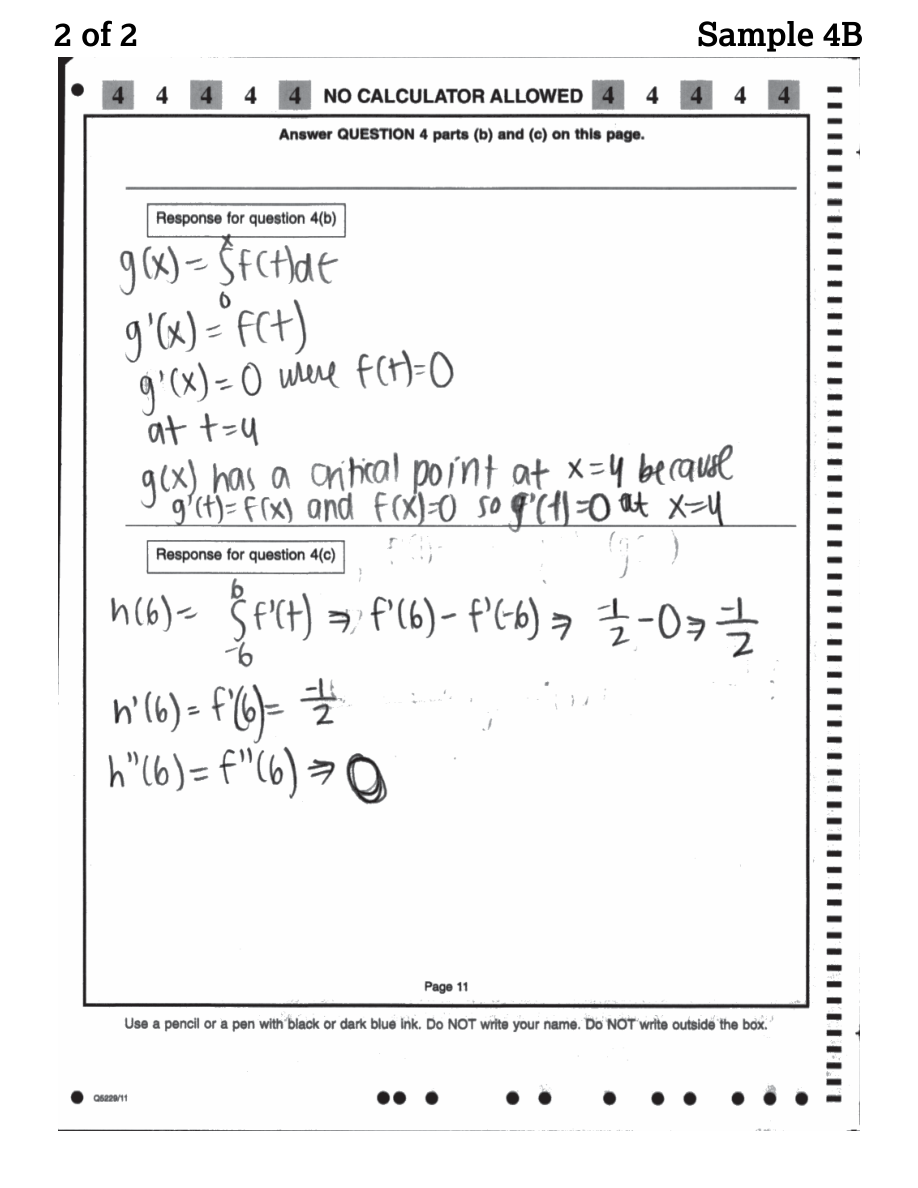
The Fundamental Theorem of Calculus expresses the central relationship between integration and differentiation. In its accumulation-function form, if $f$ is continuous on an interval containing $a$, then
$$ A(x)=\int_a^x f(t),dt \quad\Longrightarrow\quad A'(x)=f(x). $$
This is the conceptual bridge between the two major operations of calculus:
$$ \text{rate of change} ;\xrightarrow{\text{integration}}; \text{accumulated change} $$
and
$$ \text{accumulated change} ;\xrightarrow{\text{differentiation}}; \text{rate of change}. $$
The second practical form evaluates a definite integral using an antiderivative. If $F'(x)=f(x)$, then
$$ \int_a^b f(x),dx=F(b)-F(a). $$
For the tank model, if $q(t)=3t^2+2$ gallons per hour, then an antiderivative is
$$ Q(t)=t^3+2t. $$
The amount of water added from $t=1$ to $t=4$ is
$$ \int_1^4(3t^2+2),dt
\left[t^3+2t\right]_1^4
(64+8)-(1+2)
$$
Thus, $69$ gallons enter the tank during that interval.
The first FTC application differentiates an accumulation function; the second evaluates an accumulated quantity using an antiderivative.
Misconception check
Misconception: “The integral always gives total amount.” A definite integral gives net accumulated change. If a rate becomes negative, its contribution reduces the result. Also, the bounds matter: $\int_a^b f(x),dx$ and $\int_b^a f(x),dx$ have opposite signs.
A second common error is writing an accumulation function as $\int_a^x f(x),dx$. The same symbol cannot clearly serve as both the moving endpoint and the integration variable. Write $\int_a^x f(t),dt$ instead.
AP Calculus alignment and retrieval check
Topics 6.3 Riemann Sums, Summation Notation, and Definite Integral Notation and 6.4 The Fundamental Theorem of Calculus and Accumulation Functions are core AP Calculus AB and BC expectations within Unit 6: Integration and Accumulation of Change, weighted approximately 17–20% of either exam. They chiefly develop Skill 2.C: Identify a re-expression of mathematical information presented in a given representation and Skill 1.D: Identify an appropriate mathematical rule or procedure based on the relationship between concepts. They also require Mathematical Practice 1—Implementing Mathematical Processes, Mathematical Practice 2—Connecting Representations, Mathematical Practice 3—Justification, and Mathematical Practice 4—Communication and Notation.
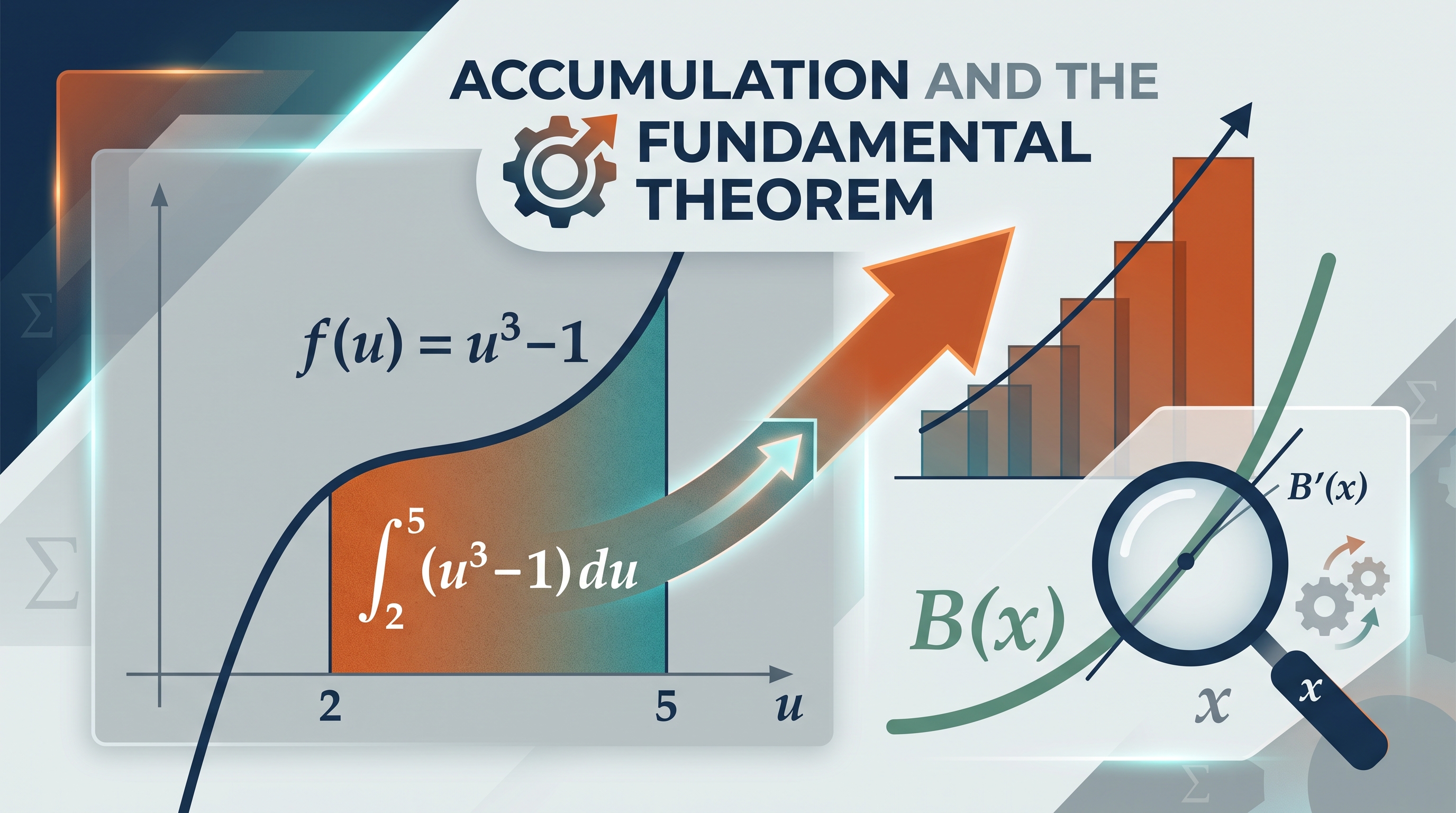
Retrieval check: If $B(x)=\int_2^x (u^3-1),du$, identify $B'(x)$ and explain what $\int_2^5(u^3-1),du$ represents. The answers are
$$ B'(x)=x^3-1 $$
and the net accumulation of the rate $u^3-1$ from $u=2$ to $u=5$.
Source Materials
- Learn More (.pdf)
- AP Calculus AB and BC Course and Exam Description
- AP Calculus AB Course Overview
- AP Calculus Course at a Glance
- AP Calculus AB and BC Course at a Glance Poster
- Adopt AP Calculus AB
- AP Calculus AB
- AP Calculus AB
- Figure — Sample Responses Q4 (p. 2)
- Figure — Sample Responses Q4 (p. 5)
- Figure — Sample Responses Q4 (p. 6)
- Figure — Sample Responses Q4 (p. 7)