From the free course AP Calculus AB on Lykke
AP Practice 6
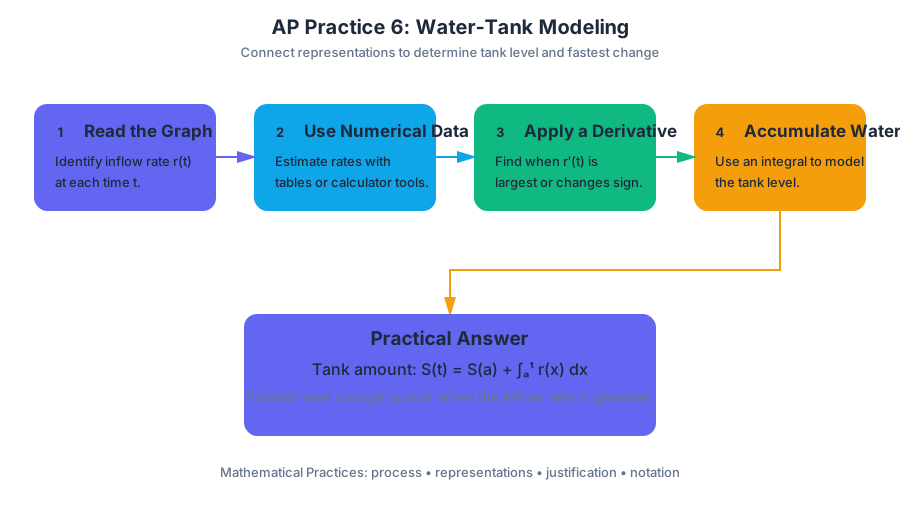
A water-treatment plant monitors the rate at which clean water enters a storage tank. The rate changes throughout the day, so the plant must combine a graph, numerical data, a derivative, and an accumulation model to answer one practical question: How much water is in the tank, and when is its level changing fastest?
This practice is an original, unofficial calculator-active free-response task. It emphasizes the four Mathematical Practices: Mathematical Practice 1: Implementing Mathematical Processes, Mathematical Practice 2: Connecting Representations, Mathematical Practice 3: Justification, and Mathematical Practice 4: Communication and Notation.
Original practice task
Let $r(t)$ be the rate, in liters per minute, at which water enters a tank $t$ minutes after noon. The function $r$ is twice differentiable on the interval $0\leq t\leq 60$. At noon, the tank contains $420$ liters. Selected values of $r$ are shown below.
| $t$ | $0$ | $15$ | $30$ | $45$ | $60$ |
|---|---|---|---|---|---|
| $r(t)$ | $8.0$ | $11.5$ | $13.0$ | $10.0$ | $6.5$ |
Define the amount of water in the tank by
$$ W(t)=420+\int_0^t r(x),dx. $$
(a) Use the data table and the trapezoidal rule with four subintervals to approximate $W(60)$. Include units.
(b) Explain the meaning of $W'(30)$ in context and determine its value.
(c) The plant begins releasing water at a rate of $q(t)=0.1t$ liters per minute for $0\leq t\leq 60$. Let $N(t)$ represent the net rate of change of water in the tank. Write an expression for $N(t)$ and explain why the tank contains more water at $t=60$ than at noon.
(d) A sensor records that $r(20)=12.4$ and $r(40)=11.2$. Explain why there must be at least one time $c$ between $20$ and $40$ at which $r'(c)=0$.
Worked solution
Part (a): Accumulating a rate
The trapezoidal rule estimates the accumulated amount entering the tank:
$$ \int_0^{60}r(t),dt \approx \frac{15}{2}\left[r(0)+2r(15)+2r(30)+2r(45)+r(60)\right]. $$
Substitute the recorded values:
$$ \int_0^{60}r(t),dt \approx \frac{15}{2}\left[8.0+2(11.5)+2(13.0)+2(10.0)+6.5\right]. $$
$$
7.5(83.5)=626.25. $$
Therefore,
$$ W(60)\approx 420+626.25=1046.25\text{ liters}. $$
Rubric-aligned evidence: A complete response identifies the trapezoidal structure, substitutes the data correctly, adds the initial amount, and reports liters. Giving only $626.25$ omits the water already present at noon.
Part (b): Interpreting a derivative
By the Fundamental Theorem of Calculus,
$$ W'(t)=r(t). $$
Thus,
$$ W'(30)=r(30)=13.0. $$
In context, $W'(30)$ is the instantaneous rate at which the amount of water in the tank is increasing $30$ minutes after noon. At that moment, the tank is gaining water at a rate of $13.0$ liters per minute.
Mathematical Practice 2: Connecting Representations appears when the table value $r(30)$ is connected to the derivative of the accumulation function. Mathematical Practice 4: Communication and Notation requires both a numerical value and a contextual interpretation with units.
Part (c): Net change
The tank gains water at rate $r(t)$ and loses water at rate $q(t)=0.1t$. Therefore,
$$ N(t)=r(t)-0.1t. $$
The total change in the tank from noon to $t=60$ is
$$ \int_0^{60}N(t),dt
\int_0^{60}r(t),dt-\int_0^{60}0.1t,dt. $$
Using the approximation from part (a),
$$ \int_0^{60}N(t),dt \approx 626.25-\left[0.05t^2\right]_0^{60}
626.25-180
446.25. $$
Because the net change is positive, the tank contains approximately
$$ 420+446.25=866.25\text{ liters} $$
at $t=60$, which is greater than the $420$ liters present at noon.
Common misconception — adding an outflow: Since water leaves the tank, its rate must be subtracted. Writing $N(t)=r(t)+0.1t$ reverses the physical meaning of the model.
Part (d): Justifying a critical point
Because $r$ is differentiable on $[20,40]$, it is continuous on that interval. The data show
$$ r(20)=12.4 \qquad\text{and}\qquad r(40)=11.2, $$
but these endpoint values alone do not guarantee $r'(c)=0$. The needed observation is that the table also gives $r(30)=13.0$, which is greater than both $r(20)$ and $r(40)$.
By the Extreme Value Theorem, $r$ has an absolute maximum on $[20,40]$. Since the interior value $r(30)=13.0$ exceeds both endpoint values, an absolute maximum occurs at some interior point $c\in(20,40)$. Because $r$ is differentiable at that interior maximum, Fermat’s theorem gives
$$ r'(c)=0. $$
This is Mathematical Practice 3: Justification: the conclusion is supported by continuity, differentiability, an interior maximum, and the theorem that applies.
Timing and error review
Allow approximately $15$ minutes: $4$ minutes for the numerical accumulation, $3$ minutes for derivative interpretation, $4$ minutes for the net-rate model, and $4$ minutes for the theorem justification. Before submitting, check three things: did you include the initial condition, did every contextual answer include units, and did every theorem claim state its required conditions?
A strong response does more than produce correct numbers. It translates between the table, the integral, the derivative, and the physical situation while making its reasoning visible—the combined work of Mathematical Practice 1: Implementing Mathematical Processes, Mathematical Practice 2: Connecting Representations, Mathematical Practice 3: Justification, and Mathematical Practice 4: Communication and Notation.

Source Materials
- Learn More (.pdf)
- AP Calculus AB and BC Course and Exam Description
- AP Calculus AB Course Overview
- AP Calculus Course at a Glance
- AP Calculus AB and BC Course at a Glance Poster
- Adopt AP Calculus AB
- AP Calculus AB
- AP Calculus AB
- AP Calculus AB-AP Students
- AP/College Calculus AB
- What's the Difference Between AP Calculus AB vs. BC-Princeton Review
- Free AP Calculus Lesson Plans-Math Medic