From the free course AP Calculus AB on Lykke
8.1 Finding the Average Value of a Function on an Interval
Key concepts: Average value of a continuous function on an interval · Distinguishing average value from average rate of change · Intermediate Value Theorem and function behavior on an interval
How to compute and interpret the average value of a function as its integral divided by the interval length, and why that is not the average rate of change.
8.1 Finding the Average Value of a Function on an Interval
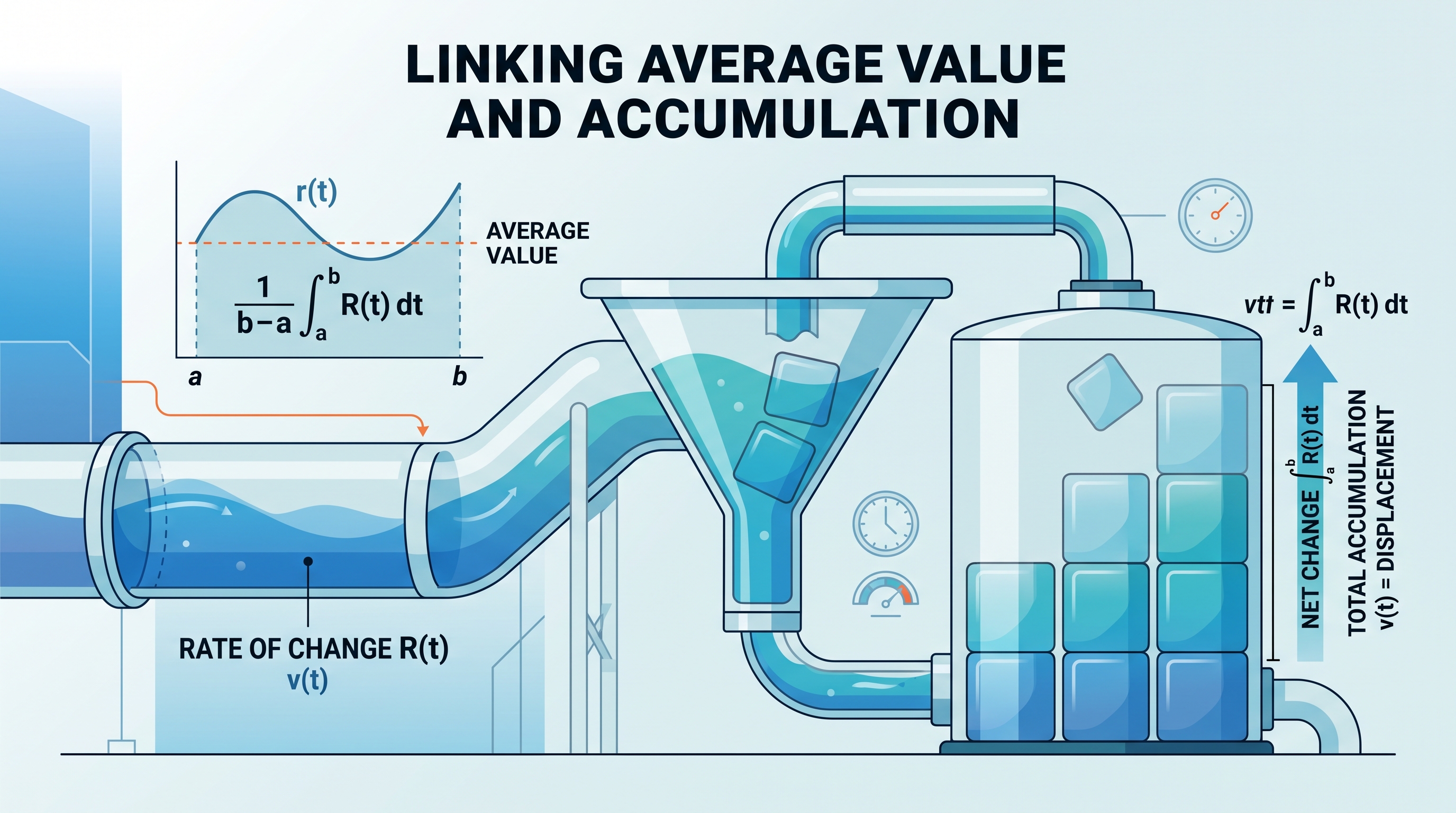
A function’s average value is the height of a constant horizontal line that would produce the same accumulated area as the original function. That idea turns a changing quantity—temperature, flow rate, population density, or velocity—into one meaningful representative value.
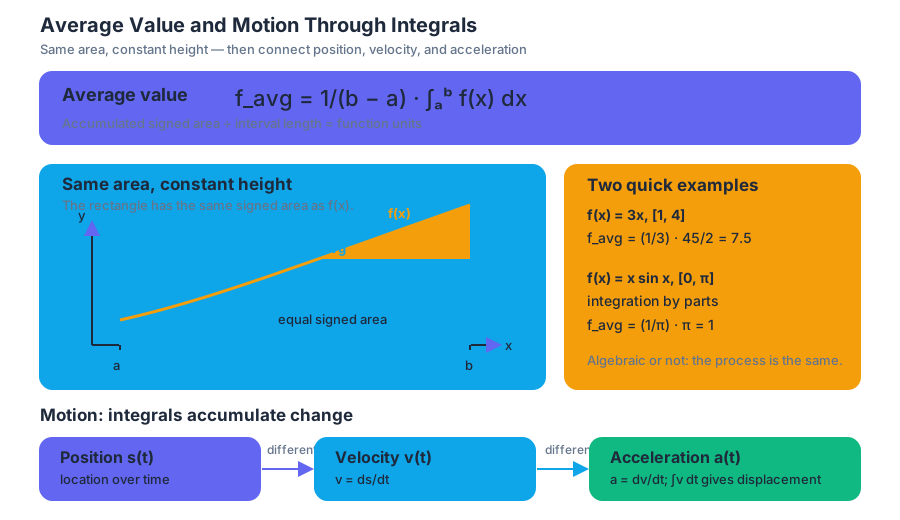
Average value: “same area, constant height”
For a continuous function $f$ on the closed interval $[a,b]$, the average value is
$$ f_{\text{avg}}=\frac{1}{b-a}\int_a^b f(x),dx. $$
The definite integral gives the signed area under $f$, and dividing by the interval length $b-a$ converts that accumulated amount back into the units of $f$.
Geometric meaning: The rectangle with width $b-a$ and height $f_{\text{avg}}$ has exactly the same signed area as the region under $f$.
For example, let $f(x)=3x$ on $[1,4]$. Then
$$ f_{\text{avg}} =\frac{1}{4-1}\int_1^4 3x,dx =\frac{1}{3}\left[\frac{3x^2}{2}\right]_1^4 =\frac{1}{3}\cdot\frac{45}{2} =\frac{15}{2}. $$
Thus, the average value is $7.5$. The graph of $y=7.5$ forms a rectangle whose signed area from $x=1$ to $x=4$ equals the area under $y=3x$.
The same procedure works when the function is not algebraic. For $f(x)=x\sin x$ on $[0,\pi]$,
$$ f_{\text{avg}} =\frac{1}{\pi}\int_0^\pi x\sin x,dx. $$
Using integration by parts,
$$ \int x\sin x,dx=-x\cos x+\sin x, $$
so
$$ f_{\text{avg}} =\frac{1}{\pi}\left[-x\cos x+\sin x\right]_0^\pi =\frac{1}{\pi}(\pi)=1. $$
Average value is not average rate of change
The average rate of change measures how much the function’s output changes per unit of input:
$$ \frac{f(b)-f(a)}{b-a}. $$
The average value measures the mean height of the function:
$$ \frac{1}{b-a}\int_a^b f(x),dx. $$
These quantities answer different questions. For $f(x)=3x$ on $[1,4]$, the average rate of change is
$$ \frac{12-3}{4-1}=3, $$
whereas the average value is $7.5$. A common misconception is to use endpoint values to find average value; endpoint values determine average rate of change, not the accumulated mean.
Because $f$ is continuous, the Intermediate Value Theorem guarantees that $f$ takes every value between $f(a)$ and $f(b)$. The Average Value Theorem for integrals strengthens this idea: there is some $c\in[a,b]$ such that
$$ f(c)=f_{\text{avg}}. $$
The average height is therefore not merely an invented number; a continuous graph actually reaches it.
Topic 8.1 is paired with Skill 1.E: apply appropriate mathematical rules or procedures, with and without technology. For average value that means a correct setup $\frac{1}{b-a}\int_a^b f(x),dx$ on the stated interval, an exact evaluation or a calculator approximation of the integral, and an answer reported in the units of $f$ with an interpretation in context. When $f$ is known only from a table, estimate the integral with a Riemann or trapezoidal sum first, then divide by $b-a$.
Retrieval check: A continuous flow rate is $q(t)$ liters per minute on $[2,8]$. Write, but do not evaluate, the average flow rate and the total volume added. Then state which integral would determine displacement if $q$ were instead velocity.

Source Materials
- Learn More (.pdf)
- AP Calculus AB and BC Course and Exam Description
- AP Calculus AB Course Overview
- AP Calculus Course at a Glance
- AP Calculus AB and BC Course at a Glance Poster
- Adopt AP Calculus AB
- AP Calculus AB
- AP Calculus AB
- Figure — AP Calculus Course at a Glance (p. 1)
- Figure — AP Calculus Course at a Glance (p. 4)
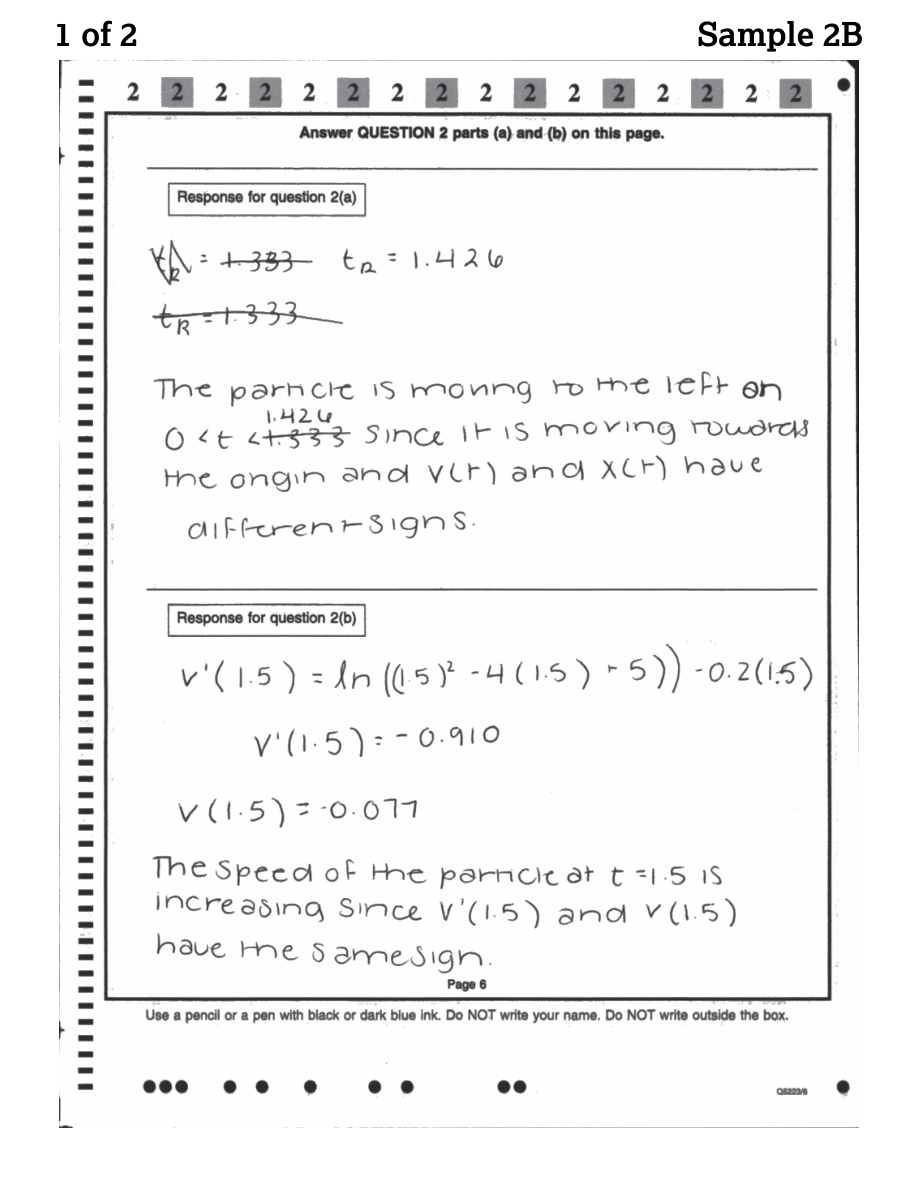
- Figure — Sample Responses Q2 (p. 6)
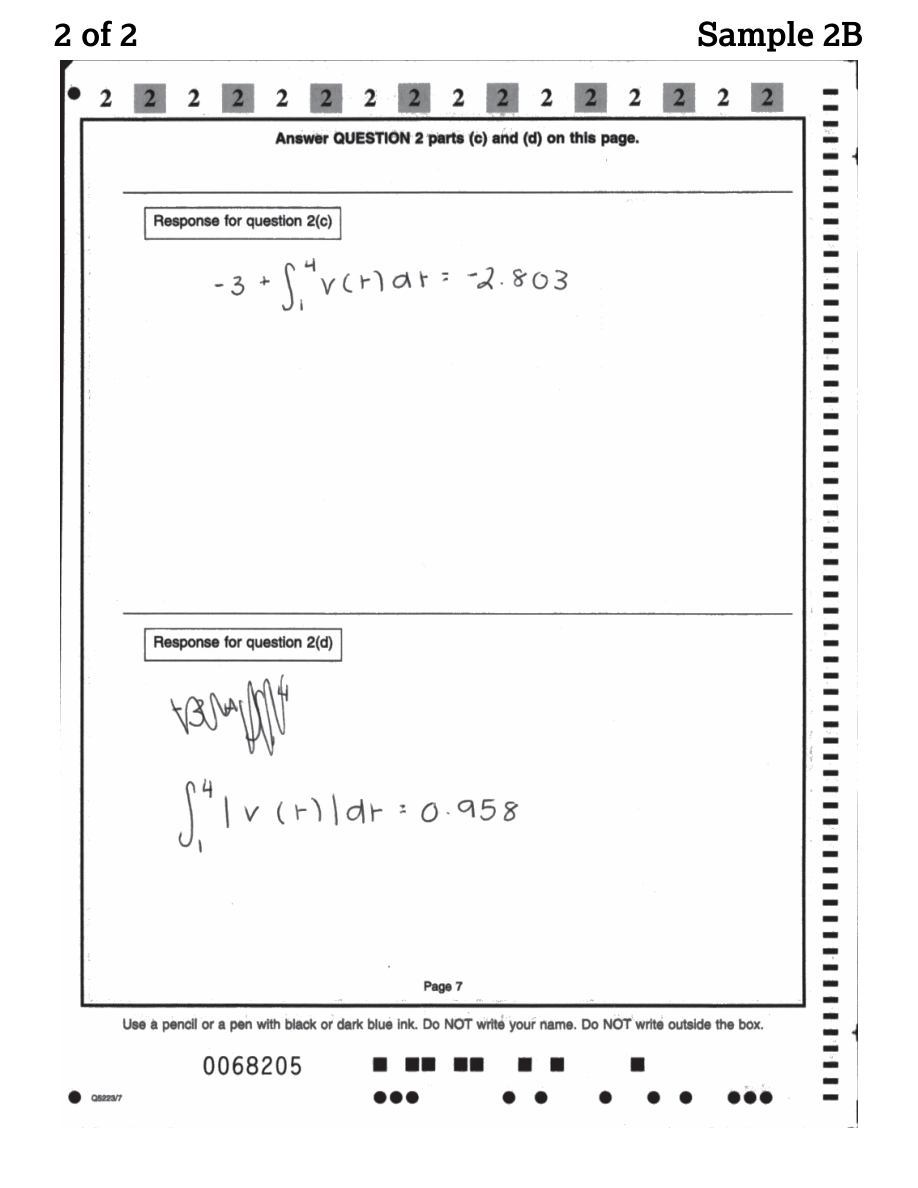
- Figure — Sample Responses Q2 (p. 7)