From the free course AP Calculus AB on Lykke
6.11 Integrating Using Integration by Parts (BC only)
Key concepts: Integration by parts (BC only) · Recognizing when an integrand benefits from integration by parts · Using the product rule in reverse to derive integration by parts
How integration by parts reverses the product rule, how to choose $u$ and $dv$, and a worked evaluation of $\int xe^x\,dx$.
6.11 Integrating Using Integration by Parts (BC only)
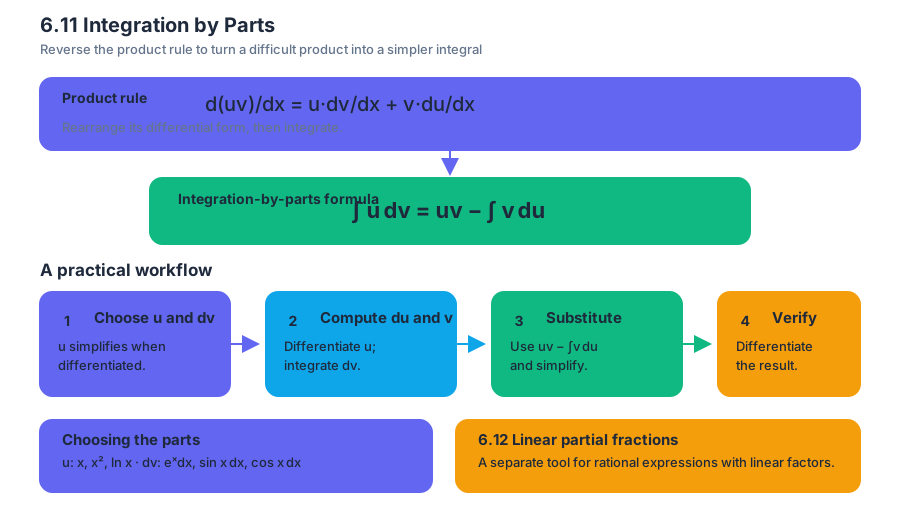
Some integrals become easy only after you reverse a familiar differentiation pattern: the product rule leads to integration by parts, while a complicated rational expression can be split into simpler fractions through linear partial fractions. Both techniques are designated BC only.
Integration by parts: reversing the product rule
The product rule says
$$ \frac{d}{dx}\bigl[u(x)v(x)\bigr]
u(x)\frac{dv}{dx} + v(x)\frac{du}{dx}. $$
Rearranging its differential form and integrating gives the integration-by-parts formula:
$$\int u,dv=uv-\int v,du$$
The method is useful when an integrand is a product whose factors behave differently under differentiation and integration. Usually, choose $u$ as the factor that becomes simpler when differentiated, and choose $dv$ as the factor that can be integrated readily.
A practical choice pattern is:
- Let $u$ be an algebraic factor such as $x$, $x^2$, or $\ln x$.
- Let $dv$ contain a factor with an immediate antiderivative, such as $e^x,dx$, $\sin x,dx$, or $\cos x,dx$.
- Compute $du$ by differentiating $u$ and $v$ by integrating $dv$.
- Substitute into $uv-\int v,du$.
- Differentiate the result to verify it.
Worked example: $\int x e^x,dx$
Choose
$$ u=x, \qquad dv=e^x,dx. $$
Then
$$ du=dx, \qquad v=e^x. $$
Applying integration by parts,
$$ \int xe^x,dx
xe^x-\int e^x,dx
xe^x-e^x+C. $$
Therefore,
$$ \boxed{\int xe^x,dx=e^x(x-1)+C}. $$
Verification uses differentiation:
$$ \frac{d}{dx}\left[e^x(x-1)\right]
e^x(x-1)+e^x
xe^x. $$
The derivative reproduces the original integrand, so the antiderivative is correct.
Misconception check — “Either factor works equally well.”
Choosing $u=e^x$ and $dv=x,dx$ is possible, but it produces an integral involving $x^2e^x$, which is more complicated rather than simpler. Integration by parts is not merely a formula-substitution exercise; the choice of $u$ and $dv$ determines whether the remaining integral improves.
The two recognition patterns
The methods can be distinguished by the structure of the integrand:
| Integrand structure | Recognition cue | Main move |
|---|---|---|
| Product such as $x e^x$ | Reverse product rule | $\int u,dv=uv-\int v,du$ |
| Rational function with distinct linear factors | Split the denominator into linear pieces | Partial-fraction decomposition |
| Ratio with a linear denominator | Numerator is related to the denominator’s derivative | Reverse chain rule and logarithm |
For FUN-6.E, integration by parts is used to determine indefinite or definite integrals when a product structure calls for it. For FUN-6.F, linear partial fractions are used to determine indefinite or definite integrals after decomposition. The associated suggested skill is 1.E — Apply appropriate mathematical rules or procedures, with and without technology, under Mathematical Practice 1: Implementing Mathematical Processes.
Retrieval check: For
$$ \int \frac{7}{5x+1},dx, $$
identify the substitution and the coefficient multiplying the logarithm. Then decide whether
$$ \int x\cos x,dx $$
is better suited to substitution or integration by parts. The answers are $u=5x+1$, coefficient $\frac{7}{5}$, and integration by parts.
Source Materials
- Learn More (.pdf)
- AP Calculus AB and BC Course and Exam Description
- AP Calculus AB Course Overview
- AP Calculus Course at a Glance
- AP Calculus AB and BC Course at a Glance Poster
- Adopt AP Calculus AB
- AP Calculus AB
- AP Calculus AB
- • P3 is earned for a definite integral with an integrand presented as a product of two nonconstant factors, with one of the factors equal to x, g x ( ) −f (x), or f (x) −g x ( ).
- • P3 is earned for a definite integral with an integrand presented as a product of two nonconstant factors, with one of the factors equal to x, g x ( ) −f (x), or f (x) −g x ( ).