From the free course AP Calculus AB on Lykke
5.12 Exploring Behaviors of Implicit Relations
Key concepts: Exploring behaviors of implicit relations · Analytical applications of differentiation · Unit 5, Topic 5.12
How implicit differentiation reveals the behavior of an implicit relation, including local slopes and horizontal and vertical tangent lines.
5.12 Exploring Behaviors of Implicit Relations
Not every curve is the graph of a single function $y=f(x)$. A circle, for example, fails the vertical line test, yet it still has a tangent line at every point. This page shows how implicit differentiation lets you study the slopes and tangent behavior of such a relation without first solving for $y$.
5.12 Exploring Behaviors of Implicit Relations
An implicit relation connects $x$ and $y$ in an equation such as
$$ x^2+y^2=25, $$
without necessarily presenting $y$ explicitly as one formula in $x$. The relation is still analyzable: implicit differentiation reveals slopes, horizontal tangents, vertical tangents, and local behavior.
Differentiate both sides with respect to $x$. Since $y$ depends on $x$, differentiating $y^2$ requires the chain rule:
$$ 2x+2y\frac{dy}{dx}=0. $$
Solving for the slope gives
$$ \frac{dy}{dx}=-\frac{x}{y}. $$
At the point $(3,4)$, the tangent slope is
$$ \frac{dy}{dx}=-\frac{3}{4}. $$
Thus, near $(3,4)$, increasing $x$ corresponds locally to decreasing $y$.
The same derivative describes special tangent behavior. A horizontal tangent has slope $0$, so
$$ -\frac{x}{y}=0 $$
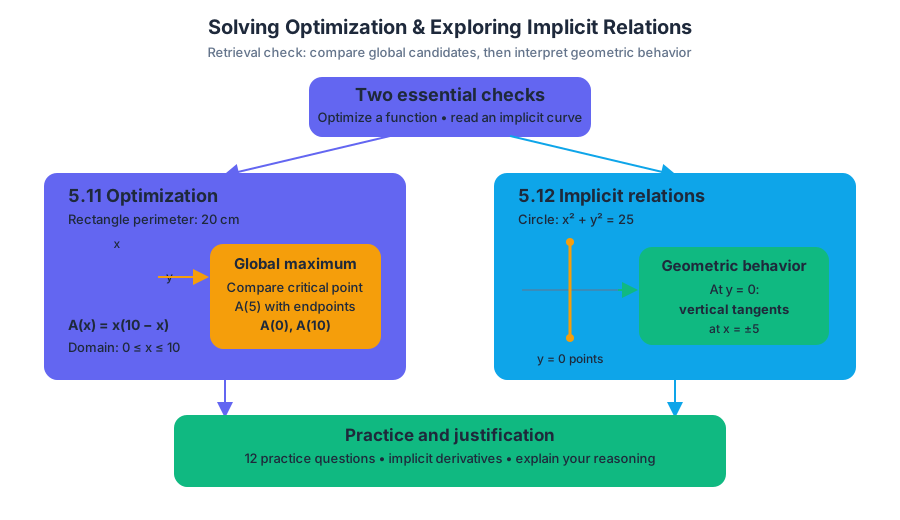
requires $x=0$ when $y\ne 0$. On the circle, this occurs at $(0,5)$ and $(0,-5)$. A vertical tangent occurs where the derivative expression is undefined because $y=0$; the corresponding points are $(5,0)$ and $(-5,0)$.
The division-by-$y$ misconception occurs when a student concludes that $\frac{dy}{dx}$ does not exist everywhere $y=0$, and therefore the curve has no tangent there. The formula $-\frac{x}{y}$ is undefined at those points, but the original differentiated equation,
$$ 2x+2y\frac{dy}{dx}=0, $$
shows that the tangent is vertical when $y=0$ and $x\ne 0$.
Exploring an implicit relation means connecting its equation, derivative, graph, and context. The derivative can identify where the curve rises or falls locally, where tangent lines are horizontal or vertical, and how the relation behaves without first solving explicitly for $y$.
The topic’s listed skills are 1.E Implementing Mathematical Processes—applying implicit-differentiation rules correctly—and 3.E Justification—using an equation, derivative, or geometric condition to support a conclusion. The governing enduring understanding is FUN-4: A function's derivative can be used to understand some behaviors of the function; implicit differentiation extends that behavioral analysis to relations that are not conveniently written as explicit functions.
Retrieval check
For the relation $x^2+y^2=25$, what is the slope of the tangent line at $(4,-3)$, and what geometric behavior occurs when $y=0$? A complete response should use $\dfrac{dy}{dx}=-\dfrac{x}{y}$ to find a slope of $\dfrac{4}{3}$ and explain that $y=0$ produces vertical tangents, even though the slope formula is undefined there.
Topic 5.12 also provides 12 practice questions for further work with implicit relations, especially derivative-based interpretation and justification.