From the free course AP Calculus AB on Lykke
1.1 Introducing Calculus: Can Change Occur at an Instant?
Key concepts: Calculus as the study of change · Whether change can be described at an instant
How calculus turns average rates over shrinking intervals into a rate of change at a single instant.
1.1 Introducing Calculus: Can Change Occur at an Instant?
A speedometer reports a car’s speed at an instant, even though speed is fundamentally a comparison of distance traveled over time. Calculus makes that comparison precise: it studies change, including how a quantity changes at one exact moment.
From average change to change at an instant
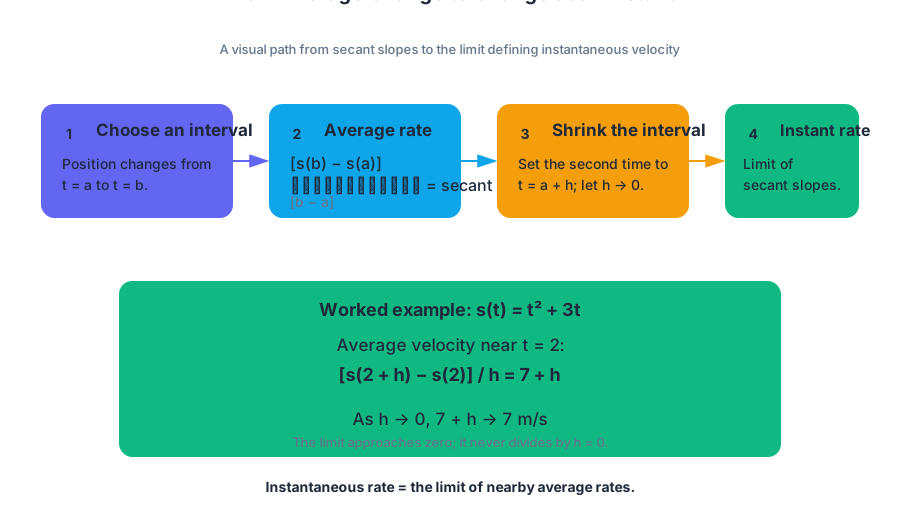
Suppose a cyclist’s position is $s(t)$ meters after $t$ seconds. Over the interval from $t=a$ to $t=b$, the average rate of change is
$$ \frac{s(b)-s(a)}{b-a}. $$
Geometrically, this is the slope of the secant line joining two points on the graph of $s$. It tells us what happened across an interval, not exactly what happened at its endpoint or midpoint.
To estimate the cyclist’s velocity at the instant $t=a$, choose a nearby time $t=a+h$. The corresponding average velocity is
$$ \frac{s(a+h)-s(a)}{h}. $$
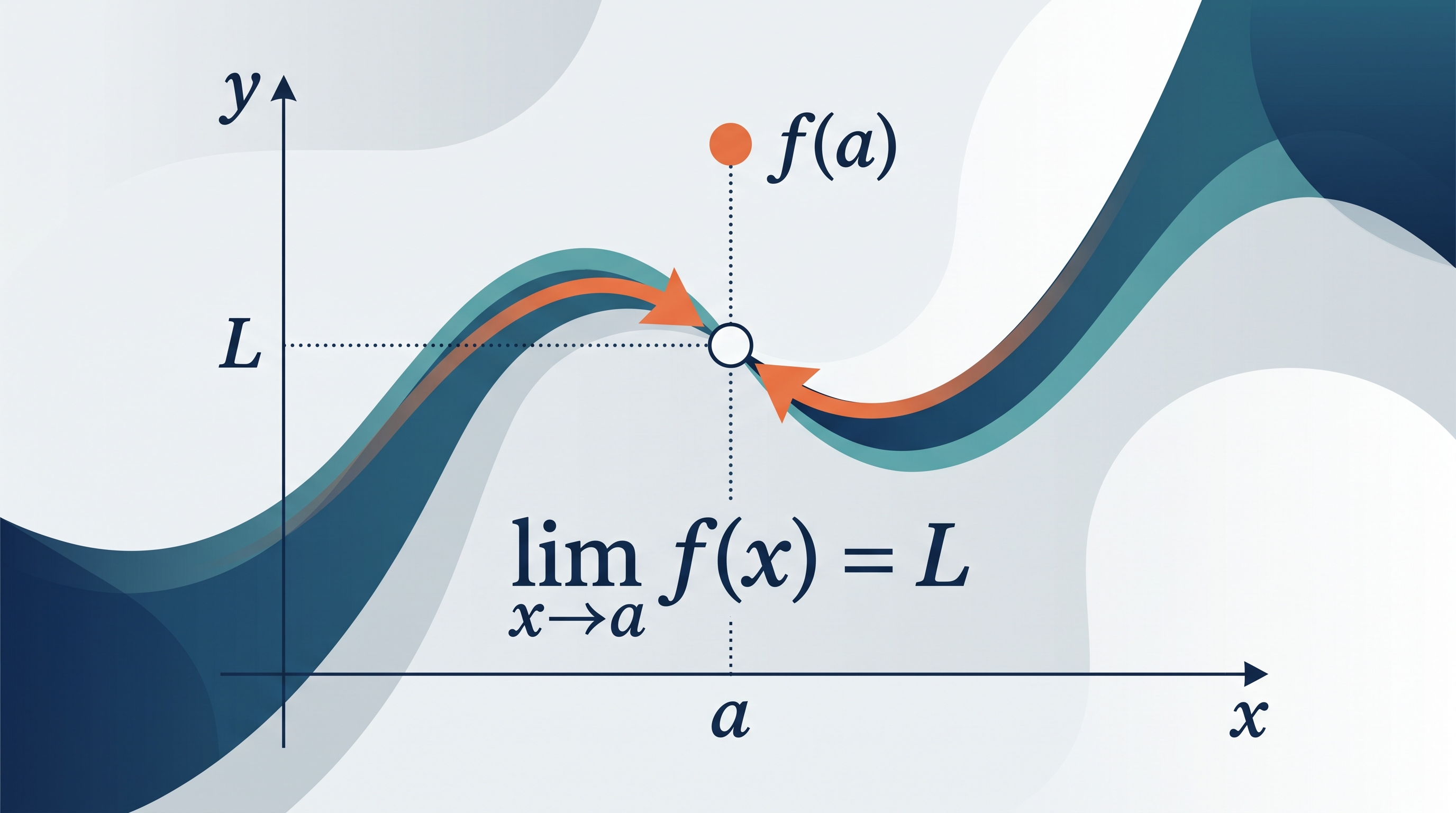
As $h$ becomes increasingly close to $0$, the second point on the graph moves toward the first. If the secant slopes approach one definite number, that number describes the cyclist’s instantaneous rate of change.
For example, let $s(t)=t^2+3t$ meters. The average velocity from $t=2$ to $t=2+h$ is
$$ \frac{s(2+h)-s(2)}{h}
\frac{(2+h)^2+3(2+h)-(2^2+3\cdot2)}{h}. $$
Simplifying,
$$ \frac{4+4h+h^2+6+3h-10}{h}
\frac{7h+h^2}{h}
7+h. $$
As $h\to0$, $7+h\to7$. Thus the velocity at $t=2$ is $7$ meters per second. The calculation does not divide by $0$; it examines values of $h$ near $0$ and identifies the value the rates approach.
Key idea: An instantaneous rate is not an average rate over a zero-length interval. It is the limit of average rates over intervals whose lengths approach zero.
Reasoning and representation
This topic is CHA 1.1 Introducing Calculus: Can Change Occur at an Instant?, and it leans on Mathematical Practice 2—Connecting Representations: the same idea appears as a secant slope on a graph, a difference quotient in symbols, and an average velocity with units in words. A strong answer connects those views and states the rate with its units, rather than reporting a bare number.
Retrieval check: For $s(t)=t^2+3t$, the average velocity from $t=2$ to $t=2+h$ simplified to $7+h$. What is the average velocity when $h=0.1$, and what value do these averages approach as $h$ shrinks? Why is that different from substituting $h=0$ at the start?
Source Materials
- Learn More (.pdf)
- AP Calculus AB and BC Course and Exam Description
- AP Calculus AB Course Overview
- AP Calculus Course at a Glance
- AP Calculus AB and BC Course at a Glance Poster
- Adopt AP Calculus AB
- AP Calculus AB
- AP Calculus AB
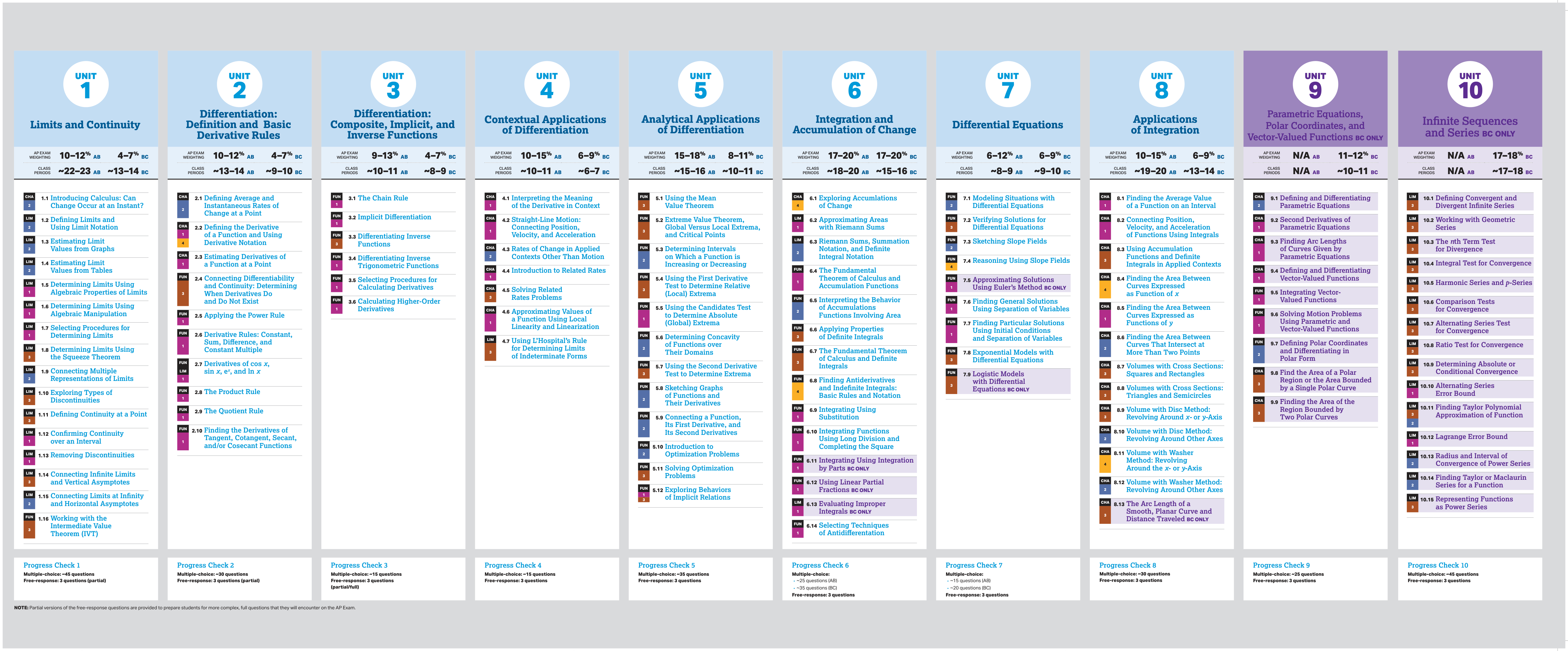
- Figure — AP Calculus AB and BC Course at a Glance Poster (p. 1)
- AP Calculus AB-AP Students
- AP/College Calculus AB
- What's the Difference Between AP Calculus AB vs. BC-Princeton Review