From the free course AP Calculus AB on Lykke
5.8 Sketching Graphs of Functions and Their Derivatives
Key concepts: Graphs of functions and their derivatives · Representing functions with graphs, tables, and verbal expressions · Derivative rules for familiar functions · Product rule for differentiable functions · Quotient rule for differentiable functions · Derivatives of trigonometric functions · Derivatives of inverse functions
How to connect graphs, tables and sign information for a function and its first and second derivatives in order to sketch and explain the function's behavior.
5.8 Sketching Graphs of Functions and Their Derivatives
Every test in this unit links a feature of $f'$ or $f''$ to a feature of $f$. Sketching uses those links in both directions: derivative information produces a graph of $f$, and a graph of $f'$ describes $f$. Every sketch depends on correct derivatives, so this page starts with the differentiation rules.
Derivative rules that support the analysis
Accurate graph analysis depends on selecting the correct derivative rule. Familiar derivatives include
$$ \frac{d}{dx}(\sin x)=\cos x,\qquad \frac{d}{dx}(\cos x)=-\sin x,\qquad \frac{d}{dx}(e^x)=e^x. $$
For a product of differentiable functions,
$$ \frac{d}{dx}\bigl[f(x)g(x)\bigr] =f'(x)g(x)+f(x)g'(x). $$
For a quotient,
$$ \frac{d}{dx}\left(\frac{f(x)}{g(x)}\right)
\frac{g(x)f'(x)-f(x)g'(x)}{[g(x)]^2}, \qquad g(x)\ne 0. $$
The reciprocal identities make trigonometric derivatives manageable:
$$ \tan x=\frac{\sin x}{\cos x},\qquad \cot x=\frac{\cos x}{\sin x},\qquad \sec x=\frac{1}{\cos x},\qquad \csc x=\frac{1}{\sin x}. $$
They lead to
$$ (\tan x)'=\sec^2x,\qquad (\cot x)'=-\csc^2x, $$
$$ (\sec x)'=\sec x\tan x,\qquad (\csc x)'=-\csc x\cot x. $$
For instance, with $h(x)=x^2e^x$,
$$ h'(x)=2xe^x+x^2e^x=e^x(x^2+2x). $$
The first term differentiates the polynomial factor; the second differentiates the exponential factor.
Sketching a function and its derivatives
A reliable sketch combines several representations: a verbal description, a table of values, a graph of $f$, and graphs or sign information for $f'$ and $f''$. Technology can check a table or graph, but it does not replace explaining what the signs mean.
| Information | Meaning for the graph of $f$ |
|---|---|
| $f'(x)>0$ | $f$ is increasing |
| $f'(x)<0$ | $f$ is decreasing |
| $f'(x)=0$ | Horizontal tangent or possible extremum |
| $f''(x)>0$ | Slopes increase; graph bends upward |
| $f''(x)<0$ | Slopes decrease; graph bends downward |
The same table lets you read a graph of $f'$ directly. Where the graph of $f'$ lies above the $x$-axis, $f$ is increasing; where it lies below, $f$ is decreasing. Where $f'$ crosses the axis, $f$ has a relative extremum. Where the graph of $f'$ is rising, $f''>0$ and $f$ bends upward; where it is falling, $f$ bends downward. A turning point of $f'$ therefore marks an inflection point of $f$.
For $f(x)=x^3-3x$, the derivative graph $y=f'(x)=3x^2-3$ is an upward-opening parabola. Its zeros at $x=-1$ and $x=1$ are the horizontal tangencies of $f$; the sign pattern of $f'$ gives increasing, decreasing, and increasing intervals, while $f''(x)=6x$ identifies the local maximum and minimum through the Second Derivative Test.
This multirepresentational reasoning is Mathematical Practice 2: Connecting Representations and is assessed through FUN 2. Justification is Mathematical Practice 3: Justification, especially 3.D, when the response must explain why a point is a maximum or minimum rather than merely label it. Topic 5.7 is tagged FUN-4.A.7 for the Second Derivative Test and FUN-4.A.8 for distinguishing relative from absolute extrema.
Retrieval check. For $f(x)=x^3-3x$, the graph of $f'(x)=3x^2-3$ has its vertex at $x=0$. What does that vertex say about the graph of $f$? It marks an inflection point: $f'$ changes from decreasing to increasing there, so $f$ changes from bending downward to bending upward.
Source Materials
- Learn More (.pdf)
- AP Calculus AB and BC Course and Exam Description
- AP Calculus AB Course Overview
- AP Calculus Course at a Glance
- AP Calculus AB and BC Course at a Glance Poster
- Adopt AP Calculus AB
- AP Calculus AB
- AP Calculus AB
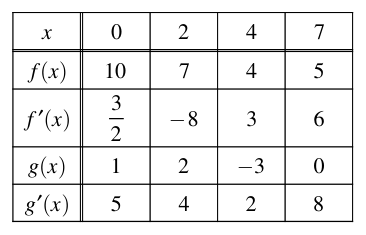
- 5. The functions f and g are twice differentiable. The table shown gives values of the functions and their first