From the free course AP Calculus AB on Lykke
1.11 Defining Continuity at a Point
Key concepts: Defining continuity at a point · Using correct continuity notation and justification
The three-condition definition of continuity at a point, and how to justify a discontinuity by naming the condition that fails.
1.11 Defining Continuity at a Point
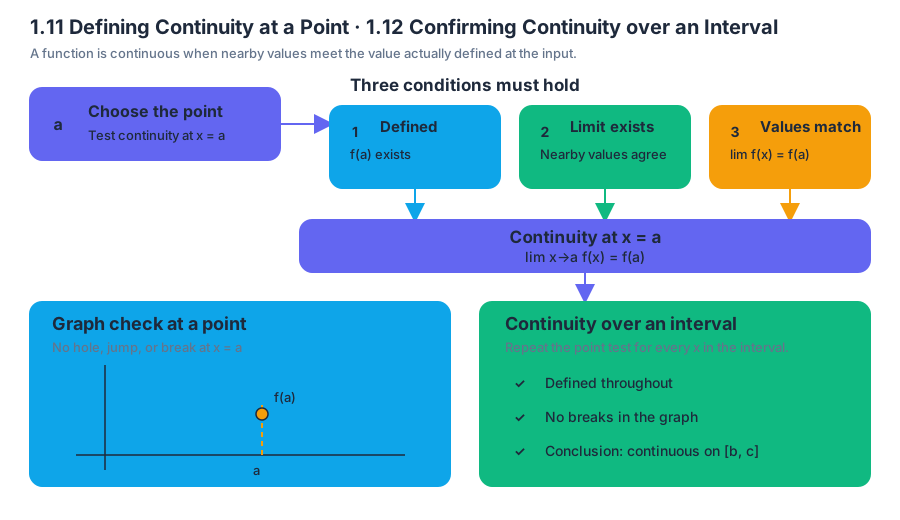
A function is continuous at $x=a$ when its graph has no break at that input: the function is defined there, its nearby values approach a single limit, and that limit equals the actual function value.
The three-condition test at a point
The formal test is not merely “the graph looks connected.” To justify continuity at $x=a$, verify all three conditions:
A function $f$ is continuous at $x=a$ if and only if
$1.$ $f(a)$ is defined;
$2.$ $\displaystyle\lim_{x\to a}f(x)$ exists; and
$3.$ $\displaystyle\lim_{x\to a}f(x)=f(a)$.
If even one condition fails, $f$ is discontinuous at $x=a$. The strongest AP-style justification identifies the failed condition rather than simply stating that the function is “not smooth” or that its graph “has a hole.”
Worked example: a temperature sensor with a missing reading
Suppose a sensor model is
$$ T(t)=\frac{t^2-9}{t-3}, $$
where $t$ is time in minutes. At $t=3$,
$$ T(3)=\frac{3^2-9}{3-3}=\frac{0}{0}, $$
so $T(3)$ is not defined. Although algebraic simplification gives
$$ T(t)=t+3 \qquad (t\ne 3), $$
the original function still has no value at $t=3$. Therefore, $T$ is not continuous at $t=3$ because Condition 1 fails. The simplified expression describes the nearby behavior, but it does not automatically create the missing value.
Misconception check — “The limit equals the formula after cancellation, so the function is continuous.” Cancellation can reveal the limit, but continuity also requires an actual function value at the point. Always check $f(a)$ separately.
Reasoning and retrieval check
Each condition can fail on its own. In the sensor example Condition 1 failed. At a jump, where the left- and right-hand limits differ, Condition 2 fails. When the limit exists and $f(a)$ is defined but the two numbers differ—a hole with a filled point at another height—Condition 3 fails. A strong justification states $f(a)$ and $\lim_{x\to a}f(x)$ explicitly and names the condition that decides the question.
Retrieval check: Let $f(x)=x+1$ for $x\ne2$ and $f(2)=5$. Is $f$ continuous at $x=2$? Here $f(2)=5$ is defined and $\lim_{x\to2}f(x)=3$ exists, but $3\ne5$, so Condition 3 fails and $f$ is discontinuous at $x=2$.
Source Materials
- Learn More (.pdf)
- AP Calculus AB and BC Course and Exam Description
- AP Calculus AB Course Overview
- AP Calculus Course at a Glance
- AP Calculus AB and BC Course at a Glance Poster
- Adopt AP Calculus AB
- AP Calculus AB
- AP Calculus AB
- • A response that uses this method earns the first point by using y = 1 in 2 2 3 2 48 x y y + + = .
- • To earn P3, a response must state that R is continuous because R is differentiable (or equivalent). A response that simply states “R is continuous” without justification does not earn P3.
- • To earn P3, a response must state that R is continuous because R is differentiable (or equivalent). A response that simply states “R is continuous” without justification does not earn P3.