From the free course AP Calculus AB on Lykke
6.7 The Fundamental Theorem of Calculus and Definite Integrals
Key concepts: Definition of an antiderivative: a function whose derivative is the given function · The Fundamental Theorem of Calculus connecting derivatives and definite integrals · Evaluating a definite integral using an antiderivative · Definite integrals and accumulation of change
How the Fundamental Theorem of Calculus evaluates a definite integral as the endpoint difference $F(b)-F(a)$ of an antiderivative.
6.7 The Fundamental Theorem of Calculus and Definite Integrals
A definite integral measures accumulated change, while an antiderivative reverses differentiation. The Fundamental Theorem of Calculus connects these two ideas: instead of adding infinitely many tiny contributions directly, we can find a function whose derivative is the integrand and evaluate that function at the endpoints.
If $F'(x)=f(x)$, then $F$ is an antiderivative of $f$.
Finding antiderivatives is the work of Topic 6.8; this page is about what to do once you have one. For a polynomial, reverse the power rule term by term: an antiderivative of $4x^3-6x+5$ is $x^4-3x^2+5x$, which you can confirm by differentiating.
The Fundamental Theorem evaluates definite integrals
If $f$ is continuous on $[a,b]$ and $F$ is an antiderivative of $f$, then the evaluation part of the Fundamental Theorem of Calculus states $$ \int_a^b f(x),dx=F(b)-F(a). $$ The definite integral is therefore an endpoint difference, not an indefinite family.
Worked example. Evaluate $$ \int_1^3 \left(4x^3-6x+5\right),dx. $$ An antiderivative is $$ F(x)=x^4-3x^2+5x. $$ Apply the endpoint rule: $$ \int_1^3 \left(4x^3-6x+5\right),dx =F(3)-F(1). $$ Compute: $$ F(3)=81-27+15=69, $$ $$ F(1)=1-3+5=3. $$ Therefore, $$ \boxed{\int_1^3 \left(4x^3-6x+5\right),dx=69-3=66}. $$
Although the antiderivative may be written as $F(x)+C$, the constant disappears in the endpoint difference: $$ [F(b)+C]-[F(a)+C]=F(b)-F(a). $$ That is why $+C$ is required for an indefinite integral but is not written in the final evaluation of a definite integral.
Accumulation and the first part of the Fundamental Theorem
If $f$ is continuous on an interval containing $a$, define an accumulation function by $$ F(x)=\int_a^x f(t),dt. $$ The Fundamental Theorem states $$ \frac{d}{dx}\left(\int_a^x f(t),dt\right)=f(x). $$ The variable $t$ is a temporary integration variable; the variable $x$ determines the moving endpoint. This result proves that the accumulation function itself is an antiderivative of $f$, matching FUN-6.B.2.
AP alignment and retrieval check
This topic develops FUN-6: Recognizing opportunities to apply knowledge of geometry and mathematical rules can simplify integration, FUN-6.B: Evaluate definite integrals analytically using the Fundamental Theorem of Calculus, and FUN-6.B.1, FUN-6.B.2, FUN-6.B.3. It also develops FUN-6.C: Determine antiderivatives of functions and indefinite integrals, using knowledge of derivatives, including FUN-6.C.1 and FUN-6.C.2. The relevant AP skill is 3.D: Apply an appropriate mathematical definition, theorem, or test—here, selecting and applying the Fundamental Theorem with correct notation and endpoint evaluation.
Retrieval check: If a proposed antiderivative of $f(x)$ is $G(x)$, differentiate $G(x)$ and compare the result with $f(x)$. If they match, $G(x)+C$ describes the full indefinite-integral family. For a definite integral, use $G(b)-G(a)$; the two constants cancel.
Source Materials
- Learn More (.pdf)
- AP Calculus AB and BC Course and Exam Description
- AP Calculus AB Course Overview
- AP Calculus Course at a Glance
- AP Calculus AB and BC Course at a Glance Poster
- Adopt AP Calculus AB
- AP Calculus AB
- AP Calculus AB
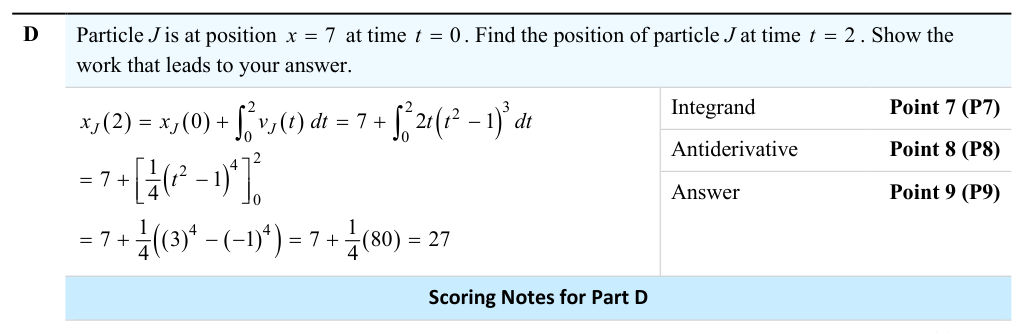
- • To earn P7, a response must present an indefinite or definite integral with an integrand of vJ ( )t or