From the free course AP Calculus AB on Lykke
2.10 Derivatives of \(\tan x\), \(\cot x\), \(\sec x\), and \(\csc x\)
Key concepts: Derivatives of tan x · Derivatives of cot x · Derivatives of sec x · Derivatives of csc x · Using trigonometric identities to derive derivatives · Learning objective FUN-3.B
Deriving the derivatives of tan x, cot x, sec x and csc x by rewriting each as a quotient of sine and cosine, with the four resulting formulas and their sign patterns.
2.10 Derivatives of (\tan x), (\cot x), (\sec x), and (\csc x)
Tangent, cotangent, secant and cosecant are built from sine and cosine by division, so their derivatives need no new limits. Rewrite each one as a quotient, apply the quotient rule of Topic 2.9, $\left(\frac{u}{v}\right)'=\frac{vu'-uv'}{v^2}$, together with $\frac{d}{dx}[\sin(x)]=\cos(x)$ and $\frac{d}{dx}[\cos(x)]=-\sin(x)$, and simplify with $\sin^2(x)+\cos^2(x)=1$.
Trigonometric quotients
The trigonometric functions in Topic $2.10$ are connected by identities. Rewriting them exposes a product or quotient whose derivative can be calculated with rules already established:
$$ \tan(x)=\frac{\sin(x)}{\cos(x)},\qquad \cot(x)=\frac{\cos(x)}{\sin(x)}, $$
$$ \sec(x)=\frac{1}{\cos(x)},\qquad \csc(x)=\frac{1}{\sin(x)}. $$
This is FUN-3.B.3: Rearranging tangent, cotangent, secant, and cosecant functions using identities allows differentiation using derivative rules. The identity is not merely a memorization trick: it reveals which differentiation procedure applies.
Derivative of $\tan x$
Using $\tan(x)=\dfrac{\sin(x)}{\cos(x)}$, with numerator $\sin(x)$ and denominator $\cos(x)$,
$$ \frac{d}{dx}[\tan(x)] =\frac{\cos(x)\cos(x)-\sin(x)(-\sin(x))}{\cos^2(x)}. $$
The numerator becomes $$ \cos^2(x)+\sin^2(x)=1, $$ so $$ \boxed{\frac{d}{dx}[\tan(x)]=\sec^2(x)}. $$
Derivative of $\cot x$
Using $\cot(x)=\dfrac{\cos(x)}{\sin(x)}$,
$$ \frac{d}{dx}[\cot(x)] =\frac{\sin(x)(-\sin(x))-\cos(x)\cos(x)}{\sin^2(x)} =-\frac{\sin^2(x)+\cos^2(x)}{\sin^2(x)}. $$
Therefore, $$ \boxed{\frac{d}{dx}[\cot(x)]=-\csc^2(x)}. $$
Derivatives of $\sec x$ and $\csc x$
Write $\sec(x)=\dfrac{1}{\cos(x)}$. Applying the quotient rule gives
$$ \frac{d}{dx}[\sec(x)] =\frac{\cos(x)(0)-1(-\sin(x))}{\cos^2(x)} =\frac{\sin(x)}{\cos^2(x)} =\sec(x)\tan(x). $$
Likewise, $\csc(x)=\dfrac{1}{\sin(x)}$, so
$$ \frac{d}{dx}[\csc(x)] =\frac{\sin(x)(0)-1\cos(x)}{\sin^2(x)} =-\frac{\cos(x)}{\sin^2(x)} =-\csc(x)\cot(x). $$
The four essential formulas are therefore
$$ \boxed{\frac{d}{dx}[\tan(x)]=\sec^2(x)},\qquad \boxed{\frac{d}{dx}[\cot(x)]=-\csc^2(x)}, $$
$$ \boxed{\frac{d}{dx}[\sec(x)]=\sec(x)\tan(x)},\qquad \boxed{\frac{d}{dx}[\csc(x)]=-\csc(x)\cot(x)}. $$
Products and quotients together
A function may require more than one rule. For $$F(x)=x^2\sec(x),$$ use the product rule: $$ F'(x)=2x\sec(x)+x^2\sec(x)\tan(x). $$ For $$G(x)=\frac{\tan(x)}{x^2+1},$$ use the quotient rule: $$ G'(x)=\frac{(x^2+1)\sec^2(x)-\tan(x)(2x)}{(x^2+1)^2}. $$
A common misconception is “differentiate the top and bottom separately”: $$ \left(\frac{u}{v}\right)'\neq\frac{u'}{v'}. $$ The quotient rule contains the cross-products $vu'$ and $uv'$, because changing either part affects the entire ratio.
A second misconception concerns signs. The derivative of $\tan x$ is always positive where defined, and the derivative of $\cot x$ is always negative. The signs of $\sec x\tan x$ and $-\csc x\cot x$ depend on the interval, so their formulas must be used to determine the sign.
Retrieval check
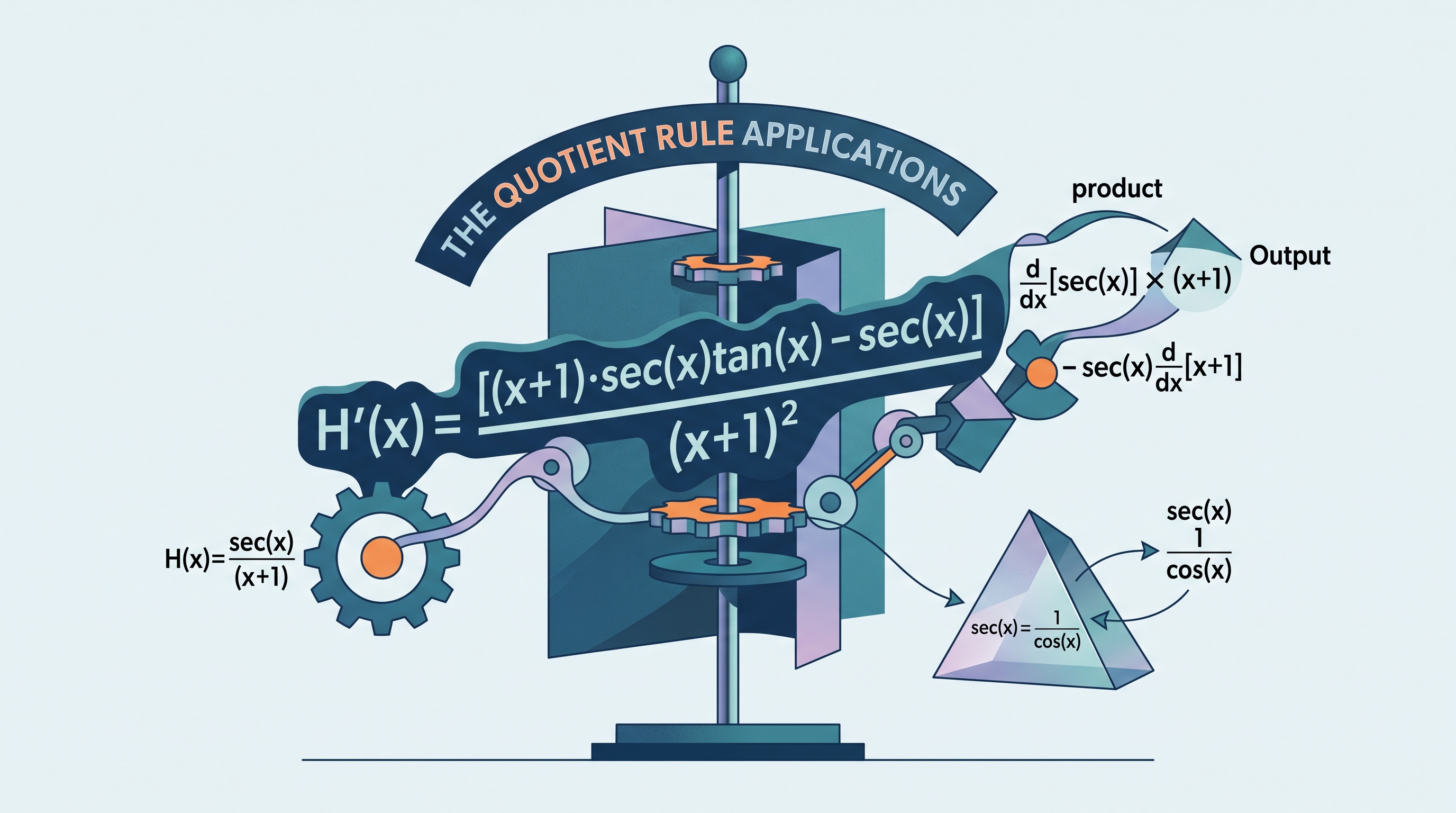
For $$H(x)=\frac{\sec(x)}{x+1},$$ identify the rule and write $H'(x)$ without expanding. Then state which identity would allow a derivation of $\sec'(x)$ from earlier derivative rules. The answers are
$$ H'(x)=\frac{(x+1)\sec(x)\tan(x)-\sec(x)}{(x+1)^2}, $$ and $$ \sec(x)=\frac{1}{\cos(x)}. $$