From the free course AP Calculus AB on Lykke
8.5 Finding the Area Between Curves Expressed as Functions of \(y\)
Key concepts: Finding the area between curves expressed as functions of y · Applications of integration · Analytical applications
How to find the area between curves written as x in terms of y, using horizontal slices and integrating right boundary minus left boundary with respect to y.
8.5 Finding the Area Between Curves Expressed as Functions of (y)
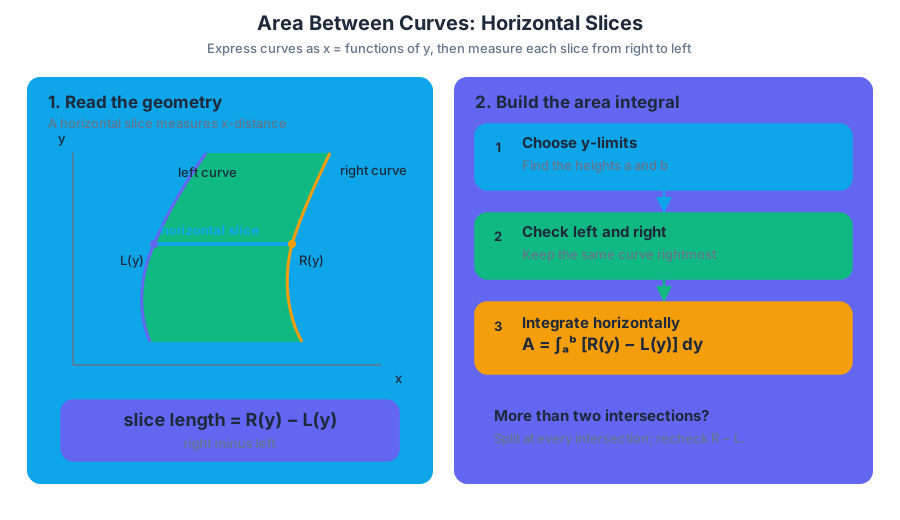
When curves are written as $x$-values depending on $y$, the natural “thin slice” is horizontal: its length is right boundary minus left boundary, and its thickness is $dy$. The central question is therefore:
Which curve is farther right at each level $y$, and where do the boundaries exchange positions?
These topics belong to Unit 8, Applications of Integration, under enduring understanding CHA-5. Topic 8.5 Finding the Area Between Curves Expressed as Functions of $y$ emphasizes 1.E: Apply appropriate mathematical rules or procedures, with and without technology. Topic 8.6 Finding the Area Between Curves That Intersect at More Than Two Points emphasizes 2.B: Identify mathematical information from graphical, numerical, analytical, and/or verbal representations.
Horizontal slices: area as right minus left
Suppose two boundaries are given by
$$ x=R(y) \qquad\text{and}\qquad x=L(y). $$
At height $y$, a horizontal slice extends from $x=L(y)$ to $x=R(y)$. Its length is
$$ R(y)-L(y), $$
so the area between the curves from $y=a$ to $y=b$ is
$$ A=\int_a^b\bigl(R(y)-L(y)\bigr),dy, $$
provided the same curve remains rightmost throughout the interval.
The variable of integration determines the geometry. Integrating with respect to $y$ means measuring horizontal distances; integrating with respect to $x$ measures vertical distances. The phrase right minus left is not a new formula to memorize—it is a description of the length of each horizontal slice.
Worked example: one $dy$ integral
Find the area enclosed by $x=y^2$ and $x=y+2$. Setting $y^2=y+2$ gives $(y-2)(y+1)=0$, so the curves meet at $y=-1$ and $y=2$. At the test level $y=0$ the line is at $x=2$ and the parabola is at $x=0$, so the line is the right boundary and $A=\int_{-1}^{2}\bigl[(y+2)-y^2\bigr],dy$. An antiderivative is $\frac{y^2}{2}+2y-\frac{y^3}{3}$, which gives $A=\frac{10}{3}-\left(-\frac{7}{6}\right)=\frac{9}{2}$ square units. Vertical slices would need two integrals here, because for $0\le x\le 1$ the parabola $x=y^2$ is both the top and the bottom of the region.
Retrieval check
Suppose $x=y^2-1$ and $x=y+1$ intersect at $y=-1$ and $y=2$. At $y=0$, the values are $-1$ and $1$, so $x=y+1$ is the right boundary. At $y=1$, the values are $0$ and $2$, so it is still right. The area is therefore set up as
$$ \int_{-1}^{2}\left[(y+1)-(y^2-1)\right],dy. $$
If a graph or table showed an additional intersection inside $[-1,2]$, the correct response would be to split the integral there and recheck which curve is right on each resulting interval. That decision—not the antiderivative—is the essential reasoning in these problems.