From the free course AP Calculus AB on Lykke
4.5 Solving Related Rates Problems
Key concepts: Related rates · Rates of change · Identifying changing quantities as variables · Using known rates of change to find unknown rates · Distinguishing information that applies always from information that applies only at an instant · Drawing and labeling diagrams for related-rates problems
A six-step method for related-rates problems, worked on a moving point whose distance from the origin changes, with emphasis on differentiating before substituting.
4.5 Solving Related Rates Problems
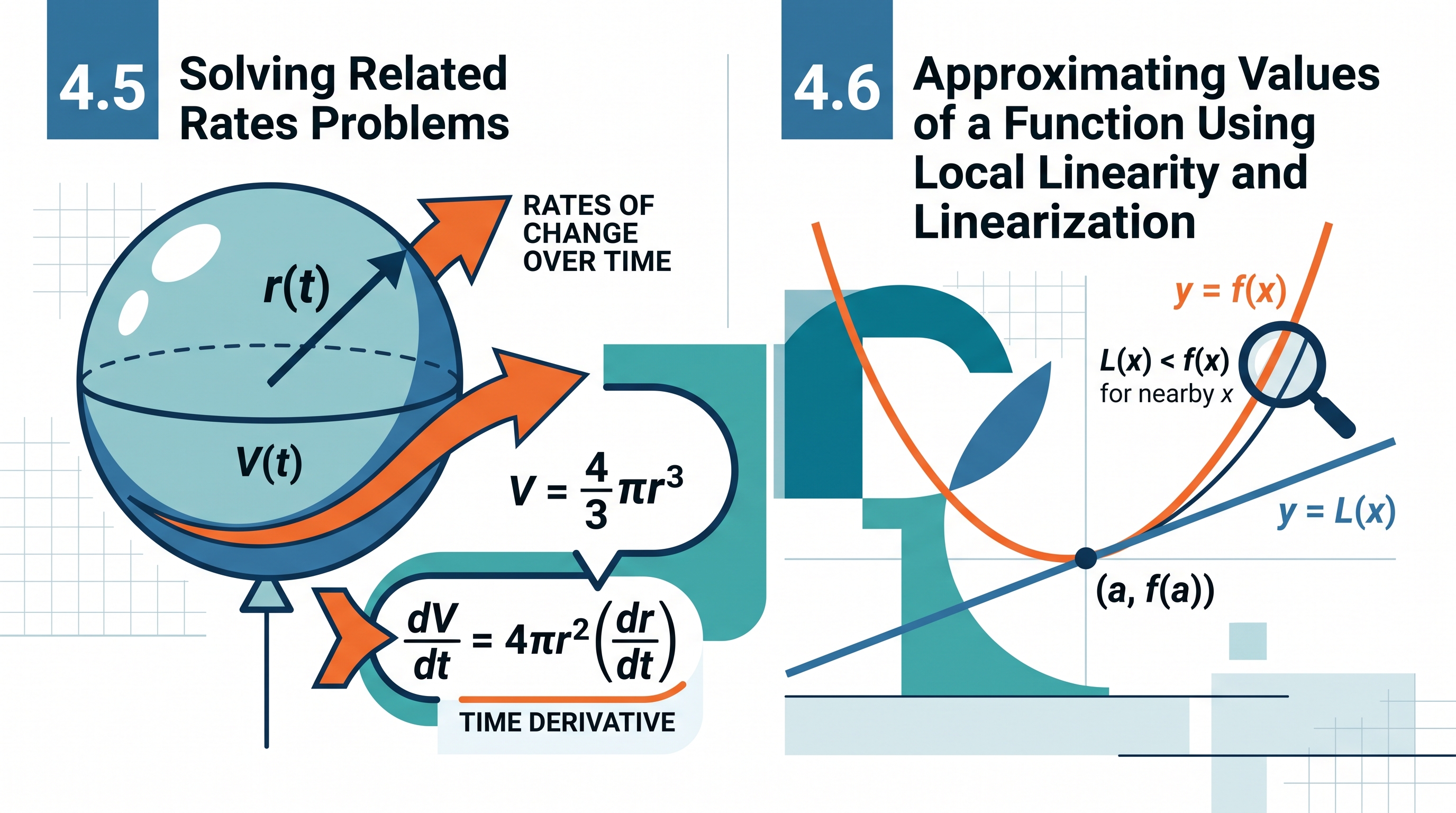
A changing quantity rarely moves alone: when a balloon expands, its radius, area, and volume all change together. Related rates use a relationship among variables to determine one rate of change from another, while linearization uses a tangent line to estimate a nearby function value.
Related rates: turn a changing picture into an equation
The essential idea is captured by CHA-3.E.1: The derivative can be used to solve related quantities whose rates of change are known. A reliable solution begins with a diagram, labels every changing quantity as a variable, identifies the desired rate, and distinguishes information that is true always from information supplied only at one instant.
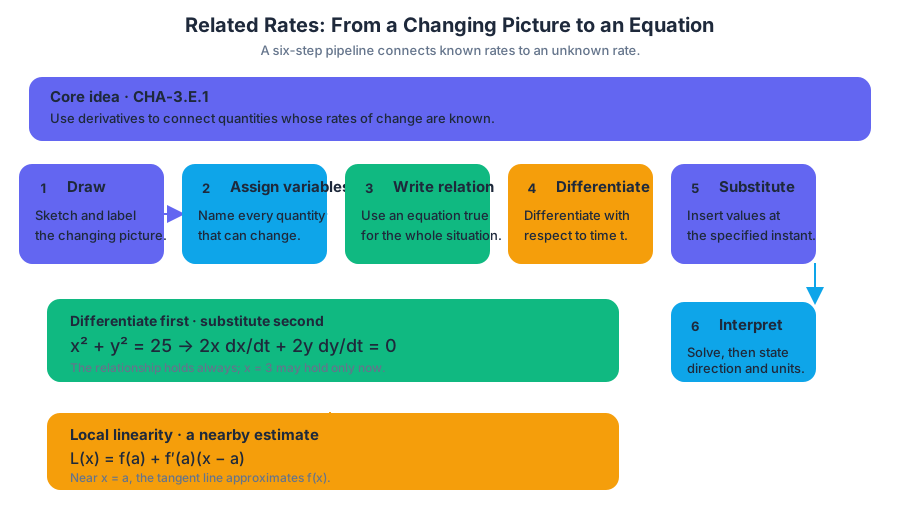
Use this pipeline:
- Draw and label the situation.
- Assign variables to changing quantities.
- Write a relationship that is true for the entire situation.
- Differentiate that relationship with respect to time $t$.
- Substitute the values and rates given at the specified instant.
- Solve for the unknown rate and interpret its meaning and direction.
The order matters. A geometric relationship such as $x^2+y^2=25$ may hold always, but values such as $x=3$ or $\frac{dy}{dt}=4$ may apply only at one instant. Substituting instant-specific values before differentiating can destroy the relationship needed to connect the rates.
Worked example: a moving point and a changing distance
A point moves along a coordinate path so that its horizontal position is $x(t)$ and its vertical position is $y(t)$. Its distance from the origin is $r(t)$. Suppose the point is currently at $(3,4)$, with $\frac{dx}{dt}=2$ units per second and $\frac{dy}{dt}=1$ unit per second. How fast is its distance from the origin changing?
The diagram gives a right triangle, so the always-true relationship is
$$ x^2+y^2=r^2. $$
Differentiate with respect to time. Every variable depends on $t$, so the chain rule appears:
$$ 2x\frac{dx}{dt}+2y\frac{dy}{dt}=2r\frac{dr}{dt}. $$
At the instant described, $x=3$, $y=4$, and $r=\sqrt{3^2+4^2}=5$. Substitute only now:
$$ 2(3)(2)+2(4)(1)=2(5)\frac{dr}{dt}. $$
Therefore,
$$ \frac{dr}{dt}=\frac{12+8}{10}=2. $$
The distance from the origin is increasing at $2$ units per second at that instant. This interpretation supplies the units and direction required by Suggested Skill 3.F: Explain the meaning of mathematical solutions in context.
Misconception check — “Differentiate the numbers.”
The values $3$, $4$, and $5$ describe one instant; they are not functions to differentiate. Differentiate the variable relationship first, then evaluate at the instant.
Retrieval check
A sphere has radius $r(t)$ and volume $V=\frac43\pi r^3$. The radius is growing at $0.5$ centimeters per second. How fast is the volume changing when $r=4$ centimeters? Differentiate before inserting the radius: $\frac{dV}{dt}=4\pi r^2\frac{dr}{dt}$. Then substitute: $\frac{dV}{dt}=4\pi(4)^2(0.5)=32\pi$, so the volume is increasing at $32\pi$ cubic centimeters per second at that instant.
Source Materials
- Learn More (.pdf)
- AP Calculus AB and BC Course and Exam Description
- AP Calculus AB Course Overview
- AP Calculus Course at a Glance
- AP Calculus AB and BC Course at a Glance Poster
- Adopt AP Calculus AB
- AP Calculus AB
- AP Calculus AB
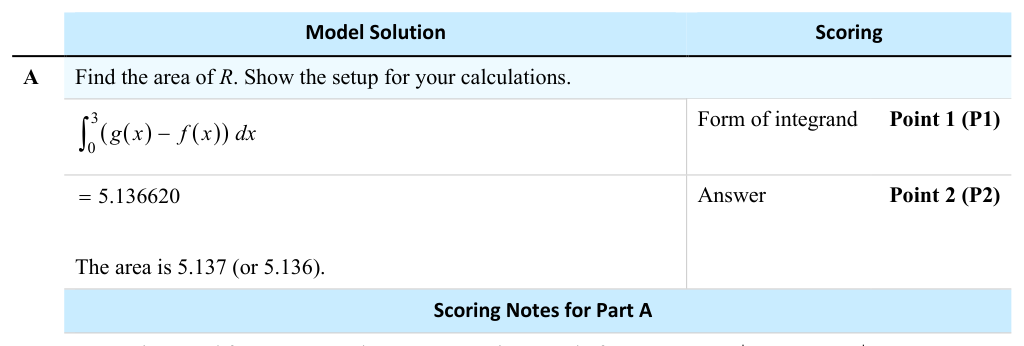
- • P1 is earned for a response that presents an integrand of g x ( ) −f (x), g x ( ) −f (x) , f (x) −g x ( ),
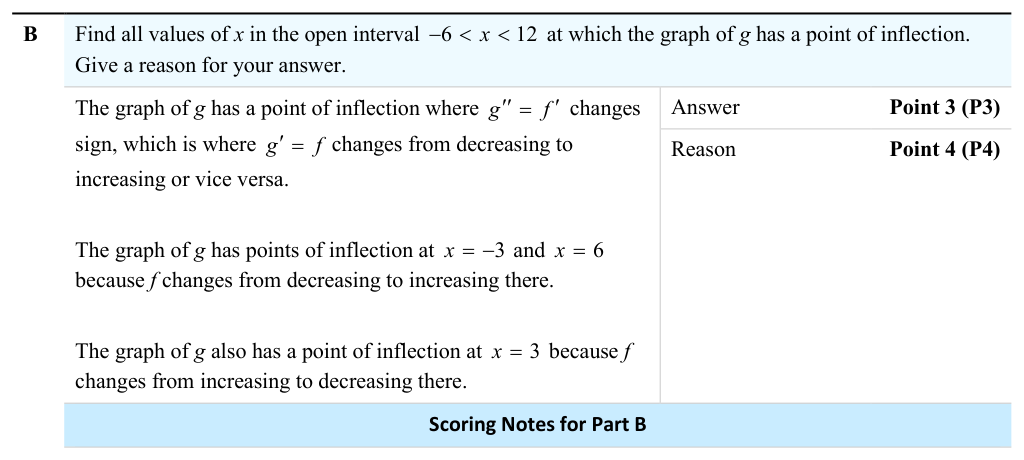
- • P3 is earned only for an answer of x = −3, x = 3, and x = 6 . If any other/additional values of x in
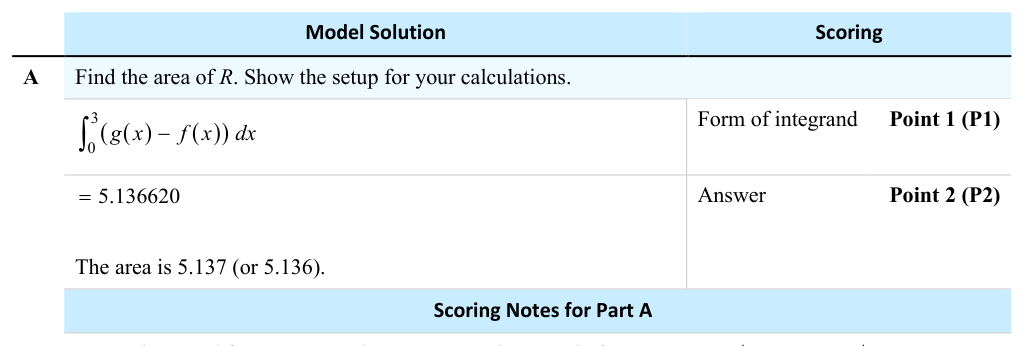
- • P1 is earned for a response that presents an integrand of g x ( ) −f (x), g x ( ) −f (x) , f (x) −g x ( ),
- • P3 is earned only for an answer of x = −3, x = 3, and x = 6 . If any other/additional values of x in