From the free course AP Calculus AB on Lykke
4.2 Straight-Line Motion: Connecting Position, Velocity, and Acceleration
Key concepts: Real-world applications of derivatives · Straight-line motion · Connections among position, velocity, and acceleration · Applying appropriate mathematical rules and procedures · Using representations to describe changing quantities
How the position, velocity and acceleration of a particle on a line are linked by derivatives, and how the sign of velocity gives the direction of motion.
4.2 Straight-Line Motion: Connecting Position, Velocity, and Acceleration
When the changing quantity is the position of an object moving along a line, its derivatives have names of their own. Velocity is the rate of change of position and acceleration is the rate of change of velocity, so everything Topic 4.1 says about reading a derivative, with its sign, instant and units, applies directly to motion.
The enduring understanding for these topics is CHA-3: Derivatives allow us to solve real-world problems involving rates of change. The learning objective is CHA-3.B: Calculate rates of change in applied contexts. Its essential knowledge, CHA-3.B.1, states that the derivative can solve rectilinear-motion problems involving position, speed, velocity, and acceleration.
Straight-line motion: position, velocity, and acceleration
For a particle moving along a line, let $s(t)$ denote its position at time $t$. Position gives location relative to a chosen origin. Its first derivative is velocity:
$$ v(t)=s'(t), $$
and the derivative of velocity is acceleration:
$$ a(t)=v'(t)=s''(t). $$
| Quantity | Meaning | Mathematical relationship | Typical units |
|---|---|---|---|
| Position $s(t)$ | Location on the line | Given function | meters |
| Velocity $v(t)$ | Signed rate of position change | $s'(t)$ | meters per second |
| Speed | Magnitude of velocity | $\lvert v(t)\rvert$ | meters per second |
| Acceleration $a(t)$ | Rate of velocity change | $v'(t)=s''(t)$ | meters per second squared |
Velocity is signed, so it describes both how fast and which direction. A particle moves right when $v(t)>0$ and left when $v(t)<0$. Speed is never negative because it is $\lvert v(t)\rvert$.
Worked motion example
A particle moves along the $x$-axis with position
$$ x(t)=t^3-6t^2+9t, $$
where $x$ is measured in meters and $t$ in seconds. Differentiate:
$$ v(t)=x'(t)=3t^2-12t+9, $$
$$ a(t)=v'(t)=6t-12. $$
At $t=1$,
$$ v(1)=3-12+9=0, $$
so the particle is momentarily at rest. Its acceleration is
$$ a(1)=6(1)-12=-6\ \text{m/s}^2. $$
At $t=3$,
$$ v(3)=27-36+9=0, $$
so the particle is again at rest. To determine direction, factor velocity:
$$ v(t)=3(t-1)(t-3). $$
Thus $v(t)>0$ on $0<t<1$, $v(t)<0$ on $1<t<3$, and $v(t)>0$ for $t>3$. The particle moves right, then left, then right again.
Applying procedures with and without technology
The suggested skill for Topic 4.2 is 1.E: Apply appropriate mathematical rules or procedures, with and without technology. A graphing calculator may help graph $s(t)$, $v(t)$, and $a(t)$ or estimate a derivative numerically, but the interpretation must still include a sign, an instant, a quantity, and units.
Retrieval check: If $s(t)$ is measured in feet and $t$ in seconds, what do $s'(4)$ and $s''(4)$ measure? If $s'(4)=-12$, state its meaning in context.
Answer: $s'(4)$ is velocity in feet per second; $s''(4)$ is acceleration in feet per second squared. The value $s'(4)=-12$ means that at $t=4$ seconds, the particle is moving in the negative direction at $12$ feet per second.
Source Materials
- Learn More (.pdf)
- AP Calculus AB and BC Course and Exam Description
- AP Calculus AB Course Overview
- AP Calculus Course at a Glance
- AP Calculus AB and BC Course at a Glance Poster
- Adopt AP Calculus AB
- AP Calculus AB
- AP Calculus AB
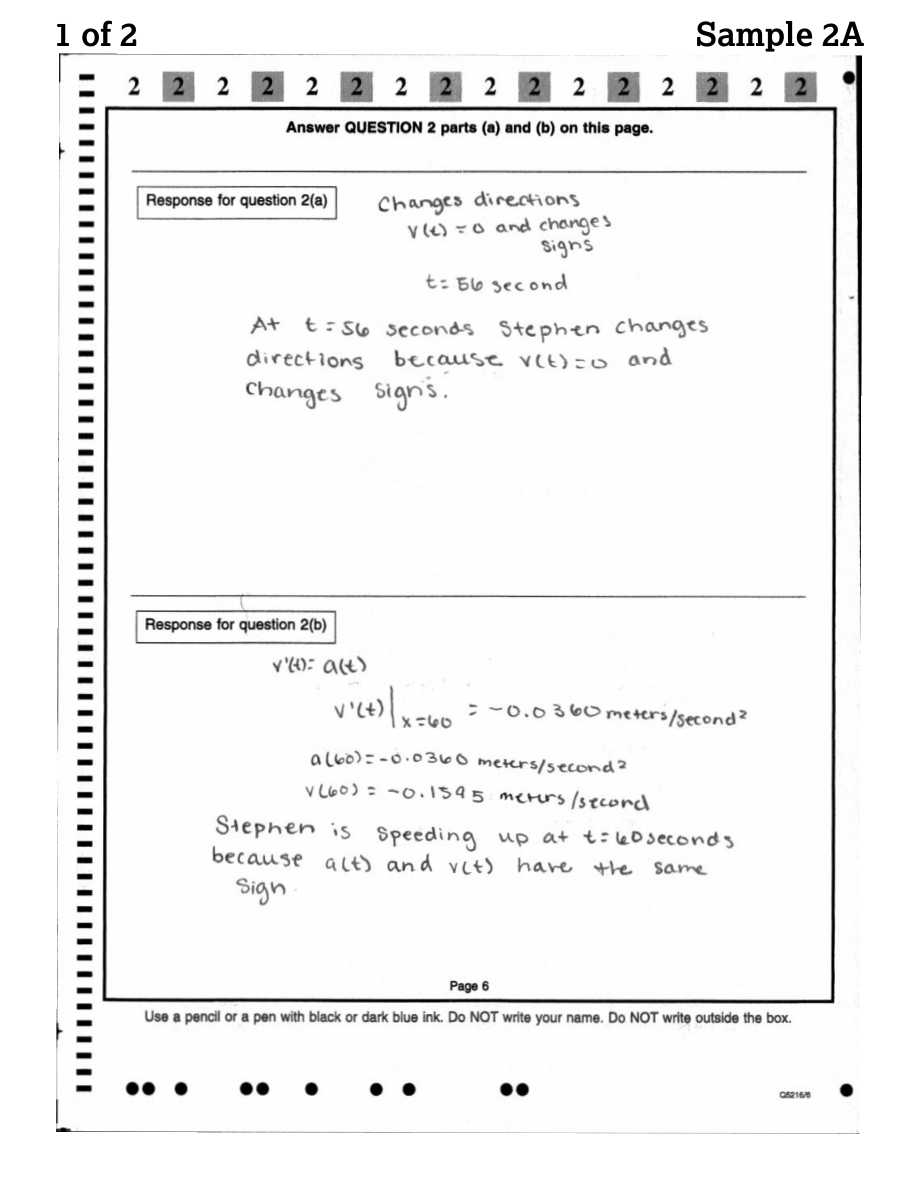
- Figure — Sample Responses Q2 (p. 5)
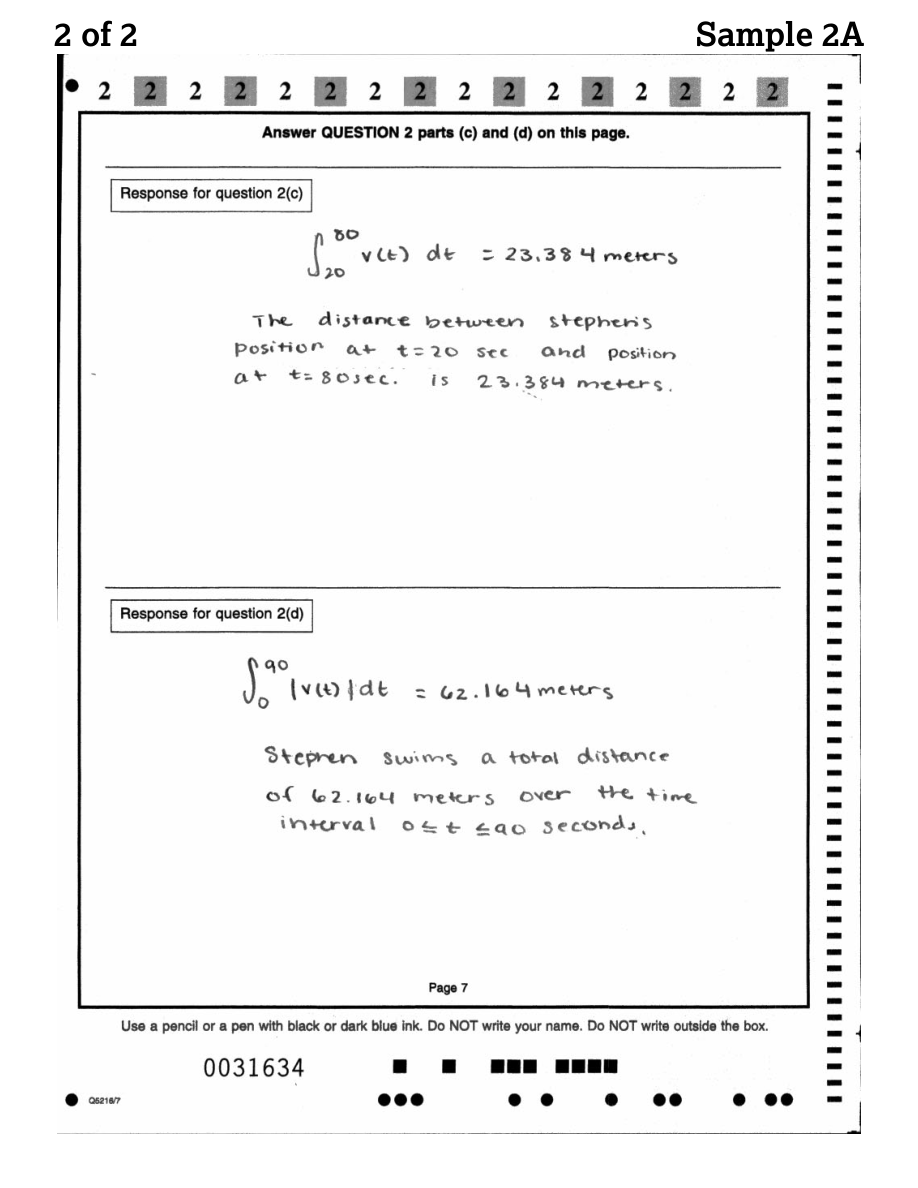
- Figure — Sample Responses Q2 (p. 6)
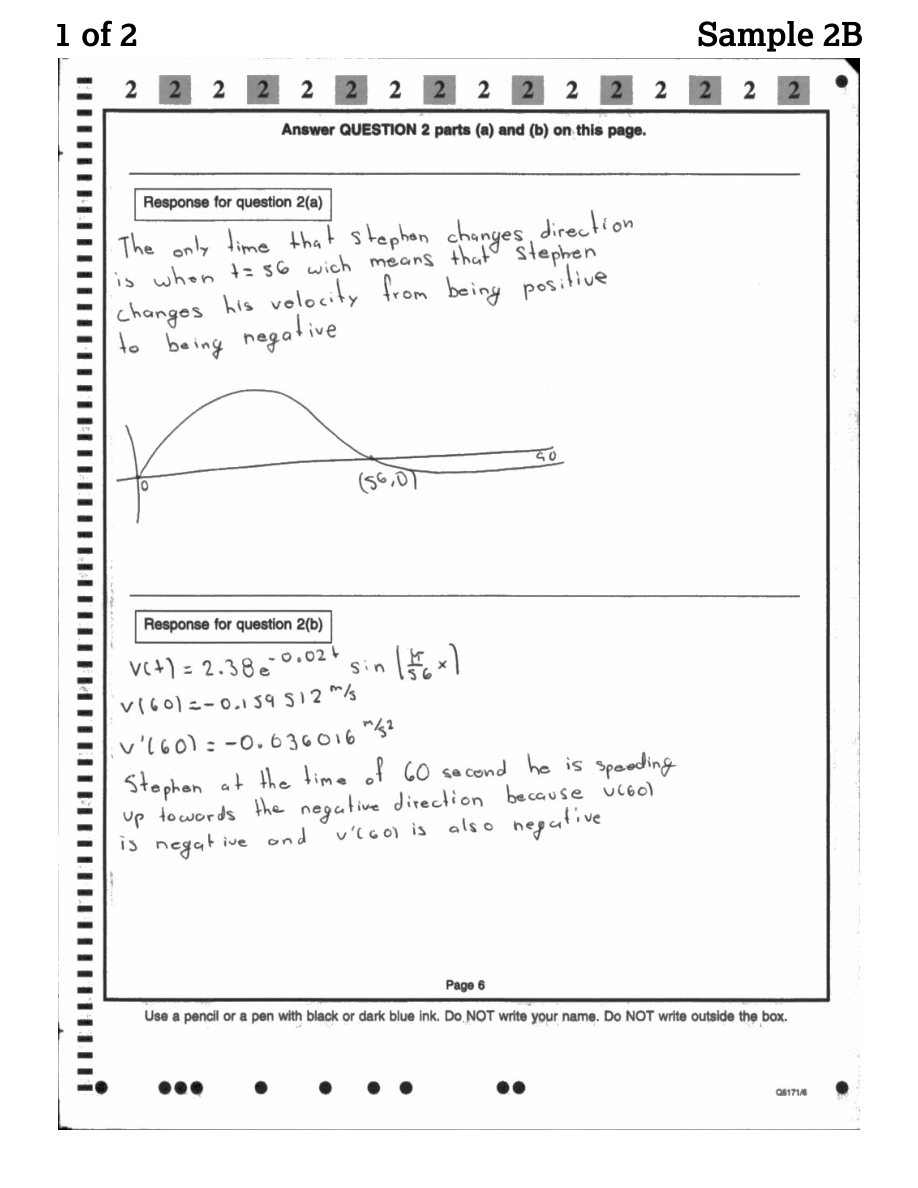
- Figure — Sample Responses Q2 (p. 7)
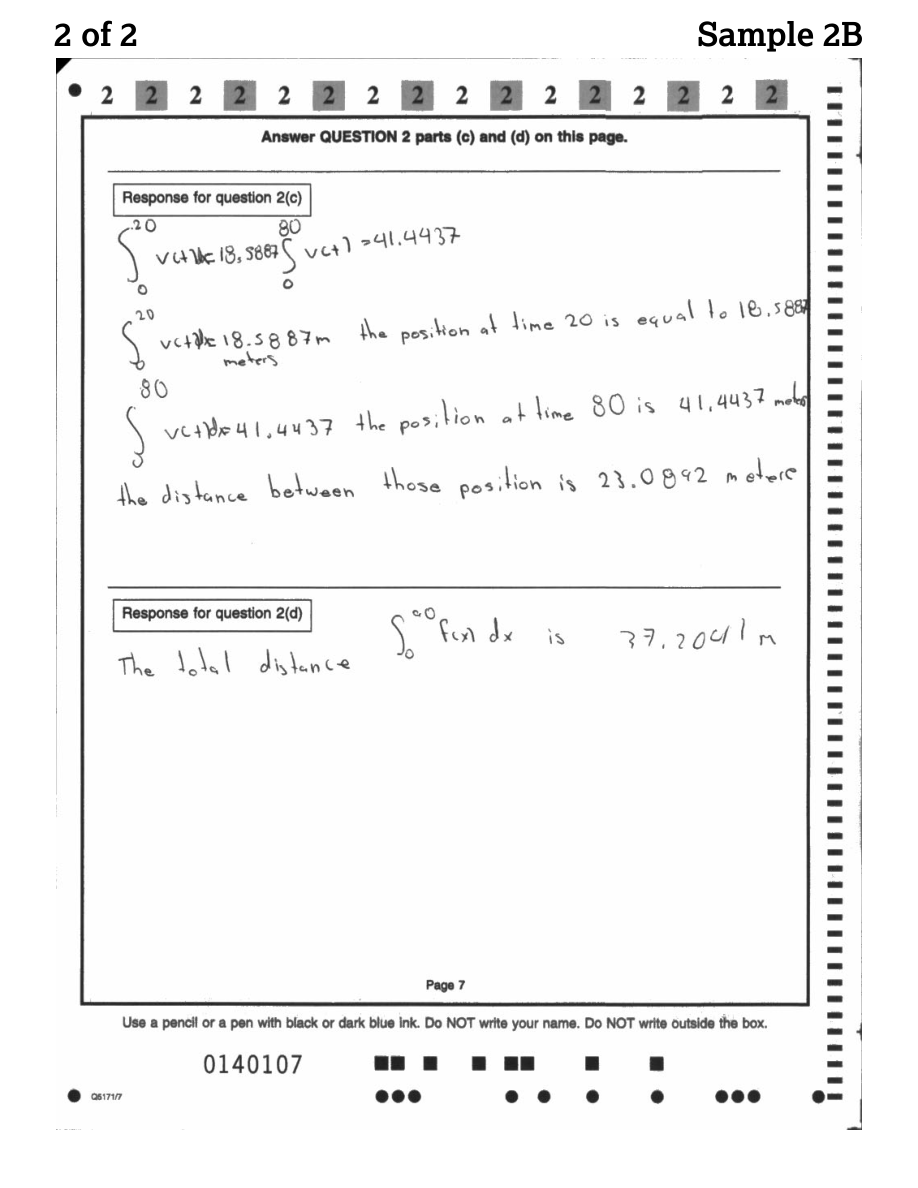
- Figure — Sample Responses Q2 (p. 8)