From the free course AP Calculus AB on Lykke
7.3 Sketching Slope Fields
Key concepts: Slope fields · Sketching slope fields · Matching equations to slope fields · Translating mathematical information between representations · Rewriting verbal statements mathematically
How to sketch a slope field by evaluating the differential equation at chosen points, and how to match a field to its equation using zero slopes and sign changes.
7.3 Sketching Slope Fields
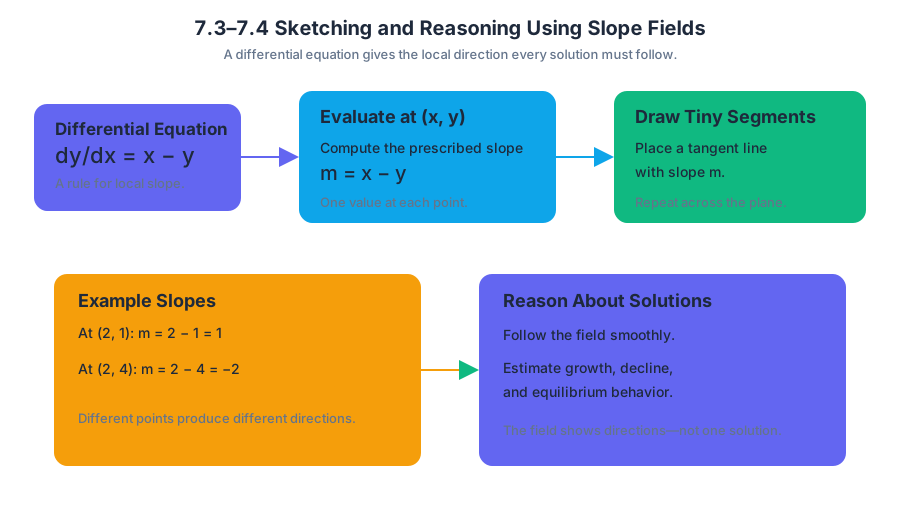
A differential equation can be read as a rule for drawing tiny tangent lines across the entire coordinate plane. A slope field is a collection of short line segments where each segment at $(x,y)$ has slope equal to the value prescribed by the differential equation.
For an equation such as
$$\frac{dy}{dx}=x-y,$$
the segment located at $(2,1)$ has slope $2-1=1$, while the segment at $(2,4)$ has slope $2-4=-2$. The field does not yet show one particular solution; it shows the local direction that every solution must follow.
Reading the geometry of a slope field
To sketch a slope field, choose several representative points, evaluate the right-hand side, and draw a short segment with that slope. Horizontal segments correspond to slope $0$, upward segments to positive slopes, and downward segments to negative slopes. Equal slope values create visually aligned segments, which often reveal the equation’s structure more efficiently than plotting point by point.
For
$$\frac{dy}{dx}=y-2,$$
the slope depends only on $y$, not on $x$. Therefore every point on the same horizontal line has the same slope:
- below $y=2$, segments slope downward;
- on $y=2$, segments are horizontal;
- above $y=2$, segments slope upward.
A solution passing through a point must be tangent to the segments as it moves across the field.
Matching an equation to a slope field
Matching requires looking for structural clues rather than estimating every segment. Ask three questions:
- Does the slope change horizontally? If the segments in each horizontal row look alike, the equation may depend only on $y$.
- Where are the horizontal segments? These occur where $\frac{dy}{dx}=0$.
- How does the sign change? Compare the directions above and below a horizontal or vertical equilibrium line.
Suppose a field has horizontal segments along $y=2$, upward segments above $y=2$, and downward segments below $y=2$. The equation
$$\frac{dy}{dx}=y-2$$
matches that field. At $y=2$, the derivative is $0$; when $y>2$, it is positive; and when $y<2$, it is negative.
A crucial language distinction appears when translating verbal statements. “The signed difference between $y$ and $2$” can mean $y-2$, so the model is
$$\frac{dy}{dx}=k(y-2).$$
But “the distance between $y$ and $2$” is an unsigned quantity. Distance cannot be negative, so it must be represented by an absolute value:
$$\frac{dy}{dx}=k\lvert y-2\rvert.$$
If $k>0$, this second equation gives positive slopes both above and below $y=2$, with horizontal segments on $y=2$. Confusing distance with signed difference reverses the direction of the field below $y=2$.
Misconception check — “distance” always means subtraction.
The expression $y-2$ records direction: it is negative when $y$ lies below $2$. The expression $\lvert y-2\rvert$ records only separation. Translate the wording first; choose the algebra afterward.
Translating among representations
The same information may appear as an equation, a slope field, or a verbal statement:
| Representation | Evidence to extract |
|---|---|
| Equation $\frac{dy}{dx}=F(x,y)$ | Compute the slope at $(x,y)$ |
| Slope field | Observe sign, steepness, and horizontal segments |
| Verbal statement | Identify the changing quantity, independent variable, and signed or unsigned relationship |
For example, “the rate at which $y$ changes is proportional to the signed difference between $y$ and $2$” becomes $\frac{dy}{dx}=k(y-2)$. “The rate is proportional to the distance from $y=2$” becomes $\frac{dy}{dx}=k\lvert y-2\rvert$. In each case, the graphical test is immediate: locate $y=2$, then inspect the slopes on either side.
This work develops Mathematical Practice 2—Connecting Representations by moving between equations, slope fields, and verbal descriptions. It also uses Mathematical Practice 3—Justification when a conclusion is supported by slope signs or equilibrium lines, and Mathematical Practice 4—Communication and Notation when variables, derivatives, constants, and absolute values are written precisely.
Retrieval check
For $\frac{dy}{dx}=x-y$, compute the slopes at $(1,1)$, $(0,2)$ and $(3,1)$, and say where the horizontal segments lie. The slopes are $0$, $-2$ and $2$. Horizontal segments occur where $x-y=0$, along the line $y=x$; above that line the segments slope downward, and below it they slope upward.