From the free course AP Calculus AB on Lykke
6.6 Applying Properties of Definite Integrals
Key concepts: Applying properties of definite integrals · Calculating definite integrals · Connecting definite integrals with Riemann sums · Breaking complex expressions into familiar components
The algebraic properties of definite integrals: linearity, reversing bounds and adding adjacent intervals, used to get new values from known ones.
6.6 Applying Properties of Definite Integrals
An accumulation function is built from a definite integral, so anything that simplifies definite integrals also simplifies the work of Topic 6.5. This page collects the algebraic properties that let you scale, split, combine and reverse integrals whose values you already know, often without ever finding a formula for $f$.
Properties of definite integrals: simplify before calculating
Definite integrals obey algebraic properties that allow a complicated expression to be separated into familiar components:
$$\int_a^b \left[c f(x)+d g(x)\right],dx
c\int_a^b f(x),dx+d\int_a^b g(x),dx.$$
Reversing the bounds changes the sign,
$$\int_b^a f(x),dx=-\int_a^b f(x),dx,$$
and adjacent intervals can be combined:
$$\int_a^c f(x),dx+\int_c^b f(x),dx
\int_a^b f(x),dx.$$
For example, if
$$\int_1^4 f(x),dx=7 \qquad\text{and}\qquad \int_4^6 f(x),dx=-2,$$
then
$$\int_6^1 f(x),dx
-\int_1^6 f(x),dx
-\left(7+(-2)\right) =-5.$$
This is often faster and safer than attempting to find a formula for $f$. Break complex expressions into known pieces, preserve coefficients, and check the direction of every interval.
Two more facts round out the list. An integral over an interval of zero width is zero: $\int_a^a f(x),dx=0$. And linearity combines known values: if $\int_1^4 f(x),dx=7$ and $\int_1^4 g(x),dx=3$, then $\int_1^4\left[2f(x)-5g(x)\right]dx=2(7)-5(3)=-1$.
Connecting a definite integral with a formula
Sometimes a limit of a Riemann sum or a definite integral is disguised inside a complicated expression. The strategic move is to identify the integrand and its interval. For instance,
$$\lim_{n\to\infty}\sum_{i=1}^{n} \left(3+\frac{2i}{n}\right)^2\frac{1}{n} $$
matches
$$\int_0^1 (3+2x)^2,dx.$$
The factor $\frac{1}{n}$ supplies the subinterval width, and $3+\frac{2i}{n}$ supplies sample inputs in the interval $[0,1]$. Conversely, an integral can be recognized as accumulated change whenever its integrand has rate units and its differential supplies the input interval.
Skill focus and retrieval check
These tasks explicitly develop 2.D Identify how mathematical characteristics or properties of functions are related in different representations, especially when a graph of $f$, an accumulation graph $G$, and an integral communicate the same behavior. They also develop 3.D Apply an appropriate mathematical definition, theorem, or test when using signed area, integral properties, and derivative-based behavior.
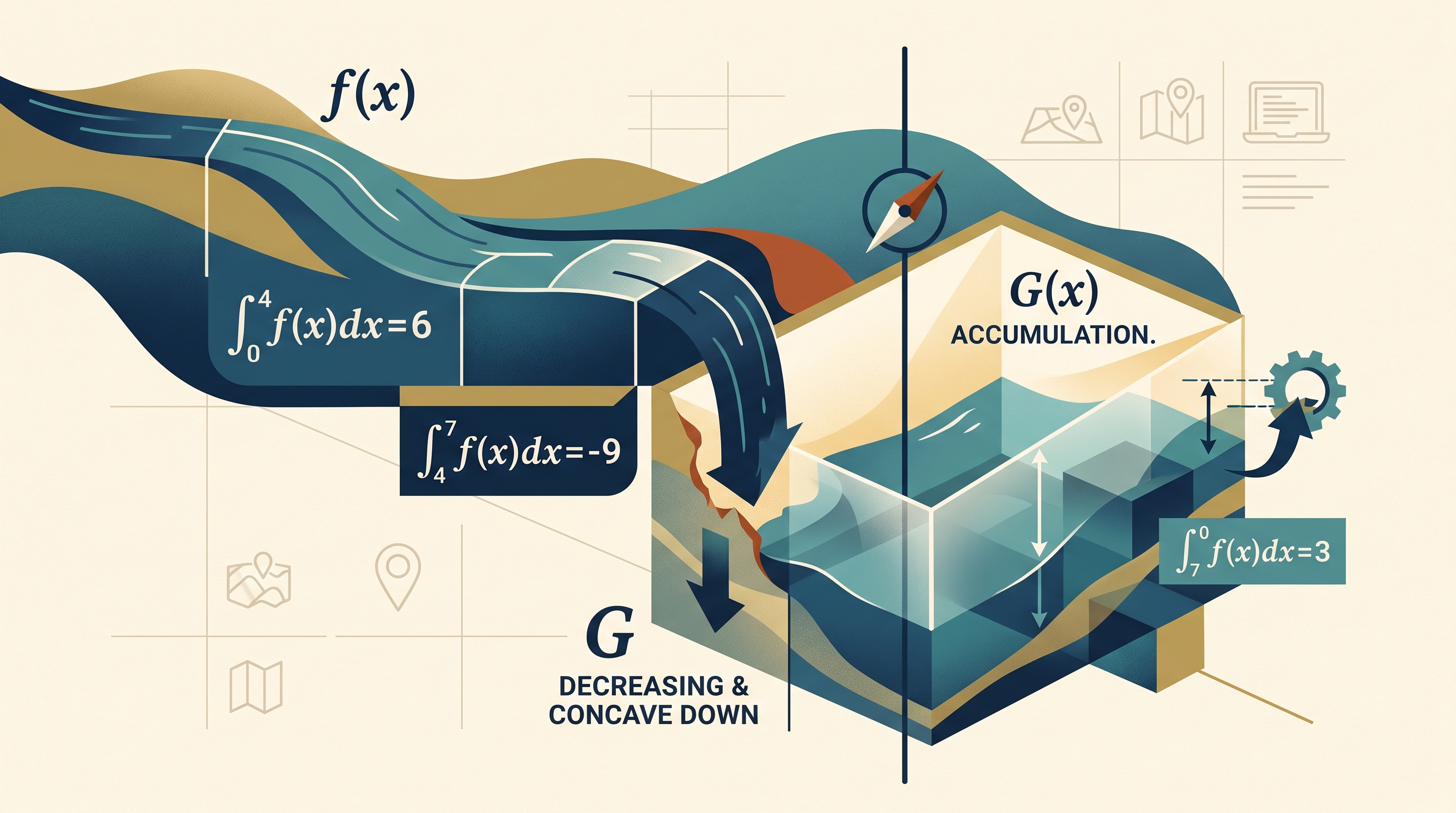
Retrieval check: If $f$ is negative and decreasing on an interval, what must be true about $G$ there, where $G'(x)=f(x)$? Answer: $G$ is decreasing and concave down. If $\int_0^4 f(x),dx=6$ and $\int_4^7 f(x),dx=-9$, then $\int_7^0 f(x),dx=3$.
Source Materials
- Learn More (.pdf)
- AP Calculus AB and BC Course and Exam Description
- AP Calculus AB Course Overview
- AP Calculus Course at a Glance
- AP Calculus AB and BC Course at a Glance Poster
- Adopt AP Calculus AB
- AP Calculus AB
- AP Calculus AB
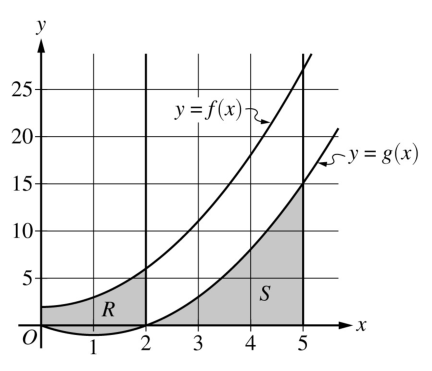
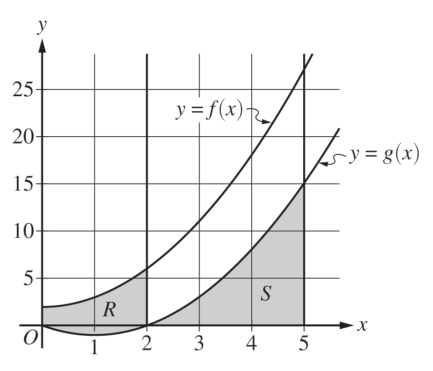
- T he functions f and g are defined by f (x) = x2 + 2 and g(x) = x2 - 2x, as shown in the graph.
- 6. The functions f and g are defined by f x x 2 2 = + ( ) and g x x x 2 2 = ( ) − , as shown in the graph.