From the free course AP Calculus AB on Lykke
6.13 Evaluating Improper Integrals (BC only)
Key concepts: Evaluating improper integrals (BC only)
How to evaluate improper integrals by replacing an infinite endpoint or a singularity with a limit, and how to decide convergence or divergence.
6.13 Evaluating Improper Integrals (BC only)
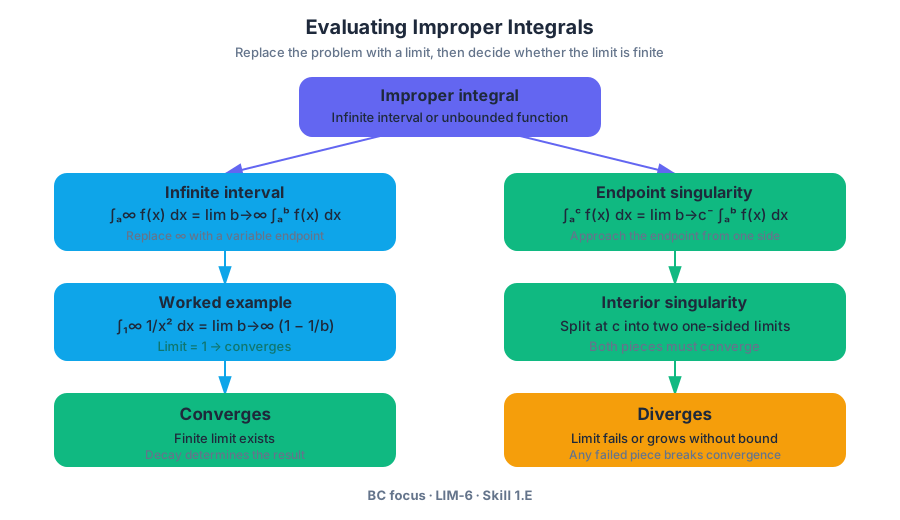
An improper integral is a definite integral whose interval is infinite or whose integrand becomes unbounded within the interval. It is not evaluated by simply substituting an infinite endpoint or a forbidden input; instead, a limit determines whether the accumulated quantity approaches a finite value.
Improper integrals: replace the problem with a limit
For an infinite interval,
$$ \int_a^\infty f(x),dx
\lim_{b\to\infty}\int_a^b f(x),dx. $$
For an integrand that is undefined or unbounded at an endpoint,
$$ \int_a^c f(x),dx
\lim_{b\to c^-}\int_a^b f(x),dx. $$
If the limit exists as a finite number, the integral converges. If the limit does not exist or grows without bound, the integral diverges. This is the BC-only focus of Topic 6.13 Evaluating Improper Integrals, associated with LIM-6 and Skill 1.E: Apply appropriate mathematical rules or procedures, with and without technology.
Worked example. Determine whether
$$ \int_1^\infty \frac{1}{x^2},dx $$
converges.
First replace $\infty$ with a variable endpoint:
$$ \int_1^\infty \frac{1}{x^2},dx
\lim_{b\to\infty}\int_1^b x^{-2},dx. $$
Using the power rule,
$$ \int_1^b x^{-2},dx
\left[-x^{-1}\right]_1^b
-\frac{1}{b}+1. $$
Therefore,
$$ \lim_{b\to\infty}\left(1-\frac{1}{b}\right)=1. $$
The integral converges to $1$. The infinite interval does not automatically make an integral infinite; the function’s decay determines the result.
Contrast: a divergent integral. The same steps applied to $\int_1^\infty\frac{1}{x},dx$ give $\lim_{b\to\infty}\left[\ln x\right]1^b=\lim{b\to\infty}\ln b$, which grows without bound, so this integral diverges. Both $\frac{1}{x}$ and $\frac{1}{x^2}$ approach $0$, but only $\frac{1}{x^2}$ decays fast enough for the accumulated area to stay finite.
Endpoint warning. If the integrand is unbounded at an interior point $c$, split the integral:
$$ \int_a^b f(x),dx
\int_a^c f(x),dx+\int_c^b f(x),dx, $$
and evaluate both pieces as separate one-sided limits. The entire integral converges only if both pieces converge.
Retrieval check: Write $\int_0^1\frac{1}{\sqrt{x}},dx$ as a limit and decide whether it converges. The integrand is unbounded at $x=0$, so $\int_0^1 x^{-1/2},dx=\lim_{a\to0^+}\left[2\sqrt{x}\right]a^1=\lim{a\to0^+}\left(2-2\sqrt{a}\right)=2$. The integral converges to $2$.