From the free course AP Calculus AB on Lykke
8.12 Volume with Washer Method: Revolving Around Other Axes
Key concepts: Washer method for finding volumes of solids of revolution · Disk and washer cross sections as ring-shaped regions · Volumes of revolution around horizontal or vertical lines other than the coordinate axes · Using definite integrals to represent volume · Determining outer and inner radii from distances to the line of revolution · Formula V = π∫(R^2 - r^2) for washer volumes · Connecting a geometric solid to its integral representation · Applying appropriate rounding procedures · Choosing the correct setup when the axis of rotation is shifted
How to set up washer-method volumes when the axis of rotation is a shifted line such as y = k or x = h, measuring both radii as distances to that line.
8.12 Volume with Washer Method: Revolving Around Other Axes
Topic 8.11 revolved regions around the $x$- or $y$-axis, where each radius could be read from a function value. When the axis of rotation is another horizontal or vertical line, such as $y=-2$ or $y=20$, the washer formula does not change, but $R$ and $r$ must both be measured from that line.
Washer area:
$$A=\pi\left(R^2-r^2\right)$$
Here, $R$ is the outer radius and $r$ is the inner radius.
The washer method accumulates these cross-sectional areas with a definite integral. If vertical slices are used, the volume is
$$V=\pi\int_a^b\left[R(x)^2-r(x)^2\right],dx.$$
For horizontal slices, the corresponding form is
$$V=\pi\int_c^d\left[R(y)^2-r(y)^2\right],dy.$$
The variable of integration is determined by the direction of the slices, not merely by the appearance of the functions.
A slice must be perpendicular to the axis of rotation. Rotation about a horizontal line produces washers from vertical slices, so the integral is usually written with respect to $x$. Rotation about a vertical line produces washers from horizontal slices, so the integral is usually written with respect to $y$.
For rotation around the coordinate axes, radii are measured from the appropriate axis:
- Around the $x$-axis, a vertical distance in $y$ becomes a radius.
- Around the $y$-axis, a horizontal distance in $x$ becomes a radius.
- Around a shifted horizontal line $y=k$, radius means vertical distance $\lvert y-k\rvert$.
- Around a shifted vertical line $x=h$, radius means horizontal distance $\lvert x-h\rvert$.
The crucial question is always: Which boundary is farther from the line of revolution?
Worked example: a shifted horizontal axis
Consider the region bounded by
$$y=\sqrt{x},\qquad y=0,\qquad x=0,\qquad x=4,$$
rotated about the horizontal line $y=-2$.
A representative vertical rectangle has thickness $dx$. When rotated around $y=-2$, it forms a washer. For $x>0$, the upper edge at $y=\sqrt{x}$ is farther from $y=-2$ than the lower edge at $y=0$. Therefore,
$$R(x)=\sqrt{x}+2,\qquad r(x)=2.$$
The cross-sectional area is
$$A(x)=\pi\left[(\sqrt{x}+2)^2-2^2\right].$$
Thus the volume is
$$V=\pi\int_0^4\left[(\sqrt{x}+2)^2-4\right],dx.$$
Simplify the integrand:
$$ (\sqrt{x}+2)^2-4 =x+4\sqrt{x}+4-4 =x+4\sqrt{x}. $$
So
$$ \begin{aligned} V &=\pi\int_0^4\left(x+4x^{1/2}\right),dx\ &=\pi\left[\frac{x^2}{2}+\frac{8}{3}x^{3/2}\right]_0^4\ &=\pi\left(8+\frac{64}{3}\right)\ &=\frac{88\pi}{3}. \end{aligned} $$
Numerically,
$$V\approx 92.154\text{ cubic units}.$$
This example shows why the shifted axis changes the radii. If the same region were rotated about the $x$-axis, the distances would be measured from $y=0$, giving $R(x)=\sqrt{x}$ and $r(x)=0$. Moving the axis down to $y=-2$ changes both distances to $R(x)=\sqrt{x}+2$ and $r(x)=2$.
A radius is a distance, not automatically a function value
The expressions $R(x)$ and $r(x)$ must represent distances to the axis of rotation. For example, if a region between $y=f(x)$ and $y=g(x)$ is rotated about $y=20$, with $0\le g(x)\le f(x)\le20$, then
$$R(x)=20-g(x),\qquad r(x)=20-f(x).$$
The lower boundary is farther from $y=20$, even though $g(x)$ is the smaller function value. Comparing function heights alone can therefore produce the wrong radius assignment.
For an axis $y=k$, distances may require absolute values:
$$\text{distance from }y=u\text{ to }y=k=\lvert u-k\rvert.$$
If the region crosses the axis, the outer and inner boundaries may change, and the interval may need to be split where the geometry changes.
The AP skill 2.D — Connecting Representations appears when you connect the rectangle, its rotated washer, the radius functions, and the definite integral. The AP skill 4.E — Use appropriate mathematical symbols, notation, and language matters when you identify $R$, $r$, bounds, units, and a properly rounded numerical result.
Misconception check: The “outer” radius is not necessarily the larger function value. It is the larger distance to the rotation line.
Retrieval check: A region lies between $y=f(x)$ and $y=g(x)$ and rotates about $y=-2$, with $f(x)\ge g(x)\ge0$. Which setup is correct?
$$\pi\int_a^b\left[(f(x)+2)^2-(g(x)+2)^2\right],dx.$$
The reason is geometric: both radii are measured upward from $y=-2$, and the boundary farther from that line produces $R(x)$.
Source Materials
- Learn More (.pdf)
- AP Calculus AB and BC Course and Exam Description
- AP Calculus AB Course Overview
- AP Calculus Course at a Glance
- AP Calculus AB and BC Course at a Glance Poster
- Adopt AP Calculus AB
- AP Calculus AB
- AP Calculus AB
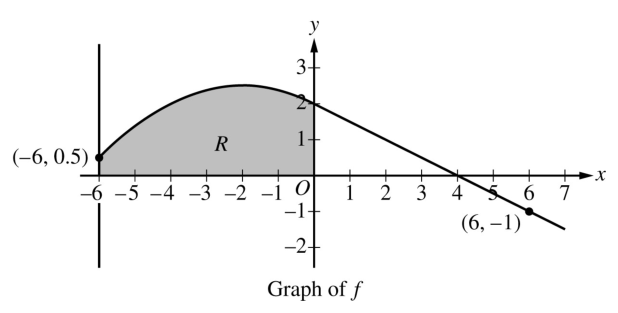
- The graph of the differentiable function f , shown for -6 ≤ x ≤ 7, has a horizontal tangent at x = -2 and is linear for 0 ≤ x ≤ 7. Let R be the region in the second quadrant bounded by the graph of f
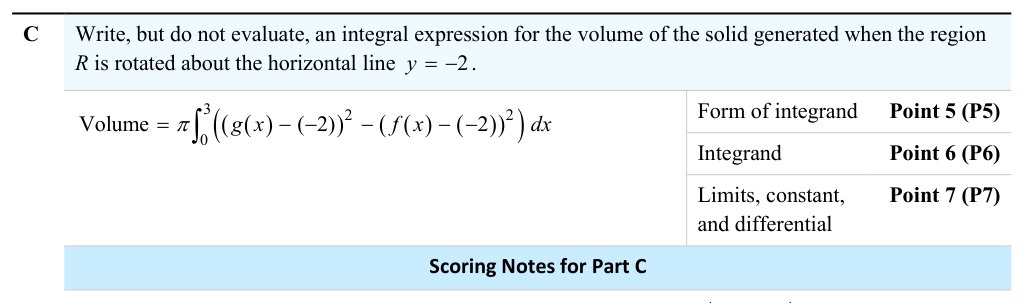
- • P5 is earned for a definite integral with an integrand of R2 2 −r or R2 − , where one of {R r , }
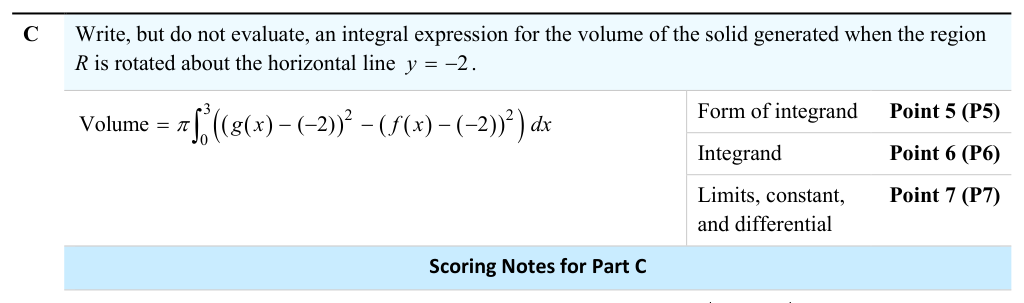
- • P5 is earned for a definite integral with an integrand of R2 2 −r or R2 − , where one of {R r , }