From the free course AP Calculus AB on Lykke
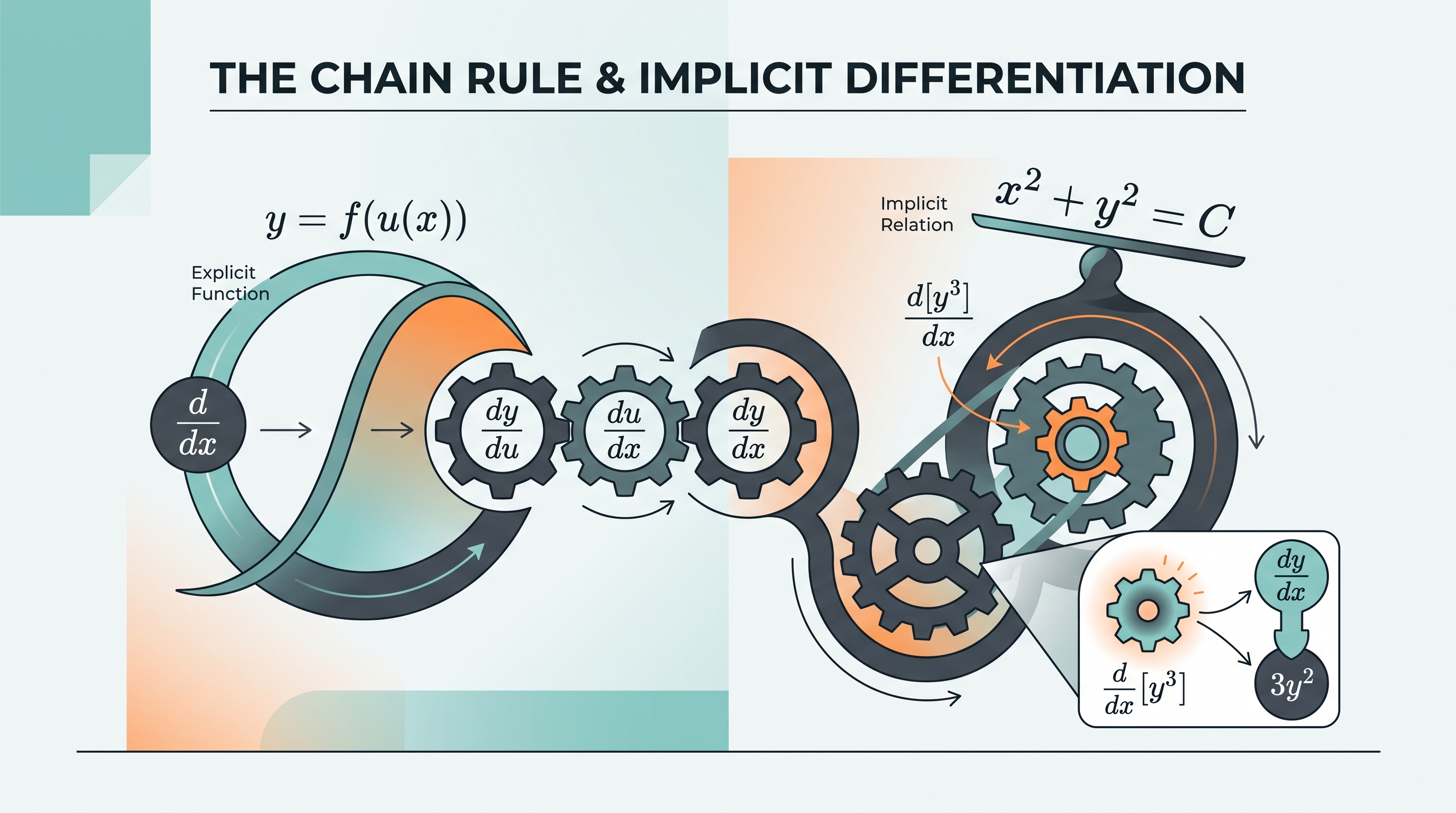
3.1 The Chain Rule
Key concepts: Composite functions · Identifying functions embedded within other functions · Decomposing composite functions · Chain rule · Differentiation of composite functions · Product rule · Quotient rule · Applying derivative rules strategically
How to recognize a composite function, name its inner and outer parts, and differentiate it with the chain rule, alone, in context, and alongside the product and quotient rules.
3.1 The Chain Rule
A temperature can change because time changes an inner quantity, which changes the temperature through an outer rule. The chain rule measures this linked change: differentiate the outside function, keep the inside function temporarily intact, then multiply by the derivative of the inside.
Composite functions: functions inside functions
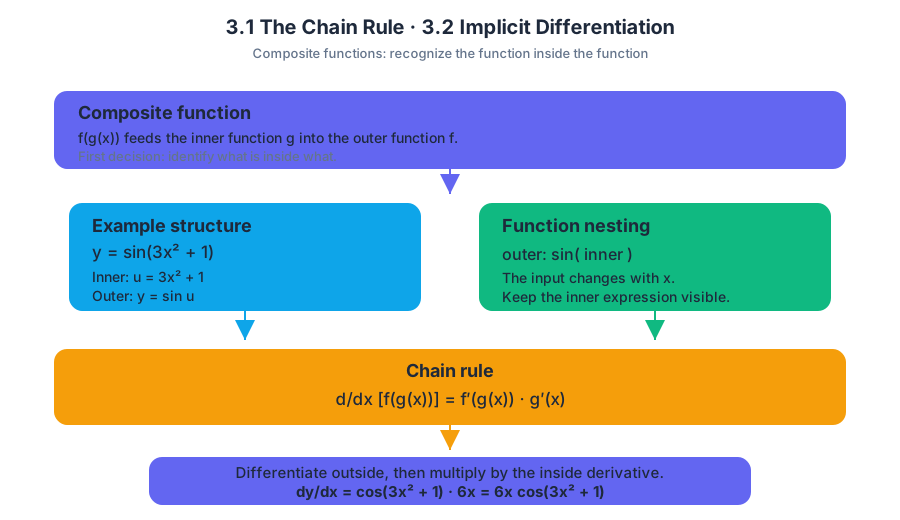
A composite function is a function built by feeding one function into another. In $f(g(x))$, the function $g$ is the inner function and $f$ is the outer function. Recognizing this structure is the key decision before differentiating.
For example,
$$ y=\sin(3x^2+1) $$
has inner function $u=3x^2+1$ and outer function $y=\sin u$. The expression is not merely “a sine function”; its input is itself changing with $x$.
The chain rule is
$$ \frac{d}{dx}\left[f(g(x))\right] =f'(g(x))\cdot g'(x). $$
In words: differentiate the outer function at the inner input, then multiply by the derivative of the inner function.
Applying it gives
$$ \frac{dy}{dx} =\cos(3x^2+1)\cdot 6x =6x\cos(3x^2+1). $$
The inner expression remains visible until its derivative has been multiplied in.
A contextual example
Suppose a temperature model, in temperature units, is
$$ T(t)=10+\cos(2.4t), $$
where $t$ is measured in minutes. The outer function is cosine, and the inner function is $2.4t$:
$$ T'(t)=-\sin(2.4t)\cdot 2.4. $$
At $t=1$,
$$ T'(1)=-2.4\sin(2.4)\approx -1.621. $$
Thus, at one minute, the temperature is decreasing at approximately $1.621$ temperature units per minute. The negative sign describes direction; the units describe meaning.
The same chain-rule idea appears in equations, tables, and graphs. An equation may display the nested structure directly, a table may provide an inner rate and an outer derivative separately, and a graph may show how a change in one quantity produces a change in another. Practice 2—Connecting Representations is developed when these forms are interpreted as equivalent descriptions rather than separate procedures.
Choosing the correct derivative rule
Before differentiating, classify the expression. A sum uses the sum rule, a product uses the product rule, a quotient uses the quotient rule, and a composition uses the chain rule. Some expressions require several rules in sequence.
For a product,
$$ y=x^2\cos x, $$
the product rule gives
$$ y'=2x\cos x-x^2\sin x. $$
For a quotient,
$$ y=\frac{\sin x}{x^2+1}, $$
the quotient rule gives
$$ y'=\frac{(x^2+1)\cos x-\sin x(2x)}{(x^2+1)^2}. $$
A useful simplification is to rewrite expressions when that exposes a familiar rule. For instance,
$$ y=(x^2+1)^5 $$
is a power of a composite expression, so
$$ y'=5(x^2+1)^4(2x)=10x(x^2+1)^4. $$
Misconception check — “Differentiate only the visible outside.” Writing
$$ \frac{d}{dx}\sin(3x^2+1)=\cos(3x^2+1) $$
misses the fact that the input $3x^2+1$ also changes. The missing factor is $(3x^2+1)'=6x$.
Skills and retrieval check
This topic targets FUN-3.C—Calculate derivatives of compositions of differentiable functions—with FUN-3.C.1—The chain rule provides a way to differentiate composite functions. Suggested Skill 1.C is Identify an appropriate mathematical rule or procedure based on the classification of a given expression: decide whether an expression is a sum, a product, a quotient or a composition, and name its inner and outer functions, before differentiating. Topic 3.2 applies the same rule when the inner function is an unknown $y(x)$ inside an equation.
Retrieval check: Identify the inner and outer functions in $y=\ln(5x^3-2)$, then find $dy/dx$. Which factor in your answer is the derivative of the inner function, and what is lost if it is left out?
Source Materials
- Learn More (.pdf)
- AP Calculus AB and BC Course and Exam Description
- AP Calculus AB Course Overview
- AP Calculus Course at a Glance
- AP Calculus AB and BC Course at a Glance Poster
- Adopt AP Calculus AB
- AP Calculus AB
- AP Calculus AB
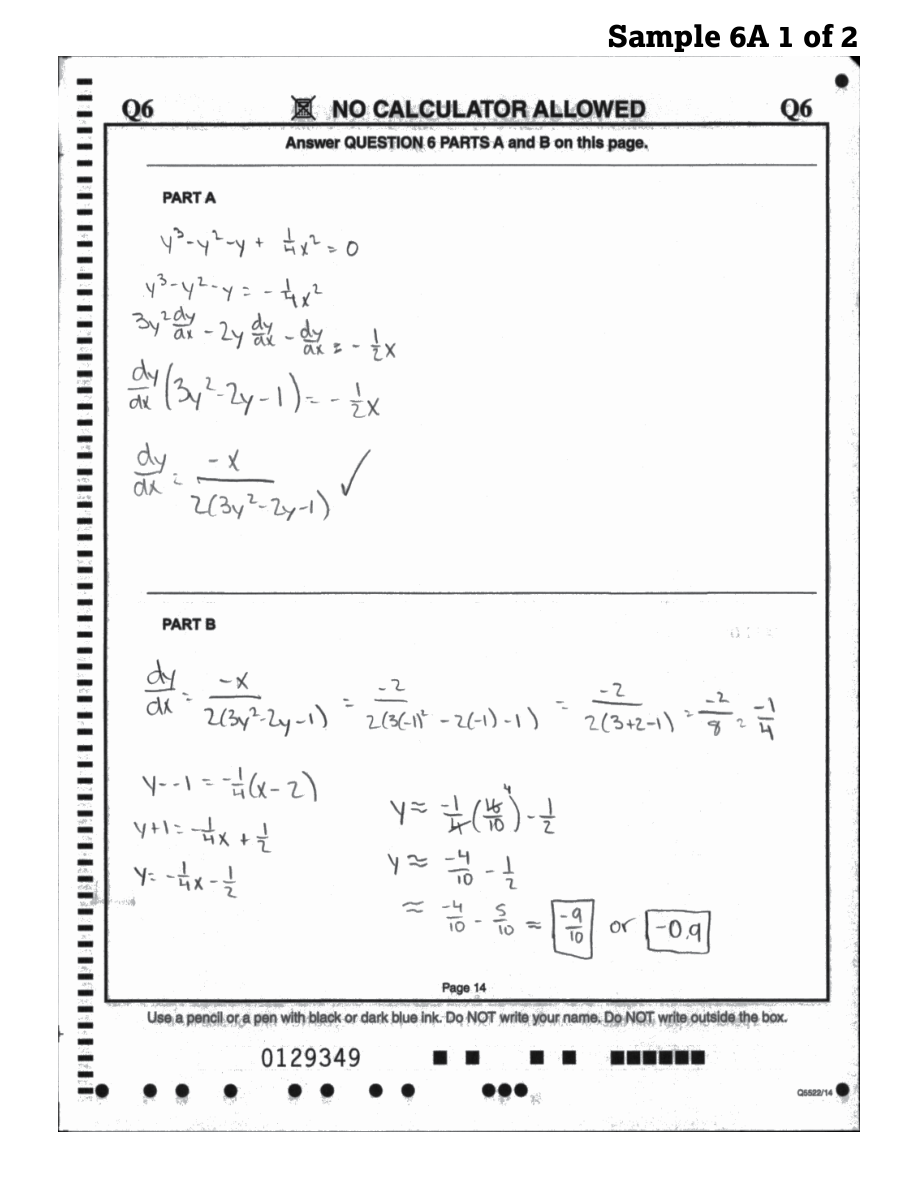
- Figure — Sample Responses Q6 (p. 6)
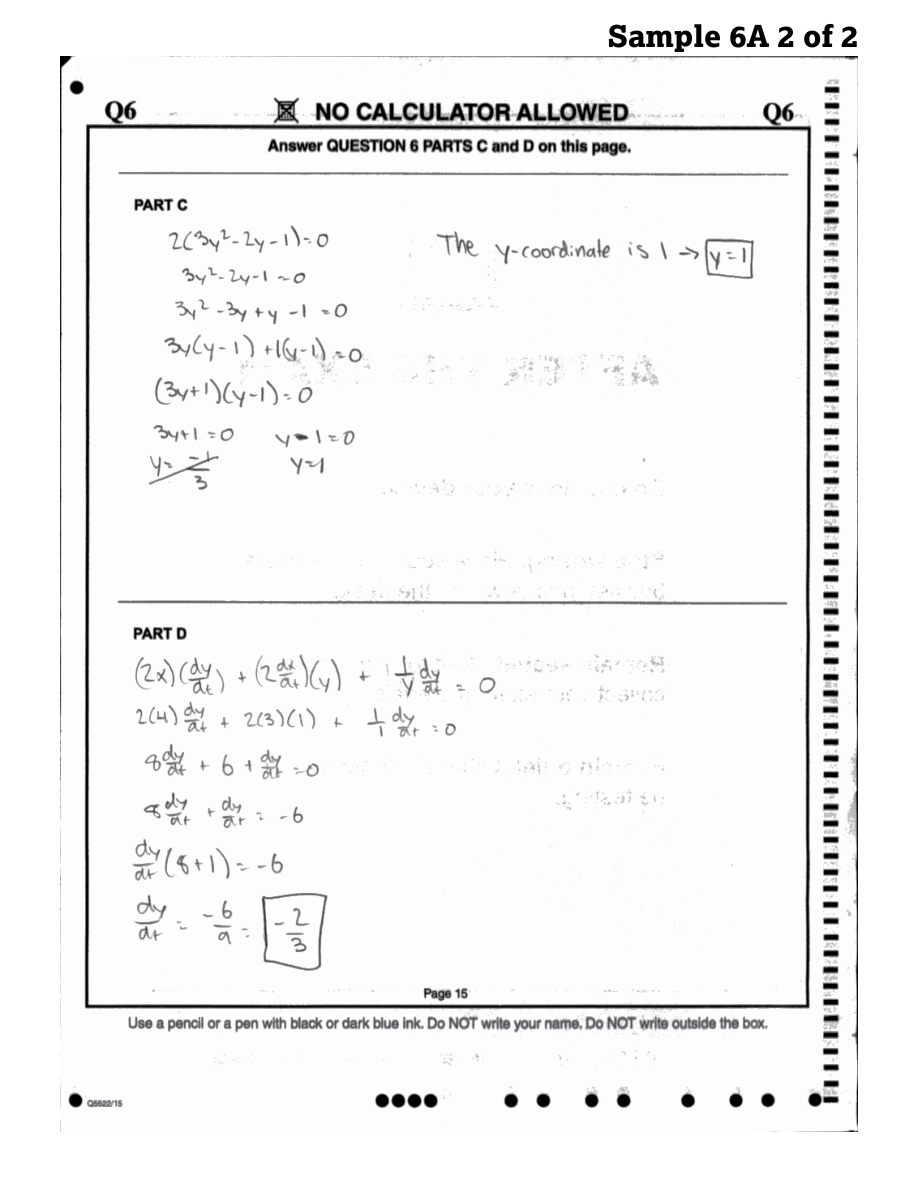
- Figure — Sample Responses Q6 (p. 7)
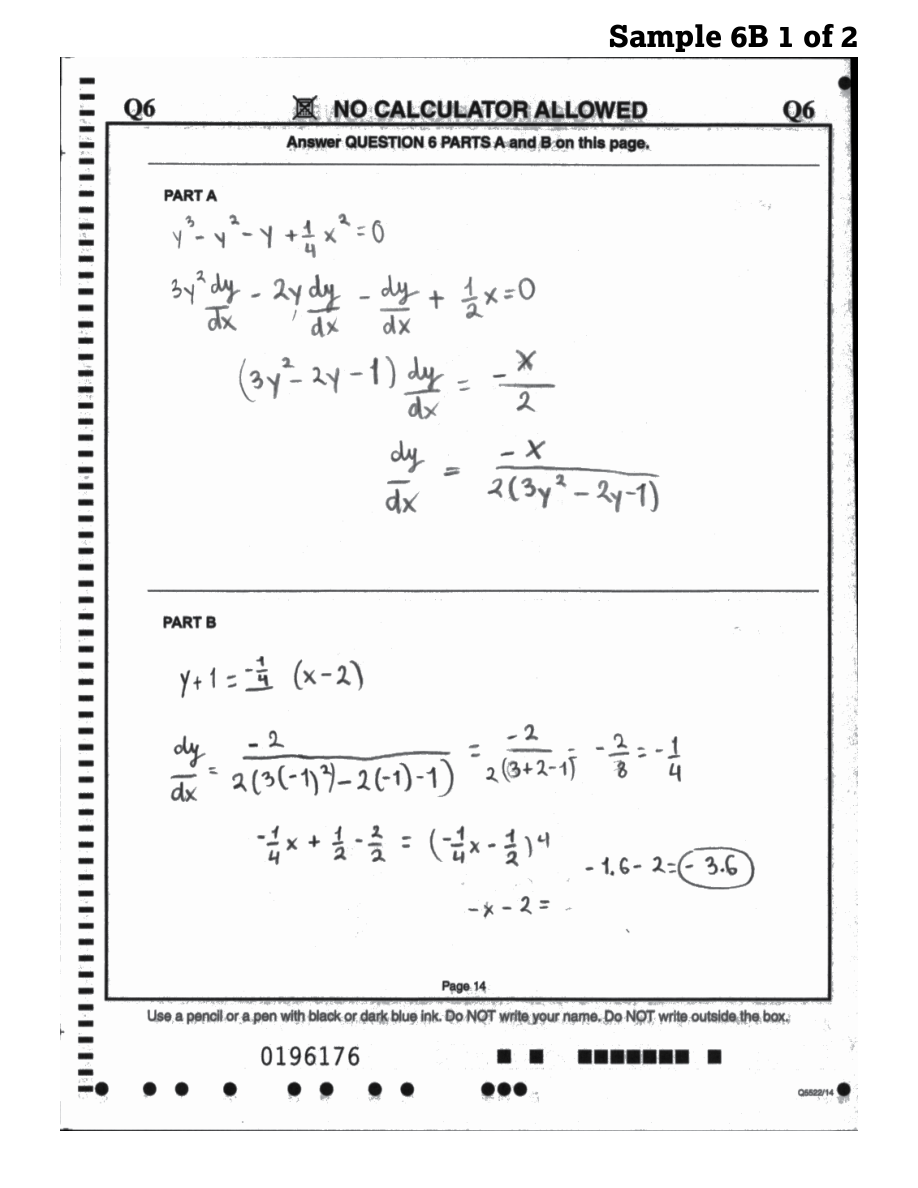
- Figure — Sample Responses Q6 (p. 8)
- Figure — Sample Responses Q6 (p. 9)