From the free course AP Calculus AB on Lykke
5.9 Connecting a Function, Its First Derivative, and Its Second Derivative
Key concepts: Higher-order derivatives · Connecting a function, its first derivative, and its second derivative · Concavity and its relationship to the first derivative · Second derivative and points of inflection · Connecting mathematical representations · Analytical applications of differentiation · Interpreting functions in contextual situations
How a function, its first derivative and its second derivative relate across formulas, graphs, tables and words, including concavity and inflection points.
5.9 Connecting a Function, Its First Derivative, and Its Second Derivative
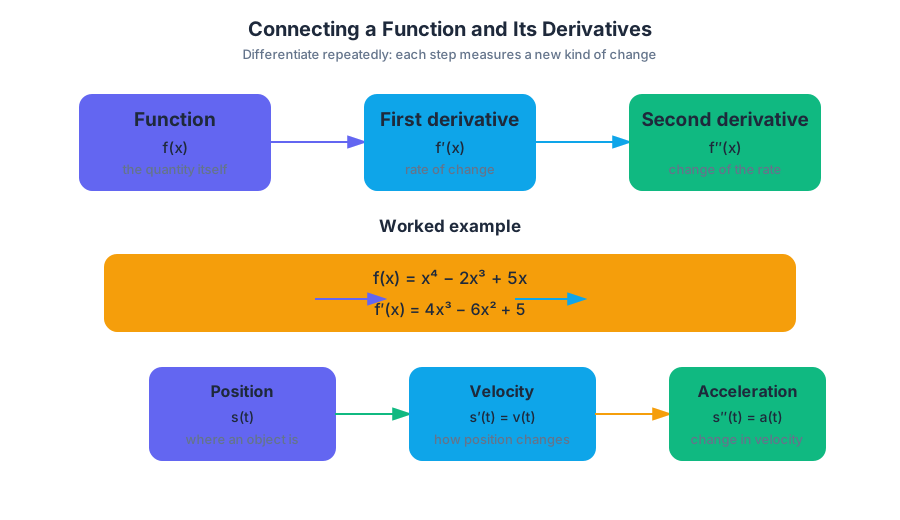
A function, its first derivative, and its second derivative form a three-level description of behavior: the function shows what exists, the first derivative shows how it changes, and the second derivative shows how that change itself changes. These connections turn derivative calculations into a system for analyzing graphs and solving optimization problems.
Higher-order derivatives: differentiating the change
Taking a higher-order derivative means differentiating repeatedly. If $f$ describes a quantity, then $f'$ describes its rate of change, and $f''$ describes the rate of change of that rate:
$$ f(x)\longrightarrow f'(x)\longrightarrow f''(x). $$
For example, if
$$ f(x)=x^4-2x^3+5x, $$
then
$$ f'(x)=4x^3-6x^2+5 $$
and
$$ f''(x)=12x^2-12x. $$
The process is familiar each time; the interpretation changes.
In a motion model, if $s(t)$ is position, then $s'(t)=v(t)$ is velocity and $s''(t)=a(t)$ is acceleration. In a population model, $P'(t)$ may represent the population’s growth rate, while $P''(t)$ indicates whether that growth rate is increasing or decreasing.
The derivative chain and concavity
Concavity describes the direction in which a graph bends. It is determined by how the first derivative changes:
- If $f'$ is increasing, the slopes of $f$ are becoming larger, so $f$ is concave up.
- If $f'$ is decreasing, the slopes of $f$ are becoming smaller, so $f$ is concave down.
When the second derivative exists, this becomes the efficient test
$$ f''(x)>0 \Rightarrow f\text{ is concave up}, \qquad f''(x)<0 \Rightarrow f\text{ is concave down}. $$
For
$$ f(x)=x^3-3x, $$
we have
$$ f'(x)=3x^2-3,\qquad f''(x)=6x. $$
Thus $f''(x)<0$ for $x<0$, so the graph is concave down there; $f''(x)>0$ for $x>0$, so it is concave up there.
An inflection point is a point on the graph where concavity changes. In this example, concavity changes at $x=0$, and the corresponding point is
$$ (0,f(0))=(0,0). $$
A sign change in $f''$ is a useful test when $f''$ exists on both sides of the candidate value, but it is not the definition itself. The second derivative may be undefined at an inflection point. For instance, a graph can change concavity at a point where the formula for $f''$ does not exist.
Misconception check — “$f''(c)=0$ automatically means an inflection point.” Not necessarily. The value $f''(c)=0$ only identifies a candidate. Concavity must actually change across $c$, and the inflection point is $(c,f(c))$, not merely the number $c$.
Connecting representations
The same behavior can appear algebraically, graphically, numerically, or verbally. A table showing that $f'$ changes from negative to positive indicates a local minimum of $f$; a graph of $f'$ crossing the $x$-axis communicates the same fact; an equation for $f''$ can establish the concavity that confirms the shape.
| Representation | What to inspect |
|---|---|
| Formula for $f$ | Values and overall graph behavior |
| Formula or graph of $f'$ | Increasing/decreasing behavior of $f$ |
| Formula or graph of $f''$ | Concavity and possible inflection points |
| Table of values | Sign changes, trends, and approximations |
| Verbal description | Meaning of rates, extrema, and curvature in context |
This is Suggested Skill 2.D, connecting mathematical characteristics across representations. It also supports Suggested Skill 1.E, applying appropriate mathematical rules or procedures, and Suggested Skill 3.E, providing reasons for conclusions. A numerical answer is stronger when the representation used also explains why the answer is valid.
Retrieval check: If $g''(x)>0$ on an interval, what happens to the slopes of $g$, and what does that imply about the graph? If $g''(3)=0$, what else must be checked before calling $(3,g(3))$ an inflection point?