From the free course AP Calculus AB on Lykke
8.11 Volume with Washer Method: Revolving Around the \(x\)- or \(y\)-Axis
Key concepts: Washer method for finding volumes of solids of revolution · Disk and washer cross sections as ring-shaped regions · Volumes of revolution around the x-axis or y-axis · Using definite integrals to represent volume · Determining outer and inner radii from distances to the line of revolution · Formula V = π∫(R^2 - r^2) for washer volumes · Connecting a geometric solid to its integral representation · Applying appropriate rounding procedures
How the washer method gives the volume of a region revolved around the x-axis or y-axis by integrating pi times outer radius squared minus inner radius squared.
8.11 Volume with Washer Method: Revolving Around the (x)- or (y)-Axis
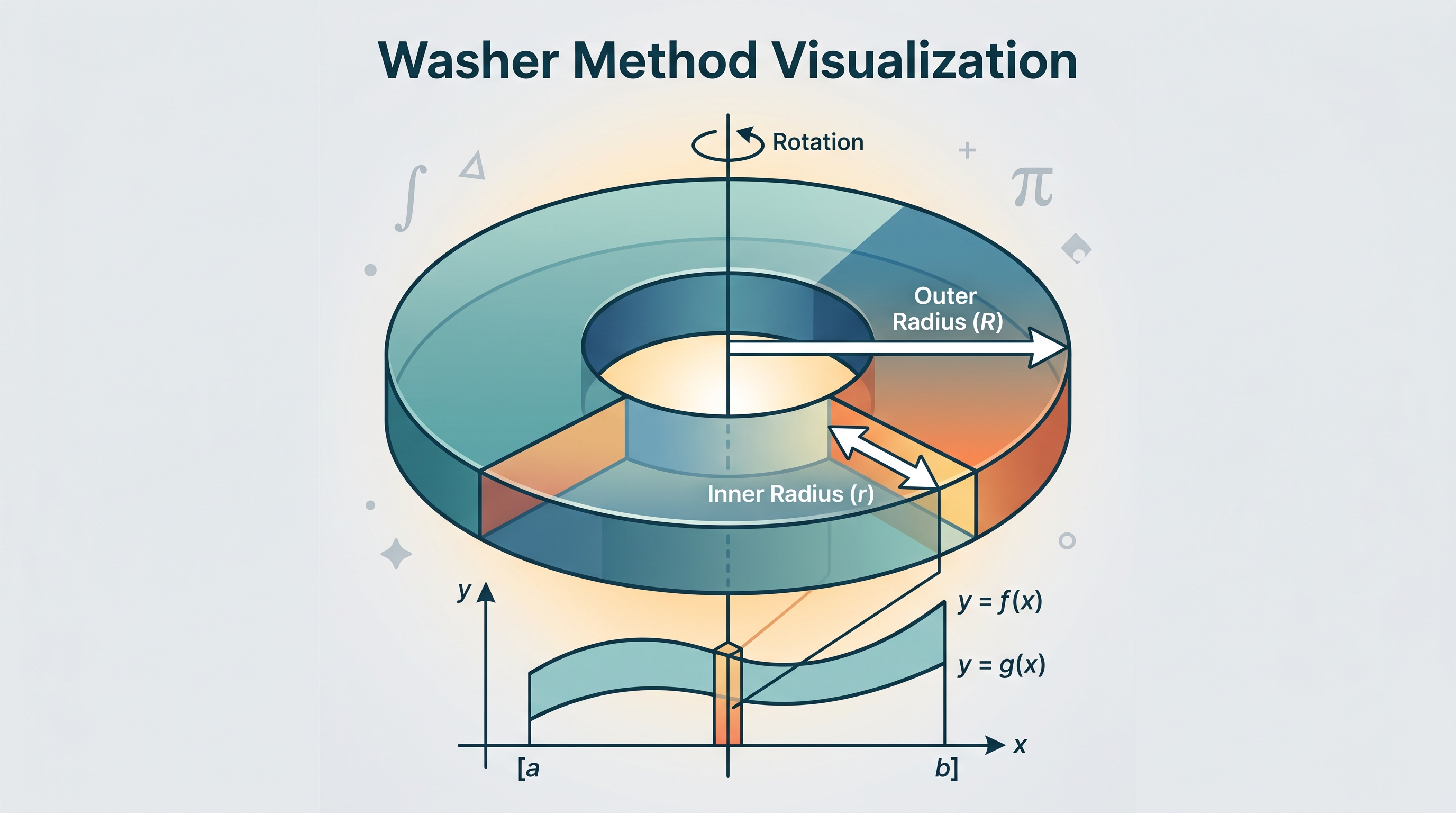
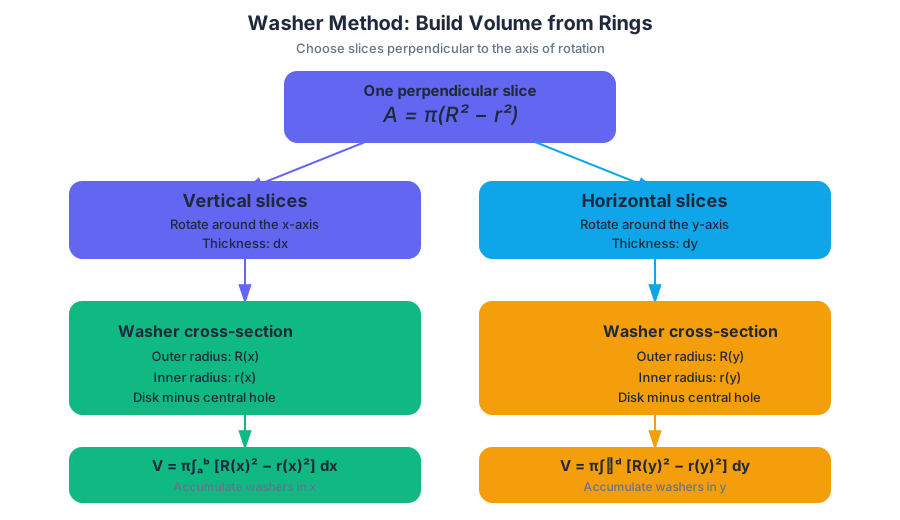
A rotating region does not always produce a solid cylinder. When each perpendicular slice leaves a hole in the middle, the slice is a washer: a ring-shaped cross section whose area is the area of the outer disk minus the area of the inner disk.
Washer area:
$$A=\pi\left(R^2-r^2\right)$$
Here, $R$ is the outer radius and $r$ is the inner radius.
The washer method accumulates these cross-sectional areas with a definite integral. If vertical slices are used, the volume is
$$V=\pi\int_a^b\left[R(x)^2-r(x)^2\right],dx.$$
For horizontal slices, the corresponding form is
$$V=\pi\int_c^d\left[R(y)^2-r(y)^2\right],dy.$$
The variable of integration is determined by the direction of the slices, not merely by the appearance of the functions.
Choosing the slice direction
A slice must be perpendicular to the axis of rotation. Rotation about a horizontal line produces washers from vertical slices, so the integral is usually written with respect to $x$. Rotation about a vertical line produces washers from horizontal slices, so the integral is usually written with respect to $y$.
For rotation around the coordinate axes, radii are measured from the appropriate axis:
- Around the $x$-axis, a vertical distance in $y$ becomes a radius.
- Around the $y$-axis, a horizontal distance in $x$ becomes a radius.
- Around a shifted horizontal line $y=k$, radius means vertical distance $\lvert y-k\rvert$.
- Around a shifted vertical line $x=h$, radius means horizontal distance $\lvert x-h\rvert$.
The crucial question is always: Which boundary is farther from the line of revolution?
Worked example: the region between $y=x$ and $y=x^2$
The curves $y=x$ and $y=x^2$ meet at $x=0$ and $x=1$, and the line is on top between them. Revolved around the $x$-axis, a vertical slice sweeps out a washer with outer radius $R(x)=x$ and inner radius $r(x)=x^2$, so $V=\pi\int_0^1\left(x^2-x^4\right)dx=\pi\left(\frac13-\frac15\right)=\frac{2\pi}{15}$.
Revolved around the $y$-axis, the slices must be horizontal, so rewrite the boundaries as $x=y$ and $x=\sqrt{y}$. Now the parabola is farther from the axis: $R(y)=\sqrt{y}$ and $r(y)=y$, so $V=\pi\int_0^1\left(y-y^2\right)dy=\pi\left(\frac12-\frac13\right)=\frac{\pi}{6}$. The radii are squared separately; $\pi(R-r)^2$ is not the area of a washer.
Washer method or cylindrical shells?
Use washers when slices are perpendicular to the axis and rotation creates an outer radius with a possible inner radius. Use cylindrical shells when slices are parallel to the axis and the natural factors are circumference times height:
$$dV=2\pi(\text{radius})(\text{height}),dx.$$
A disk is simply the special case $r=0$; a washer has $r>0$.
The AP skill 2.D — Connecting Representations appears when you connect the rectangle, its rotated washer, the radius functions, and the definite integral. The AP skill 4.E — Use appropriate mathematical symbols, notation, and language matters when you identify $R$, $r$, bounds, units, and a properly rounded numerical result.
Misconception check: The “outer” radius is not necessarily the larger function value. It is the larger distance to the rotation line.
Retrieval check: The region between $y=\sqrt{x}$ and $y=2$ for $0\le x\le 4$ is revolved around the $x$-axis. Identify $R(x)$ and $r(x)$ and write the integral. Here $R(x)=2$ and $r(x)=\sqrt{x}$, so $V=\pi\int_0^4(4-x),dx$.
Source Materials
- Learn More (.pdf)
- AP Calculus AB and BC Course and Exam Description
- AP Calculus AB Course Overview
- AP Calculus Course at a Glance
- AP Calculus AB and BC Course at a Glance Poster
- Adopt AP Calculus AB
- AP Calculus AB
- AP Calculus AB
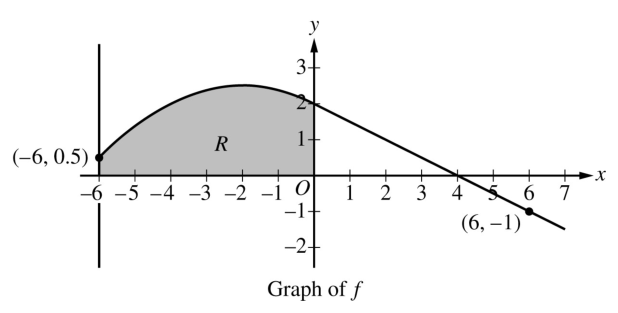
- The graph of the differentiable function f , shown for -6 ≤ x ≤ 7, has a horizontal tangent at x = -2 and is linear for 0 ≤ x ≤ 7. Let R be the region in the second quadrant bounded by the graph of f
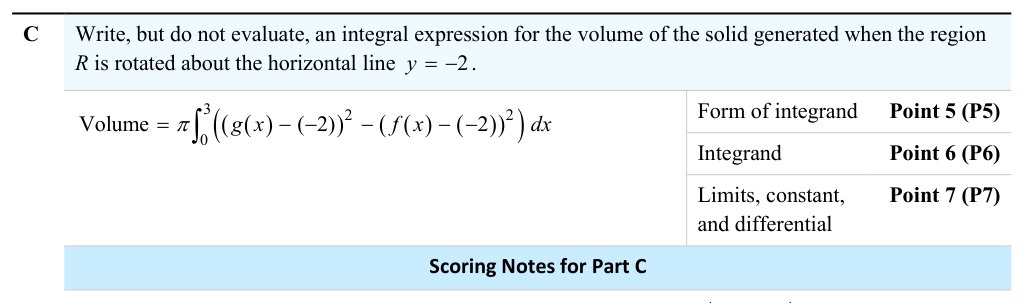
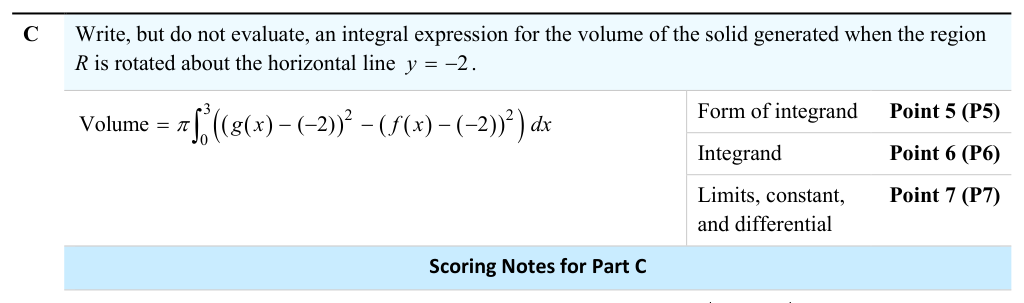
- • P5 is earned for a definite integral with an integrand of R2 2 −r or R2 − , where one of {R r , }
- • P5 is earned for a definite integral with an integrand of R2 2 −r or R2 − , where one of {R r , }