From the free course AP Calculus AB on Lykke
5.11 Solving Optimization Problems
Key concepts: Interpreting mathematical solutions in context · Solving optimization problems · Analytical applications of differentiation · Unit 5, Topic 5.11
A step-by-step method for solving optimization problems, from constraint and objective function to endpoint comparison and an answer interpreted in context with units.
5.11 Solving Optimization Problems
An optimization problem asks which allowable input makes a quantity as large or as small as possible, while an implicit relation describes how variables are linked even when one variable is not isolated as a function of the other. Both topics belong to Unit 5: Analytical Applications of Differentiation, where a derivative becomes a tool for proving and interpreting behavior.
5.11 Solving Optimization Problems
A mathematical answer is not complete until it is translated back into the situation. The value of a critical point may identify a dimension, time, or quantity, but the problem usually asks for something contextual: a maximum area, a minimum cost, or the dimensions that produce an optimum.
Interpret mathematical solutions in context: identify what the variable represents, check that the value is physically or logically allowed, evaluate the requested quantity, and state the conclusion with appropriate units.
Worked optimization: maximum area
A rectangle has perimeter $20$ centimeters. What dimensions produce the greatest possible area?
Let one side have length $x$ centimeters and the other have length $y$ centimeters. The perimeter condition gives
$$ 2x+2y=20, $$
so
$$ y=10-x. $$
Because side lengths cannot be negative, the meaningful domain is
$$ 0\le x\le 10. $$
The objective function—the quantity being optimized—is area:
$$ A(x)=xy=x(10-x)=10x-x^2. $$
Differentiate and locate the interior critical point:
$$ A'(x)=10-2x. $$
Set the derivative equal to zero:
$$ 10-2x=0 \quad\Longrightarrow\quad x=5. $$
The corresponding second side is
$$ y=10-5=5. $$
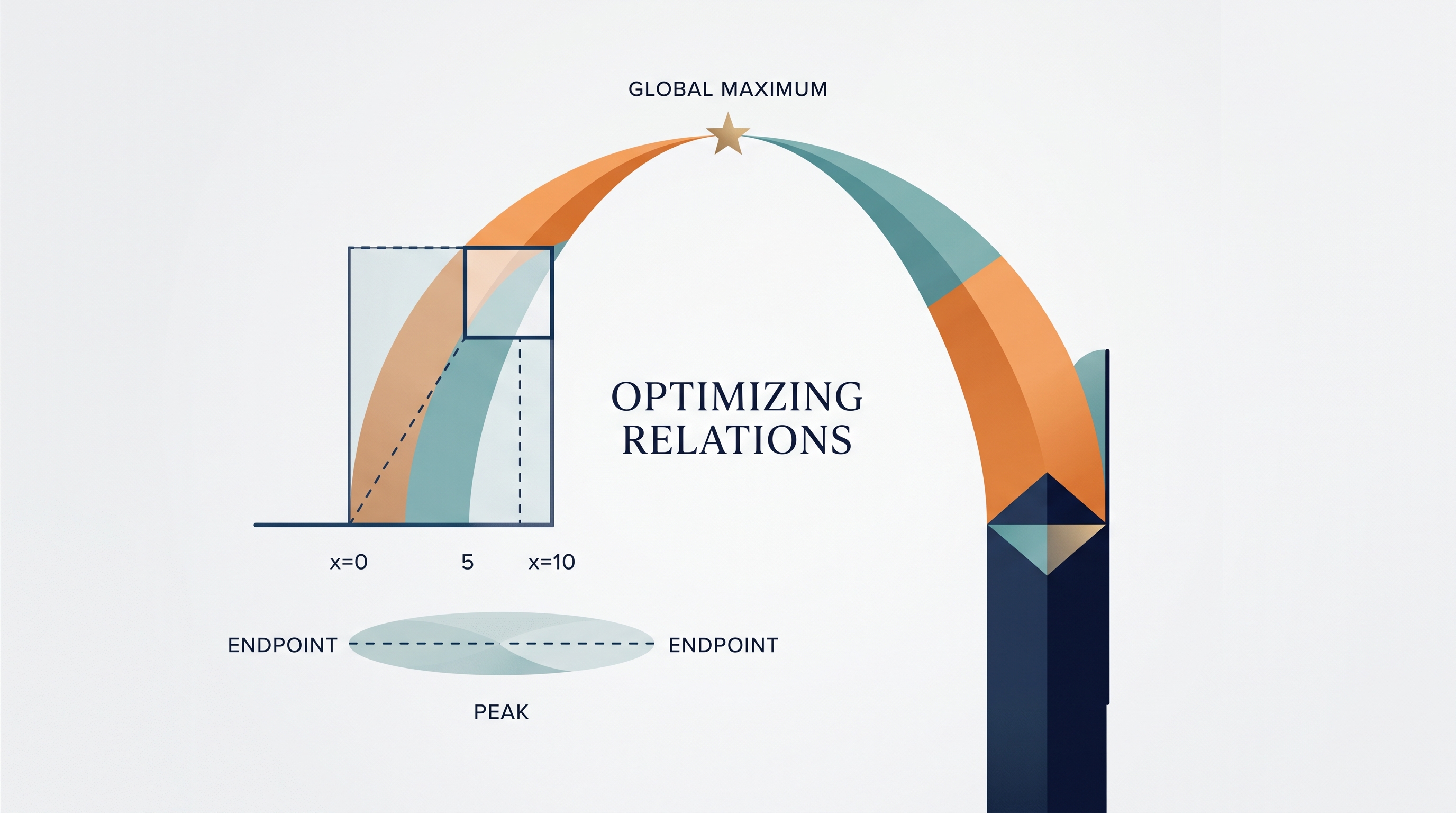
A global conclusion requires comparing the critical point with the endpoints of the closed interval:
$$ A(0)=0,\qquad A(5)=25,\qquad A(10)=0. $$
Therefore, the maximum area is
$$ \boxed{25\text{ cm}^2}, $$
and it occurs when the rectangle is a $5$-centimeter by $5$-centimeter square.
The number $5$ is a maximizing dimension; the number $25$ is the maximum area. Confusing these two answers is the wrong-output misconception: a correct derivative calculation can still lead to an incomplete contextual answer.
A reliable interpretation sequence
For an optimization problem, move through this chain:
- Define the variable and its units.
- Use the given constraint to write one variable in terms of the other.
- Build the objective function.
- Determine the feasible domain.
- Find critical values where the derivative is zero or undefined.
- Compare critical values and endpoints when the domain is closed.
- State the optimum in context, including units and the requested quantity.
This process develops 3.F Explain the meaning of mathematical solutions in context. It also uses 1.E Implementing Mathematical Processes, because the solver must select and execute appropriate differentiation and comparison procedures, and 3.E Justification, because the conclusion requires evidence rather than merely an answer.
Retrieval check
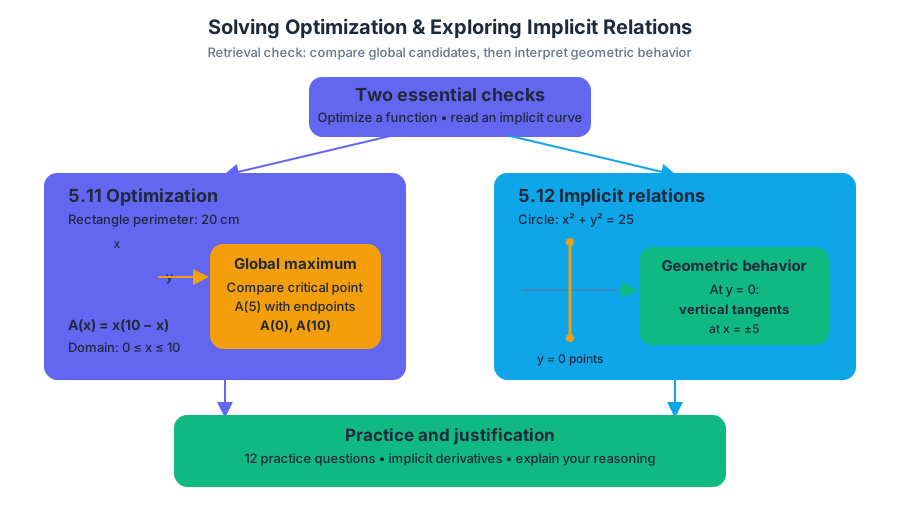
A rectangle has perimeter $20$ centimeters. Why must $A(5)$ be compared with $A(0)$ and $A(10)$? For the relation $x^2+y^2=25$, what geometric behavior occurs when $y=0$? A complete response should identify the endpoint comparison required for a global maximum and explain that $y=0$ produces vertical tangents.